Saudi Apostille, MOFA Attestation and Certified Translation: Complete Document Guide
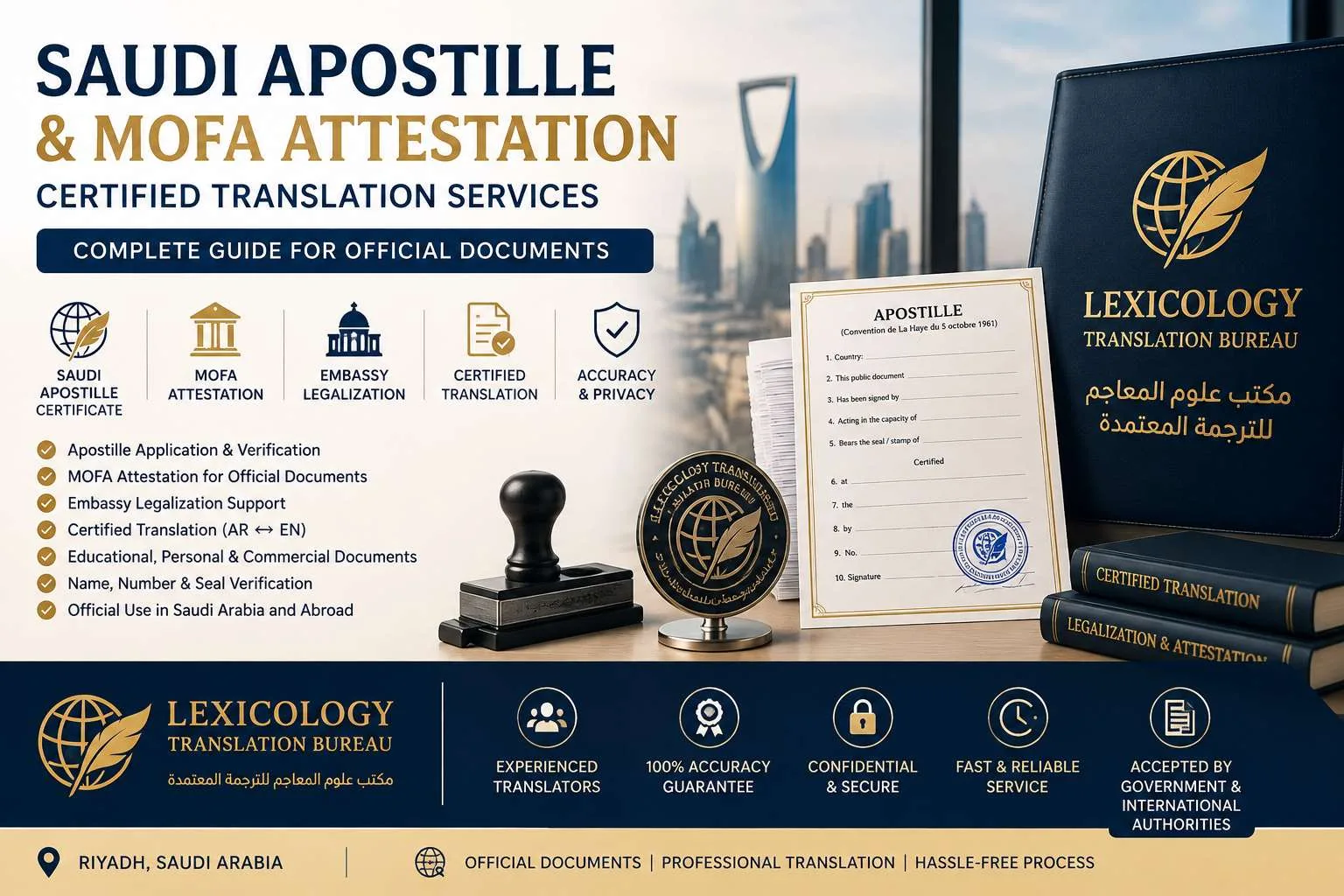
A practical guide to Saudi Apostille certificates, MOFA attestation, embassy legalization and certified translation for official document use.
When a document issued in Saudi Arabia must be used abroad, or a foreign document must be submitted to an authority in Saudi Arabia, the applicant may encounter several different terms: Apostille, Ministry of Foreign Affairs attestation, embassy legalization, notarization and certified translation.
These processes are connected, but they do not perform the same function. An Apostille authenticates the origin of a qualifying public document. Certified translation presents the document accurately in another language. MOFA attestation and embassy legalization may be required under different procedures depending on the destination country and the receiving authority.
This guide explains the differences, the documents commonly involved and the checks applicants should complete before official submission.
Guide Contents
What is a Saudi Apostille?
What information does an Apostille confirm?
Apostille versus MOFA attestation
When embassy legalization may be required
When certified translation is needed
Documents commonly involved
Translation before or after authentication
How to prepare a Saudi Apostille application
How to verify an Apostille certificate
Name, date, number and seal checks
Common mistakes to avoid
Translation review process
Frequently asked questions
What Is a Saudi Apostille?
An Apostille is an official certificate used to simplify the authentication of certain public documents for use between countries that apply the Hague Apostille Convention.
Instead of completing a long chain of traditional legalization steps, a qualifying document may be authenticated through an Apostille issued by the competent authority in the country where the document originated.
Saudi Arabia applies the Apostille Convention, and the Saudi Minister of Foreign Affairs is listed as the competent authority for Saudi Apostille certificates.
However, applicants should not assume that every Saudi document can automatically receive an Apostille or that every destination authority will accept the same process.
The document type, issuing authority, destination country and purpose of submission must all be checked first.
What Information Does an Apostille Confirm?
An Apostille generally authenticates the official origin of the document. It may confirm:
The country in which the document was issued
The person who signed the document
The official capacity of the signer
The seal or stamp appearing on the document
The authority that issued the Apostille
The place and date of issuance
The Apostille certificate number
An Apostille does not normally translate the document.
It also does not automatically confirm that every statement written inside the document is factually correct. Its main purpose is to authenticate the signature, seal, capacity or official origin associated with the public document.
Apostille Versus MOFA Attestation
A Saudi Apostille and ordinary MOFA document attestation should not automatically be treated as the same service.
The Apostille process is generally relevant when a qualifying public document will be used in another country where the Apostille Convention applies between the countries concerned.
Traditional MOFA attestation may be required when:
The destination country does not use the Apostille process for the document
The receiving authority specifically requests MOFA attestation
A separate legalization chain applies
An embassy or consulate requires prior authentication
The document falls outside the relevant Apostille procedure
Saudi MOFA’s document ratification service covers categories such as educational documents, powers of attorney and marriage contracts, commercial documents, letters and personal-status documents.
The applicant should confirm the required process with the receiving organization before paying fees or completing unnecessary steps.
When Embassy Legalization May Be Required
Embassy or consular legalization may still be required when the destination country or receiving authority does not accept an Apostille for the document.
A possible traditional legalization chain may involve:
The original issuing authority
A relevant government department
The Saudi Ministry of Foreign Affairs
The embassy or consulate of the destination country
Certified translation into the required language
The exact sequence is not the same for every document or country.
For example, the requirements for a degree certificate may differ from those for a commercial registration, court judgment, power of attorney or marriage certificate.
Applicants should obtain the current checklist directly from the authority that will receive the document.
When Is Certified Translation Needed?
Certified translation may be required when the document language is different from the language accepted by the receiving authority.
Common situations include:
An Arabic Saudi document being submitted to an English-speaking authority
An English document being submitted to an Arabic-language Saudi authority
A foreign birth certificate being used for a Saudi family or immigration procedure
An academic certificate being submitted for employment, licensing or education
A commercial document being submitted to a ministry, bank, embassy or business partner
A legal document being used before a court, notary or government department
A certified translation should accurately reproduce the relevant information appearing in the source document.
This may include:
Names
Dates
Identification numbers
Certificate numbers
Official titles
Stamps and seals
Signatures
Handwritten notes
QR-code references
Authentication statements
Apostille information
Certified translation does not replace the source document. The original document or accepted copy normally remains part of the submission package.
Documents Commonly Involved
Educational Documents
Educational documents may include:
Degree certificates
Diplomas
Academic transcripts
Training certificates
Professional qualifications
Letters issued by schools or universities
These documents may be required for employment, professional licensing, university admission or qualification evaluation.
Personal-Status Documents
Personal-status documents may include:
Birth certificates
Marriage certificates
Divorce documents
Death certificates
Family records
Name-change documents
National identity records
These documents may be required for visa, residency, family, inheritance or civil procedures.
Commercial Documents
Commercial documents may include:
Commercial registrations
Articles of association
Board resolutions
Certificates of origin
Authorization letters
Company certificates
Commercial agreements
Invoices and supporting letters
The required authentication process may depend on the issuing company, Chamber of Commerce, ministry, foreign embassy or receiving business authority.
Legal Documents
Legal documents may include:
Powers of attorney
Court judgments
Legal notices
Declarations
Affidavits
Contracts
Settlement agreements
Notarial documents
Legal terminology must be reviewed carefully because an incorrect word may change the meaning or scope of the document.
Employment and Professional Documents
These may include:
Experience certificates
Employment letters
Professional licences
Salary certificates
Job-offer letters
Qualification documents
Professional registration certificates
Employers, licensing bodies and government platforms may apply different document requirements.
Should Translation Be Completed Before or After Authentication?
There is no single order that applies to every application.
In some cases, the original document should receive the final Apostille or attestation first. The document and all final stamps can then be translated together.
This approach may prevent the applicant from needing a second translation after a new stamp, certificate or authentication page is added.
In other cases, the translation itself may need certification, notarization or further authentication.
Before beginning, ask the receiving authority:
Should the original document be authenticated first?
Must the Apostille certificate also be translated?
Is a certified translation sufficient?
Does the translation require separate attestation?
Must the document and translation be physically attached?
Will an electronic certified translation be accepted?
Is the original required, or is an accepted copy sufficient?
How to Prepare a Saudi Apostille Application
The current Saudi MOFA Apostille application requests applicant and document-related information.
Applicants should prepare accurate information such as:
Saudi or non-Saudi applicant status
National ID or Iqama number
First name and family name
Company or establishment name, when relevant
Nationality
Address and region
Mobile number
Email address
Nature of the document
Name of the government authority
Number of pages
Country where the document will be used
Purpose of requesting the Apostille
Type of attached request
Current location
Supporting attachments
The MOFA page instructs applicants to combine the required attachments into one PDF file.
Before uploading, check that:
Every page is included
The document is readable
No stamp or signature is cut off
The reverse side is included when relevant
The page order is correct
The file is not password-protected
The applicant information matches the official identity record
Submission fields and requirements may change, so applicants should review the current official portal before applying.
How to Verify a Saudi Apostille Certificate
Saudi MOFA provides an online page for checking an Apostille certificate.
The verification page uses information including:
The certificate issue date
The Apostille certificate number
Verification results may display details such as:
Certificate number
Issue date
Type of authentication
Capacity in which the person acted
Document type
Name of the signer
Place of issuance
Issuing authority
The number and date should be entered exactly as they appear on the certificate.
A translation office may translate the visible verification information, but it should not claim that a certificate is genuine unless an actual verification has been completed through the relevant official system.
Important Translation Checks
Name Matching
Personal names should be checked against the passport, Saudi national ID or Iqama when official spelling consistency is required.
A name should not be guessed from pronunciation when an official identity reference is available.
When several English spellings are possible, the spelling accepted by the receiving authority should be used consistently.
Date Review
Documents may contain:
Gregorian dates
Hijri dates
Issue dates
Expiry dates
Registration dates
Attestation dates
Apostille dates
The translator should identify the date system correctly and should not silently guess an unclear date.
Number Review
Important numbers may include:
Passport number
Iqama number
National ID number
Certificate number
Commercial registration number
Court case number
Application number
Apostille number
Licence number
Invoice or contract number
Every character should be checked carefully.
Authority Names and Official Titles
The names of ministries, universities, courts, municipalities and government bodies should be translated consistently.
The translation should preserve the identity of the issuing authority and should not replace the official name with an unrelated description.
Stamps, Seals and Signatures
Visible stamps, seals and signatures should be represented appropriately.
Examples may include:
Official seal
Embossed seal
Signature
Electronic signature
Unclear stamp
Revenue stamp
Notarial seal
When text is unreadable, it should be marked as unclear rather than invented.
QR Codes and Electronic References
A document may contain a QR code, verification link, barcode or electronic reference number.
The translation may identify its presence when relevant. However, the document should not be described as verified unless the verification was actually performed.
Common Mistakes to Avoid
Confusing an Apostille with certified translation
Assuming every destination country follows the same process
Starting embassy legalization without checking the required sequence
Submitting only the first page of a multi-page document
Ignoring stamps on the reverse side
Using a name spelling that differs from the passport
Translating from an unclear photograph
Omitting an attached Apostille certificate
Removing staples or separating connected pages
Changing a number that appears unusual
Inventing unclear handwritten information
Using machine translation without professional review
Promising acceptance by every government authority
Relying only on an old social-media checklist
How LTB Reviews Apostille and Attestation Documents
Lexicology Translation Bureau reviews the document before translation to identify:
The source and target languages
The document category
The number of pages
The intended country of use
The receiving authority communicated by the client
Visible Apostille or attestation pages
Names requiring identity-reference matching
Dates, numbers, seals and handwritten information
Missing, cropped or unreadable content
The translation review may include:
Matching names with a passport or identity reference
Checking dates and number sequences
Translating visible Apostille information
Representing stamps and seals
Maintaining consistent legal and administrative terminology
Comparing the final translation with every source page
Checking page order and attachments
Flagging unclear or incomplete information
Unclear information is not invented. The client may be asked to provide a clearer scan, the complete document or an official spelling reference.
Final Submission Checklist
Before submitting the document, confirm that:
The destination country is correct.
The receiving authority’s current requirements have been checked.
The original document is complete.
The Apostille or attestation belongs to the correct document.
Every page and attachment has been translated when required.
Names match the required identity document.
Dates and numbers have been reviewed.
Visible stamps and seals are represented.
The Apostille certificate number is correct.
The translation certification is visible.
No page has been accidentally omitted.
The document has not been altered after authentication.
The official portal has been used for any required verification.
Frequently Asked Questions
Is an Apostille the same as a certified translation?
No. An Apostille authenticates the official origin, signature, seal or capacity connected to a qualifying public document. A certified translation reproduces the document accurately in another language. Depending on the receiving authority, both services may be required.
Does every Saudi document need an Apostille for use abroad?
No. The requirement depends on the document type, issuing authority, destination country and receiving organization. Some documents may require an Apostille, while others may require MOFA attestation, embassy legalization or no additional authentication.
Should the Apostille certificate also be translated?
It may need to be translated when the receiving authority does not accept the language used on the certificate. Applicants should confirm whether the original document, Apostille and other authentication pages must all be translated.
What should I send for Saudi Apostille translation?
Send a clear copy of every page, including the Apostille certificate, reverse-side stamps and attachments. Also provide the destination country, receiving authority, required language and an identity reference when exact name spelling is important.
Conclusion
A Saudi Apostille, MOFA attestation, embassy legalization and certified translation are separate processes. The correct combination depends on the document, the issuing authority, the destination country and the organization receiving it.
The safest approach is to confirm the official requirements before beginning, prepare a complete and readable document file, and arrange a careful certified translation that includes all relevant names, dates, numbers, seals and authentication text.
For Saudi Apostille translation in Riyadh, applicants can send Lexicology Translation Bureau a clear copy of the complete document together with the destination country, receiving authority and required language for an initial review.
Official sources for current requirements
Receiving-organization requirements can change. Check the relevant official source before submitting a document.
- HCCH: Saudi Arabia Competent Authority for Apostille Certificates
- HCCH: Apostille Convention Information
- Saudi Ministry of Foreign Affairs: Apply for an Apostille Certificate
- Saudi Ministry of Foreign Affairs: Verify an Apostille Certificate
- Saudi Ministry of Foreign Affairs: Document Ratification Service
Frequently Asked Questions
Is an Apostille the same as a certified translation?
No. An Apostille authenticates the official origin, signature, seal or capacity connected to a qualifying public document. A certified translation reproduces the document accurately in another language. Depending on the receiving authority, both may be required.
Does every Saudi document need an Apostille for use abroad?
No. The requirement depends on the document type, issuing authority, destination country and receiving organization. Some documents may require an Apostille, while others may require MOFA attestation, embassy legalization or no additional authentication.
Should the Apostille certificate also be translated?
It may need to be translated when the receiving authority does not accept the language used on the certificate. Applicants should confirm whether the original document, Apostille and other authentication pages must all be translated.
What should I send for Saudi Apostille translation?
Send a clear copy of every page, including the Apostille certificate, reverse-side stamps and attachments. Also provide the destination country, receiving authority, required language and an identity reference when exact name spelling is important.