Saudi Chamber Attestation for Translated Documents: Updated Process Guide
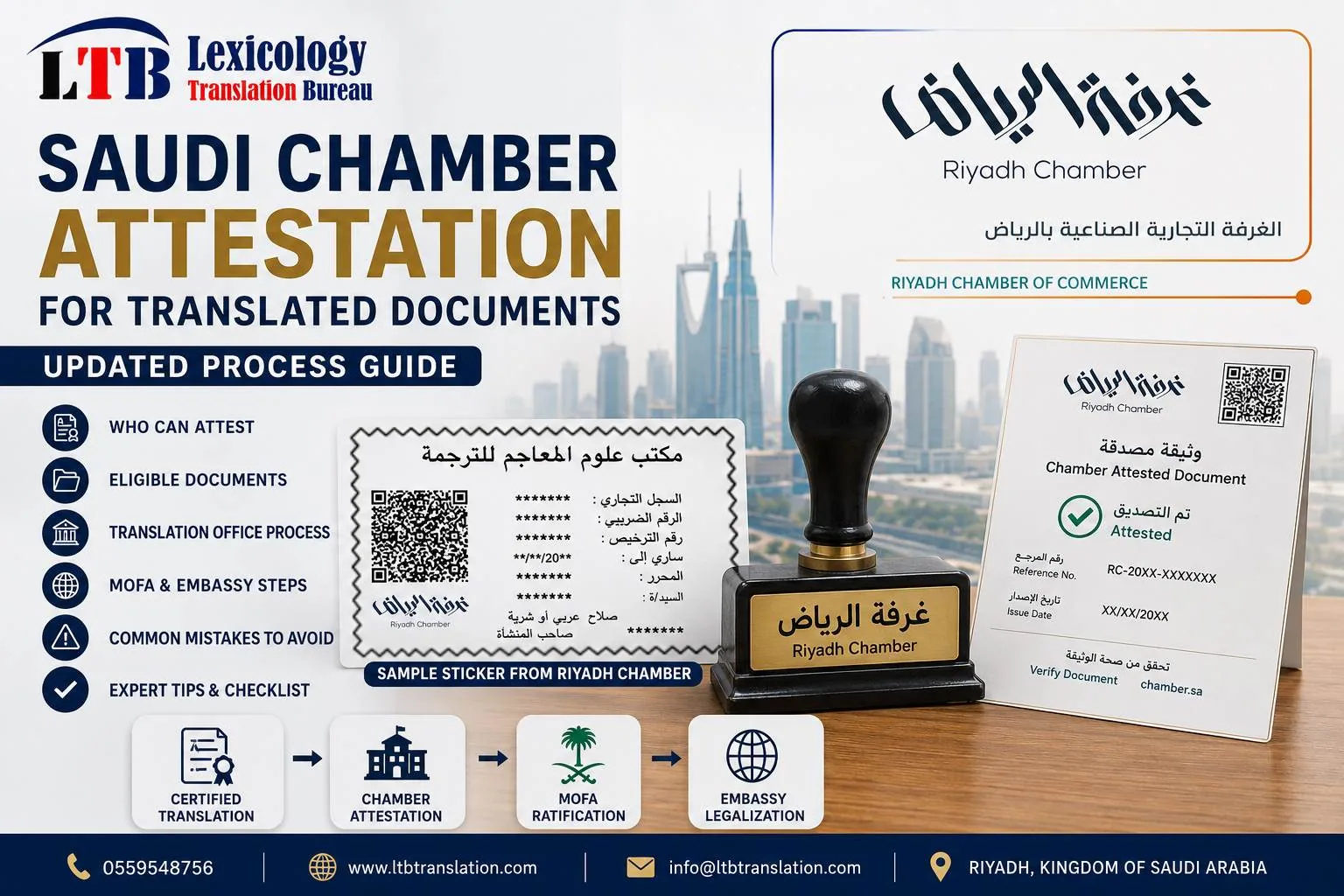
An updated guide explaining when translated documents require Saudi Chamber of Commerce attestation, why the issuing translation office must submit the attestation request, which documents qualify, and when MOFA or embassy legalization may follow.
Saudi Chamber Attestation for Translated Documents
Companies and individuals in Saudi Arabia may need translated documents for embassies, foreign authorities, banks, employers, immigration files, international contracts, visa applications and commercial transactions.
A certified translation carrying the translation office’s seal may be sufficient for some receiving authorities. Other authorities may additionally request Chamber of Commerce attestation, Saudi Ministry of Foreign Affairs ratification or destination-country embassy legalization.
These procedures serve different purposes. A certified translation confirms the translation office’s responsibility for the translated text. Chamber attestation authenticates an eligible document or signature connected to a registered Chamber subscriber. MOFA ratification gives eligible documents the authentication required for international use. Embassy legalization may be required by the country where the document will be submitted.
Lexicology Translation Bureau provides certified translation and document-preparation services in Riyadh for commercial letters, contracts, salary certificates, employment documents, experience certificates, company declarations, invitations, authorizations and other supporting documents.
What Is Chamber of Commerce Attestation?
Chamber of Commerce attestation is an authentication process for eligible documents and transactions related to the commercial activity of a registered establishment.
The Riyadh Chamber electronic system allows a subscribed establishment to prepare and submit its own documents for attestation through its account. The process is completed electronically without requiring the subscriber to attend the Chamber headquarters.
The Chamber does not simply place a stamp on every document presented by any individual. It checks that the document is associated with an eligible subscribed establishment and that the relevant signature or electronic account is authorized.
Chamber attestation should not be described as proof that every factual statement in a document is legally correct. It also does not replace certified translation, notarization, government authentication, MOFA ratification or embassy legalization.
Important Updated Process for Translated Documents
When a translation has been issued, sealed and signed by a certified translation office, the translation office is the establishment responsible for that translated document.
Accordingly, when Chamber attestation of the translation office’s seal or signature is required, the request should normally be submitted by the same translation office through its registered Chamber account.
The customer generally cannot take a translation issued by a translation office and independently ask the Chamber to attest the translation office’s seal. The Chamber’s electronic process is tied to the subscribed establishment and its authorized users or signatories.
The practical process is usually:
- The customer sends the original document to the translation office.
- The intended country, receiving authority and required language are confirmed.
- The translation office prepares, reviews, stamps and signs the certified translation.
- If Chamber attestation is required and the document is eligible, the translation office submits the attestation request through its own Chamber account.
- The electronic Chamber-attested document is issued or made available for verification.
- MOFA or embassy legalization is completed afterward when required.
A customer who needs Chamber attestation should therefore request it directly from the translation office before final delivery.
Must Attestation Be Obtained From the Same Translation Office?
In normal practice, yes.
The office that issued, signed and sealed the translation should submit the Chamber attestation request because the Chamber is authenticating that establishment’s document or authorized signature.
A different translation office should not attest another office’s translation as though it were its own work.
If the original translation office cannot provide the required service, another certified office may need to:
- Review the source document.
- Prepare a new translation.
- Issue the translation under its own name, seal and responsibility.
- Submit its own Chamber attestation request when the document is eligible.
The new office should not merely attach its stamp to another translator’s work without reviewing and formally reissuing the translation.
Can the Customer Visit the Chamber Personally?
Visiting a Chamber branch does not normally allow a customer to obtain attestation of a translation office’s seal independently.
The Riyadh Chamber’s official service is designed for subscribed establishments. The subscriber prepares and submits documents associated with its own establishment through the electronic account.
Therefore, the relevant translation office should complete the electronic attestation process for a translation issued under its name.
The customer may still need to visit MOFA, an embassy, a consulate, a visa centre or another authority later, depending on the destination and required legalization route.
Certified Translation and Chamber-Attested Translation
A certified translation normally contains:
- The translated text.
- The translation office’s name.
- Official seal.
- Authorized signature.
- Certification statement.
- Translation date.
- Page references where applicable.
- Contact or license information where included by the office.
A Chamber-attested translation additionally contains an electronic Chamber authentication, reference, QR code or verification information connected to the issuing establishment.
Not every certified translation requires Chamber attestation. The receiving authority must determine whether the translation office’s normal certification is sufficient or an additional Chamber authentication is required.
Which Translated Documents May Follow the Chamber Route?
Chamber attestation is primarily associated with documents issued by private commercial establishments and connected to their registered activities.
Translated documents that may follow this route include:
- Employment letters issued by a company.
- Salary certificates.
- Experience certificates.
- No-objection letters.
- Commercial invitation letters.
- Company authorization letters.
- Business declarations.
- Supplier appointment letters.
- Distributor appointment letters.
- Private commercial agreements.
- Company support letters.
- Letters addressed to banks or embassies.
- Employment confirmation letters.
- Assignment and secondment letters.
- Private-company certificates.
- Certain visa-related company transactions.
- Translations issued and certified by a registered translation establishment when Chamber authentication of the office’s seal is requested.
Eligibility still depends on the document’s issuer, content, signatory, Chamber membership and current receiving-authority requirements.
Documents That Do Not Automatically Follow the Chamber Route
Government, judicial, educational and civil-status documents should not automatically be treated like private company letters.
Examples include:
- Birth certificates.
- Marriage certificates.
- Divorce certificates.
- Court judgments.
- Police-clearance certificates.
- Academic degrees.
- University transcripts.
- Passports.
- National identity documents.
- Government license's.
- Judicial powers of attorney.
- Government-issued commercial registrations.
- Official government certificates.
The Saudi Chambers Executive Regulations restrict Chamber attestation of certificates and documents issued by government or judicial authorities and the content of their translations.
Such documents may instead require authentication from the issuing authority, the competent ministry, MOFA or the relevant embassy.
This does not mean that a translation office cannot translate them. It means the authentication route for the original document and its translation must be confirmed separately.
Government Document Translation and Chamber Attestation
A government-issued document and a private translation-office certification are two different components.
The original government document may require authentication through its issuing or competent authority.
The translation office then prepares a certified translation. If the receiving authority specifically requires authentication of the translation office’s seal, the office should confirm whether Chamber attestation is available and accepted for that case.
Applicants should not assume that Chamber attestation makes an unattested original government document valid for international use.
In many international files, the original document must first complete its competent authentication route before the final translation and subsequent legalization are prepared.
When Is Certified Translation Required?
Certified translation may be required when:
- An Arabic document will be submitted to a foreign authority.
- A foreign-language document will be used by a Saudi authority.
- An embassy requests an Arabic or English version.
- A company contract involves parties using different languages.
- A salary or employment certificate will be used abroad.
- An international bank or immigration authority requests translation.
- Attestation stamps and electronic references must be understood in another language.
- A foreign company document is submitted to a Saudi organization.
- The receiving authority expressly requires a certified translation.
The target language and certification requirements should be confirmed before translation begins.
Should Translation Be Done Before or After Original-Document Attestation?
There is no single sequence for every document.
For many international-use documents, completing authentication of the original first is helpful because the final translation can include all visible:
- Government stamps.
- MOFA stamps.
- Embassy endorsements.
- Chamber references.
- Verification numbers.
- QR-code descriptions.
- Dates and official notes.
However, some authorities request the translation before one or more attestation stages. Some companies also issue bilingual documents before Chamber attestation.
The correct sequence should be confirmed with the final receiving authority, embassy or competent service before work begins.
Translation Office Chamber Attestation Process
The updated practical workflow is:
- Send a complete and readable copy of the original document.
- State the country and authority where the document will be used.
- Confirm whether the original has already been authenticated.
- Confirm the required translation language.
- Ask whether Chamber attestation of the translation is required.
- The translation office prepares the final translation.
- Names, dates, numbers, stamps and attachments are reviewed.
- The translation is signed and sealed by the issuing office.
- The same translation office submits the eligible document electronically through its Chamber account.
- The Chamber-attested electronic copy or verification reference is obtained.
- MOFA ratification is completed if required.
- Embassy or consular legalization is completed if required.
- The complete document set is submitted to the receiving authority.
The translation should not be changed after Chamber attestation. Any material correction may require the translation to be reissued and attested again.
Documents the Customer Should Send to the Translation Office
Depending on the case, the customer may need to provide:
- Clear original document.
- All document pages.
- Reverse pages containing stamps or notes.
- Current passport.
- National ID or Iqama where relevant.
- Official spelling reference.
- Previous translation when available.
- Destination country.
- Name of the receiving authority.
- Required target language.
- Required deadline.
- Instructions received from the embassy or authority.
- Existing MOFA or embassy stamps.
- Related attachments and schedules.
The translation office may request a clearer copy if a seal, number, name or handwritten note cannot be read safely.
Employment and Salary Certificates
Employment and salary documents are among the common private-company documents used for:
- Embassy applications.
- Bank applications.
- Family visa files.
- Immigration procedures.
- School applications.
- Rental requirements.
- Foreign employment.
- Professional registration.
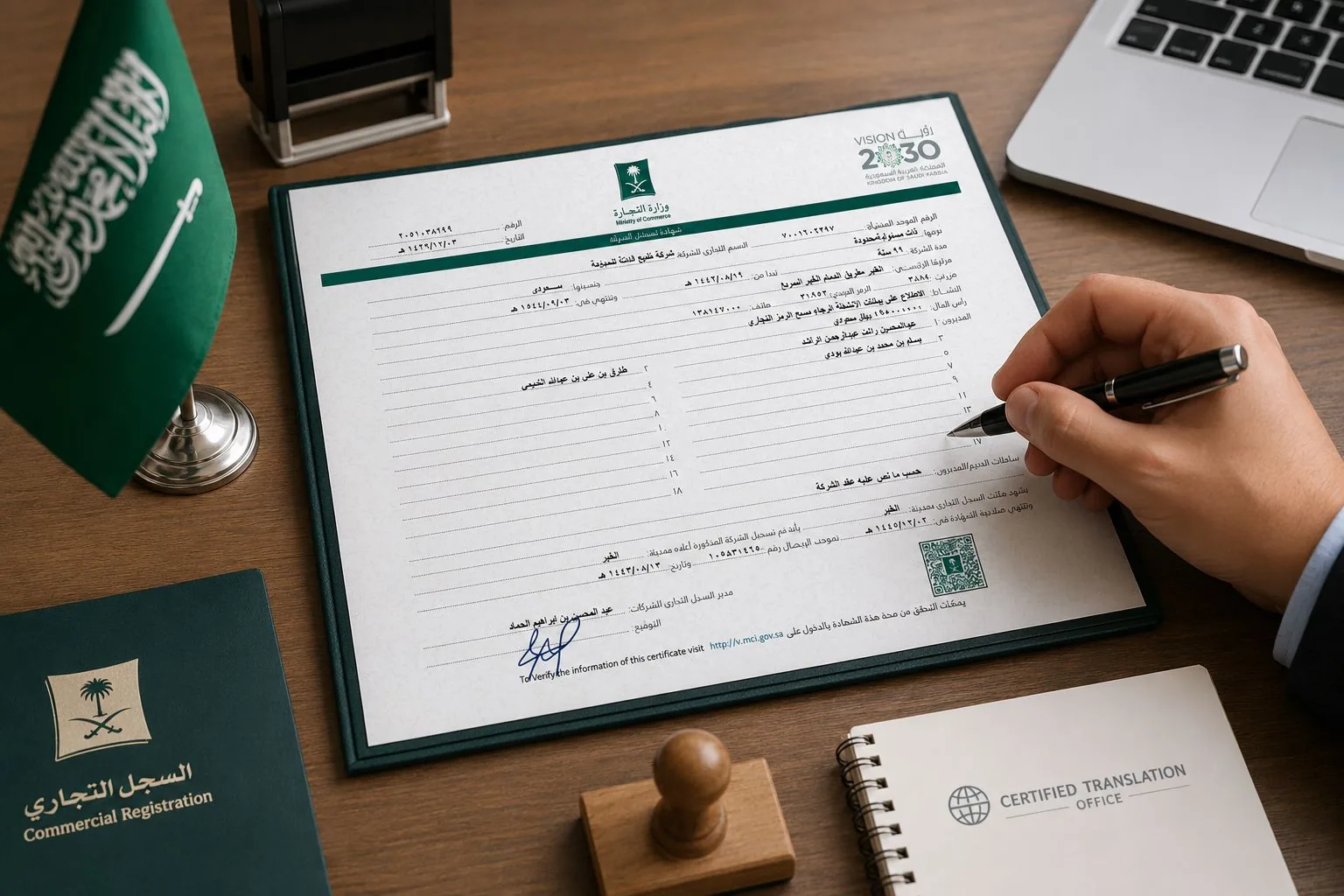
A company employment letter may contain:
- Employee’s full name.
- Nationality.
- Passport or Iqama number.
- Job title.
- Employment start date.
- Employment status.
- Salary and allowances.
- Employer name.
- Commercial details.
- Authorized signatory.
- Issue date.
- Intended recipient.
If Chamber attestation and translation are required, the company document and the translation-office document may involve separate authentication steps. The receiving authority’s required sequence should be confirmed.
Experience Certificate Translation
Experience certificates should accurately preserve:
- Employee’s official name.
- Position held.
- Department.
- Employment start and end dates.
- Employment status.
- Job responsibilities where stated.
- Employer’s legal name.
- Signatory’s name and title.
- Company seal.
- Chamber verification information.
A translator must not correct an inaccurate employment date or job title without a revised source document from the employer.
Commercial Contract Translation
Contracts that may require translation include:
- Supply contracts.
- Distribution agreements.
- Service agreements.
- Agency agreements.
- Partnership agreements.
- Consultancy contracts.
- Maintenance agreements.
- Subcontracting agreements.
- Memoranda of understanding.
Before translation, the parties should review:
- Legal names.
- Commercial registration numbers.
- Addresses.
- Contract date.
- Effective date.
- Defined terms.
- Amounts and currencies.
- Duration.
- Renewal terms.
- Governing law.
- Dispute-resolution clauses.
- Signature authority.
- Annexes and schedules.
If the final translated contract will be Chamber-attested, the parties should confirm which establishment will issue and submit the relevant document.
Authorization Letters and Company Declarations
Company authorization letters may appoint an employee or representative to complete a specific task.
The letter may state:
- Authorizing establishment.
- Authorized person.
- ID or Iqama number.
- Scope of authorization.
- Organization concerned.
- Validity period.
- Restrictions.
- Authorized signatory.
A formal notarized power of attorney is different from a private company authorization letter and may follow Ministry of Justice, MOFA or embassy procedures instead of ordinary Chamber attestation.
Saudi Documents for Use Abroad
A possible process for an eligible Saudi private-company document may be:
- Prepare the final company document.
- Obtain the authorized company signature.
- Complete company-side Chamber attestation where required.
- Obtain certified translation.
- Have the issuing translation office submit Chamber attestation of its translation when specifically required.
- Complete Saudi MOFA ratification.
- Complete destination-country embassy legalization if required.
- Submit the original and translated document set abroad.
The exact sequence may differ according to the destination country.
Foreign Documents for Use in Saudi Arabia
A foreign document may require:
- Authentication by the competent authority in the issuing country.
- Saudi embassy or consular legalization abroad when applicable.
- Saudi MOFA ratification after arrival when applicable.
- Certified Arabic translation.
- Additional authentication of the translation office’s document when expressly requested.
- Submission of the original, stamps and translation together.
The Saudi receiving authority should provide the final checklist.
Difference Between Chamber, MOFA and Embassy Attestation
Chamber of Commerce attestation authenticates eligible documents and signatures connected to a registered commercial subscriber.
Certified translation confirms that a translation office accepts responsibility for the translated content.
MOFA ratification provides eligible documents with authentication for use outside the country in which they were created. The current Saudi MOFA service covers educational documents, agencies and marriage contracts, commercial documents, letters and personal-status documents.
Embassy legalization may be required by the destination country after the preceding Saudi authentication stages.
None of these procedures automatically replaces the others.
Common Mistakes
Common mistakes include:
- Taking a translation directly to the Chamber without contacting the issuing translation office.
- Asking another translation office to attest a translation it did not issue.
- Translating an incomplete document.
- Omitting the reverse page.
- Translating before obtaining the final attestation stamps.
- Using different name spellings across the passport and translation.
- Treating a government document like a private company letter.
- Assuming every translation needs Chamber attestation.
- Assuming Chamber attestation replaces MOFA.
- Submitting an unauthorized company signature.
- Editing the translated document after attestation.
- Using a screenshot instead of the final electronic document.
- Failing to verify the Chamber reference or QR code.
- Beginning embassy procedures without confirming the required sequence.
How Lexicology Translation Bureau Can Assist
Lexicology Translation Bureau provides certified translation services in Riyadh for:
- Company letters.
- Salary certificates.
- Employment certificates.
- Experience certificates.
- Commercial contracts.
- Business invitations.
- Authorization letters.
- Company declarations.
- Supplier and distributor documents.
- Commercial records.
- MOFA and embassy stamps.
- Passport and identity documents.
- Supporting visa and immigration documents.
Where Chamber attestation of a translation issued by the office is required and the document is eligible, the request should be arranged through the issuing office rather than by taking the translation independently to the Chamber.
Before work begins, the office reviews the document type, issuing authority, destination country, required language, visible stamps, names, numbers and intended use.
The translation office does not decide visa approval, legal validity or final document acceptance. These remain decisions of the competent receiving authorities.
Conclusion
Chamber attestation of a translated document is not simply a customer walk-in stamping service.
Because the certified translation is issued under the translation office’s name, seal and responsibility, the issuing translation office normally submits the Chamber attestation request through its own registered electronic account.
The safest process is to confirm the receiving authority’s requirements first, complete any authentication required for the original document, obtain certified translation, arrange Chamber attestation through the same translation office when required, and then complete MOFA or embassy legalization in the correct order.
Official sources for current requirements
Receiving-organization requirements can change. Check the relevant official source before submitting a document.
Frequently Asked Questions
Can a customer personally take a certified translation to the Chamber for attestation?
Normally, the translation office that issued, signed and sealed the translation should submit the Chamber attestation request through its registered establishment account. The customer should request this service from the issuing translation office.
Can another translation office attest a translation issued by a different office?
A different office should not present another office’s translation as its own. It may need to prepare, certify and issue a new translation under its own responsibility before arranging attestation.
Does every certified translation need Chamber attestation?
No. Many authorities accept the normal seal of a certified translation office. Chamber attestation is required only when requested by the receiving authority and when the document is eligible.
Does Chamber attestation replace MOFA or embassy legalization?
No. Chamber attestation, MOFA ratification and embassy legalization are separate stages. The required sequence depends on the document and destination country.
.jpg.webp)