Trademark and Logo Translation in Saudi Arabia: Arabic Translation, Transliteration and Registration Guide
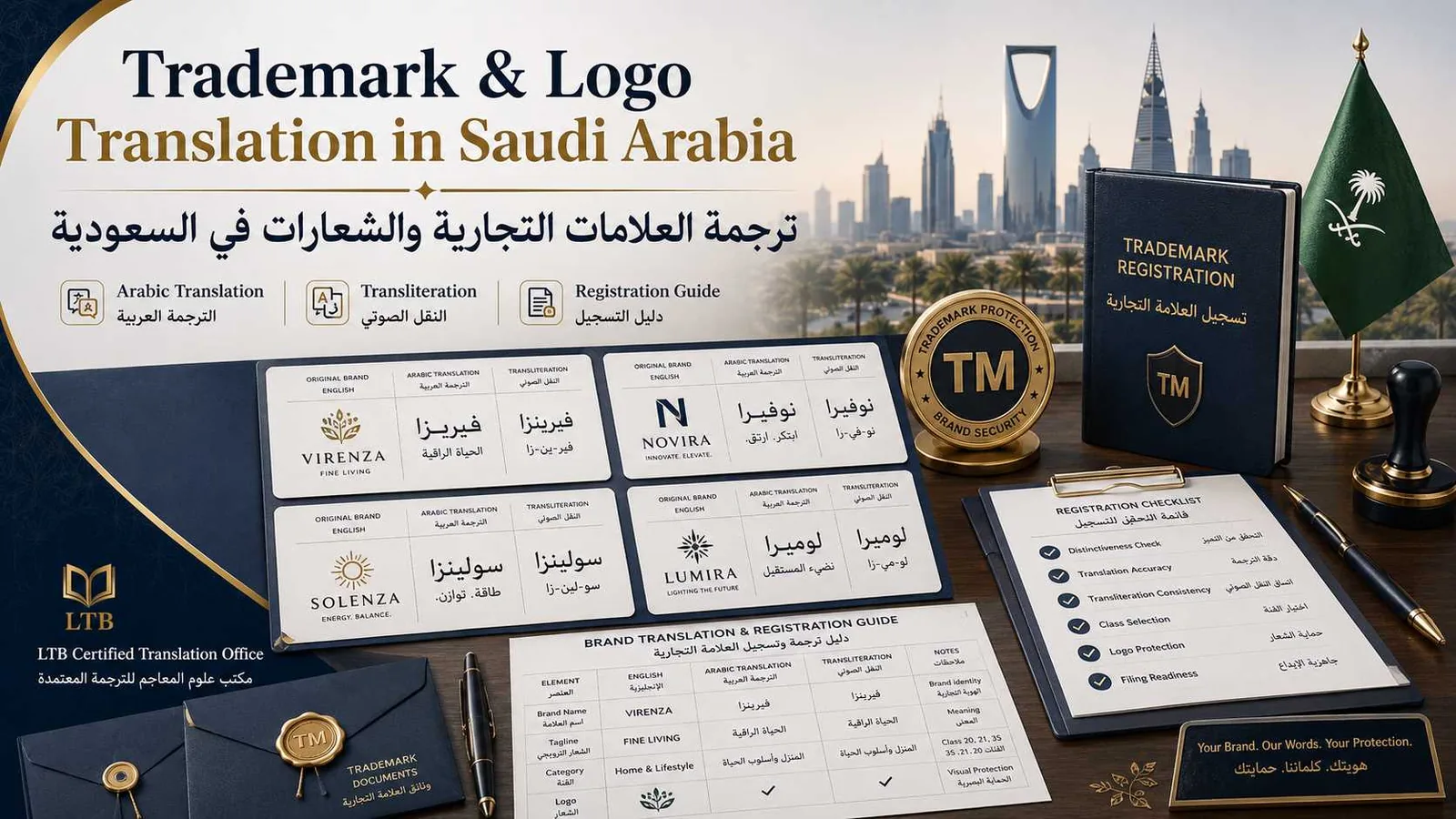
A practical guide to trademark and logo translation in Saudi Arabia, explaining certified Arabic translation, brand-name transliteration, slogan translation, registration documents, common mistakes and the steps businesses should follow before submitting a trademark application.
A trademark is more than a company name. It may include words, letters, numbers, symbols, drawings, images, colours, packaging elements or a combination of features used to distinguish the goods or services of one business from those of another. Trademark protection therefore depends not only on the visual design but also on the exact wording, pronunciation and meaning of the mark.
When a trademark or one of its elements is written in a language other than Arabic, the Saudi Authority for Intellectual Property advises applicants to attach a certified translation. This makes accurate Arabic trademark translation particularly important for foreign companies, international brands, local distributors and Saudi businesses using English or other non-Arabic brand names.
What Is Trademark and Logo Translation?
Trademark translation is the process of transferring the meaning of a brand name, slogan or other verbal element from one language into another while protecting the identity and intended commercial message of the original mark.
Logo translation usually does not mean changing the graphic design of the logo. Instead, it may involve translating, transliterating or adapting the words appearing inside or beside the logo.
For example, a logo may contain:
- A company or brand name
- A product name
- A slogan or tagline
- A description of services
- An abbreviation
- Foreign-language words
- A geographical name
- A phrase with a cultural or commercial meaning
The correct treatment of each element depends on whether the business wants to preserve the original pronunciation, communicate the literal meaning or create a market-friendly Arabic version.
Translation, Transliteration and Localisation: What Is the Difference?
These three processes are related but serve different purposes.
Translation
Translation transfers the meaning of a word or phrase into another language. For example, a descriptive expression such as “Green Gate” could be translated into Arabic as “البوابة الخضراء”.
A literal translation may be appropriate for a descriptive slogan, but it is not always suitable for a distinctive brand name.
Transliteration
Transliteration represents the pronunciation of a foreign brand name using Arabic letters. For example, an invented brand name such as “NovaTech” may be written as “نوفاتك”.
Transliteration is commonly used when the brand owner wants customers to pronounce the Arabic version in a way that remains close to the original name.
Localisation or Marketing Adaptation
Localisation adapts the message for the target market instead of translating every word literally. This is particularly useful for slogans, advertising phrases and product messages.
A marketing adaptation should not be used in an official trademark application without confirming that it accurately represents the mark the owner intends to protect.
Does Every Logo Need to Be Translated?
No. A logo consisting only of shapes, colours or abstract design elements may not contain any text requiring translation.
Translation may be needed when the logo includes:
- English or other foreign-language words
- A foreign brand name
- A slogan
- Descriptive wording
- Product information
- Abbreviations with a specific meaning
- Words that could have an unintended meaning in Arabic
The original logo design should normally remain unchanged unless the owner has specifically approved a separate Arabic version.
Businesses should also decide whether they intend to protect:
- The original foreign-language word mark
- An Arabic transliteration
- An Arabic translation
- A combined bilingual logo
- A separate figurative or graphic mark
These versions may not always provide exactly the same scope of commercial or legal protection. A trademark specialist or licensed intellectual-property agent should advise the applicant on the appropriate filing strategy.
Why Certified Arabic Translation May Be Required
The Saudi Authority for Intellectual Property states that if a trademark or one of its elements is in a language other than Arabic, a certified translation should be attached. Earlier Saudi trademark regulations also referred to providing an Arabic translation and phonetic transcription for foreign-language words included in a mark.
The translation helps explain:
- The exact meaning of the foreign wording
- How the brand name is pronounced
- Whether the wording is descriptive or distinctive
- Whether the mark contains a geographical or restricted expression
- Whether the Arabic meaning could conflict with public order or accepted values
- Whether another translation or similar mark may create confusion
The translation should clearly distinguish between the meaning of a word and its phonetic representation. A brand name may have no literal meaning but may still require an Arabic transliteration showing its pronunciation.
Documents Commonly Required for Trademark Translation
The documents requiring translation depend on the type of application, the country of origin, the applicant and whether the request concerns registration, renewal, assignment, licensing or a dispute.
Common documents include:
- Trademark registration certificates
- Foreign trademark applications
- Priority documents
- Trademark ownership certificates
- Powers of attorney
- Trademark assignment agreements
- Trademark licence agreements
- Company registration documents
- Commercial registration extracts
- Articles of association
- Authorisation letters
- Declarations of ownership
- Objections and responses
- Administrative or court decisions
- Product and service descriptions
- Evidence of prior use
- Brand guidelines and approved spelling lists
Applicants should confirm the current document requirements with SAIP or their authorised trademark agent before submitting the application.
How to Translate a Brand Name Correctly
A brand name should not be translated by looking at the word alone. The translator should first understand:
- Whether the word has a dictionary meaning
- Whether it is an invented name
- How the owner officially pronounces it
- Whether an Arabic version is already used
- Whether the mark has been registered in another country
- Whether the Arabic spelling could resemble another brand
- Whether the Arabic word has an undesirable meaning
- Whether the spelling matches packaging, websites and company records
Foreign sounds may be represented in Arabic in several ways. Using different spellings across documents can create uncertainty.
For example, the same name may appear differently in a commercial registration, distributor agreement, packaging file and trademark application. The business should therefore approve one Arabic spelling and use it consistently.
Trademark Translation Process
1. Collect the original files
Provide the clearest available copy of the logo, trademark wording, slogan, registration certificate and supporting company documents.
2. Identify every language element
The translator reviews the mark to identify the brand name, descriptive words, slogans, abbreviations and any text contained in the design.
3. Confirm the intended pronunciation
For invented names and proper nouns, the client should provide the approved pronunciation whenever possible.
4. Choose translation or transliteration
Each element is classified according to whether it needs a direct translation, phonetic Arabic rendering or explanatory note.
5. Check consistency
The Arabic spelling is compared with the company’s commercial registration, website, packaging, previous certificates and existing translations.
6. Prepare the certified translation
The final translation should clearly show the original wording, Arabic meaning, transliteration and any necessary translator’s notes.
7. Conduct a final client review
The owner should confirm that the proposed Arabic version matches the intended brand identity before filing or printing it on products.
8. Submit through the appropriate channel
Trademark applications in Saudi Arabia are handled electronically through SAIP. The official process may include examination, a request for modification, acceptance or refusal, publication and final certificate issuance. SAIP currently lists a 60-day publication period following acceptance and payment of the publication fee.
Search Before Translating and Filing
Before investing in packaging, marketing or registration, businesses should search for identical and similar trademarks.
SAIP provides an online search service for national trademark databases. The service is currently listed as immediate and free for individuals and enterprises.
A search should consider:
- The original English or foreign-language name
- The Arabic transliteration
- Alternative Arabic spellings
- The translated meaning
- Similar pronunciations
- Similar visual elements
- Relevant classes of goods and services
A language search is not a replacement for a professional trademark clearance review, but it can identify obvious conflicts before the application is filed.
Common Trademark and Logo Translation Mistakes
Translating a proper brand name literally
A distinctive invented name may need transliteration rather than literal translation.
Using several Arabic spellings
Different spellings on the logo, certificate, invoice and commercial registration may cause confusion.
Changing the meaning of a slogan
A word-for-word translation may lose the commercial promise or create an unintended claim.
Editing the logo without approval
Changing wording, spacing or design may create a different version of the mark.
Ignoring pronunciation
An Arabic spelling may look accurate but produce a pronunciation different from the original brand.
Using machine translation without review
Automated tools may not understand brand strategy, legal terminology, phonetics or cultural implications.
Confusing the trademark with the company name
A trademark, legal company name and commercial name may be related, but they are not automatically identical.
Failing to verify the goods and services
The classification and description of goods or services must reflect the activity for which protection is requested. WIPO’s Nice Classification is the international system used to organise goods and services for trademark registration.
Trademark Translation Checklist
Before approving the Arabic translation, check that:
- The owner’s name matches official documents
- The trademark is copied exactly
- Every foreign word has been identified
- The literal meaning is accurate
- The pronunciation is clearly represented
- One approved Arabic spelling is used
- The slogan retains its intended message
- Numbers, symbols and punctuation are preserved
- The logo layout has not been changed without approval
- Goods and services use consistent terminology
- Supporting certificates are complete
- Names and dates match the original documents
- The client has reviewed the final Arabic version
- Current SAIP requirements have been checked
Professional Trademark and Logo Translation in Riyadh
Trademark translation requires legal accuracy, linguistic knowledge and careful attention to brand identity. A small difference in meaning, pronunciation or Arabic spelling may affect how the brand is presented to customers and authorities.
Lexicology Translation Bureau (LTB) Office provides professional Arabic-to-English and English-to-Arabic translation services in Riyadh for trademark wording, logos, slogans, registration certificates, powers of attorney, assignment agreements, licence agreements and other commercial or intellectual-property documents.
Clients should provide the original logo, the approved pronunciation of the brand, supporting registration documents and any previously used Arabic spelling. Our translators can then prepare a consistent translation or transliteration for review before the documents are submitted to the relevant authority or authorised trademark representative.
Trademark rules, procedures and fees may change. Applicants should always verify the latest requirements through the Saudi Authority for Intellectual Property before filing.
Official sources for current requirements
Receiving-organization requirements can change. Check the relevant official source before submitting a document.
- Saudi Authority for Intellectual Property: Trademark Registration
- Saudi Authority for Intellectual Property: Trademark Protection Journey
- Saudi Authority for Intellectual Property: Search Platform for Registered Trademarks
- World Intellectual Property Organization: Trademarks
- World Intellectual Property Organization: Nice Classification
Frequently Asked Questions
What is the difference between trademark translation and transliteration?
Translation transfers the meaning of a brand name, slogan or descriptive phrase. Transliteration represents the pronunciation of a foreign name using Arabic letters. A single trademark may need both, but they should be labelled clearly and used consistently.
Is certified Arabic translation required for a foreign-language trademark in Saudi Arabia?
SAIP guidance states that when a trademark or one of its elements is in a language other than Arabic, a certified translation should be attached. Applicants should verify the current filing requirements before submission.
Does translating a logo mean changing its design?
Usually not. Logo translation normally concerns the words, brand name or slogan appearing in the design. Colours, symbols, spacing and layout should not be changed unless the owner approves a separate Arabic or bilingual version.
Should a brand name be translated or transliterated?
Descriptive wording may be translated, while invented names and proper names are often transliterated. The final choice should consider the intended meaning, approved pronunciation, existing registrations and one consistent Arabic spelling.
Can a translation office register a trademark for the client?
A translation office can prepare the certified translation, transliteration and translated supporting documents. Filing, legal representation and registration advice should be handled by the owner or an appropriately authorised trademark agent.
How long does trademark registration take in Saudi Arabia?
SAIP currently lists a 90-day execution time for the registration service and a 60-day publication period after acceptance. Modification requests, objections, missing documents or payment delays can extend the overall process.