Material Test Certificate Translation in Riyadh: Steel Grades, Heat Numbers and Inspection Reports Guide
Need Material Test Certificate (MTC) translation in Riyadh? Learn how steel grades, heat numbers, chemical composition, mechanical test results and EN 10204 inspection documents are accurately translated between Arabic and English for construction, manufacturing and industrial procurement in Saudi Arabia.
Material Test Certificate Translation in Riyadh: Steel Grades, Heat Numbers and Inspection Reports Guide
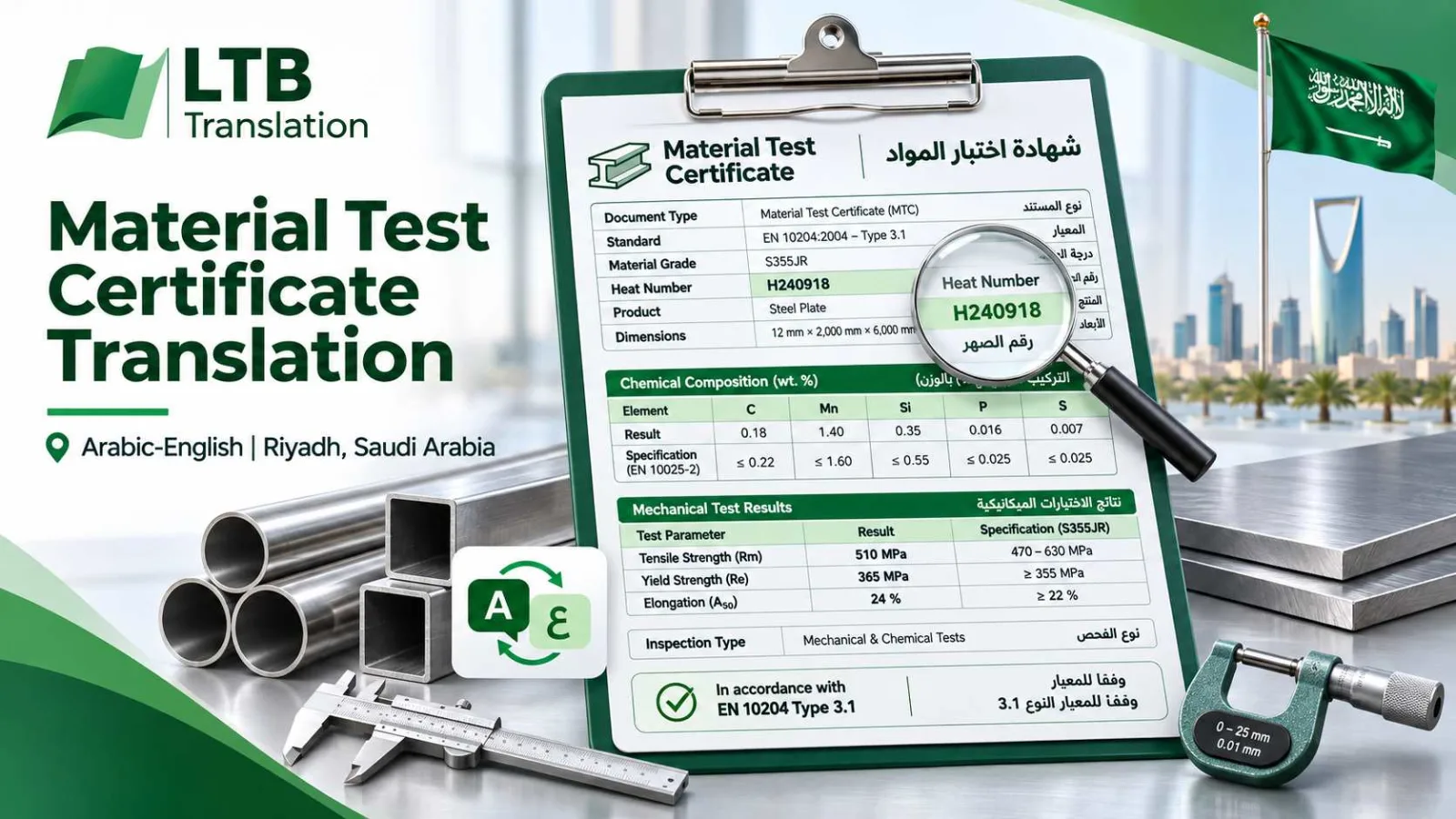
A Material Test Certificate (MTC), also commonly called a Mill Test Certificate or Mill Test Report (MTR), is an important technical document used in the steel, metal manufacturing, construction, and industrial supply sectors.
It provides information about a material's identification, specified grade, chemical composition, mechanical properties, and inspection or testing results.
In Saudi Arabia, engineering contractors, industrial suppliers, procurement departments, and quality-control teams may receive Material Test Certificates from international manufacturers in English or other languages.
Professional Material Test Certificate translation in Riyadh helps Arabic-speaking and international stakeholders review technical information accurately without changing the values or conclusions recorded in the original document.
An incorrect steel grade, heat number, tensile-strength value, or inspection-certificate reference may create confusion during material identification and engineering documentation reviews.
This guide explains the main components of MTC translation, important technical terms, inspection standards, document preparation, and quality-control procedures.
1. Understanding Material Test Certificates (MTC)
A Material Test Certificate is a document issued in connection with a material or product, often by a manufacturer or inspection organization, to report specified material information and relevant testing or inspection results.
These certificates are widely associated with steel products, pipes, plates, bars, structural sections, and other metallic materials.
Depending on the certificate type and applicable specification, an MTC may include:
- Manufacturer or steel mill name
- Certificate number
- Purchase order or delivery reference
- Product description
- Steel or material grade
- Heat or cast number
- Batch or lot identification
- Product dimensions
- Chemical composition
- Mechanical test results
- Test methods and standards
- Inspection certificate type
- Date of issue
- Signatures and verification details
The actual content depends on the material, issuing organization, product standard, and purchase agreement.
A translator should follow the source document and avoid adding technical claims that are not present in the original.
2. Importance of MTC Translation in Saudi Arabia
Material Test Certificate translation can be useful when industrial materials are supplied across borders or when engineering records must be reviewed in more than one language.
In construction and industrial projects, technical documents often pass between manufacturers, suppliers, contractors, consultants, and quality departments.
Clear Arabic–English translation helps each party identify the material and understand the inspection information.
Common applications include:
- Structural steel procurement
- Industrial plant construction
- Steel pipe and fitting supply
- Mechanical equipment manufacturing
- Infrastructure projects
- Warehouse material inspections
- Engineering procurement and construction contracts
- Supplier quality assurance
- Industrial project documentation
- Technical correspondence with international manufacturers
Translation supports communication and document consistency. It does not replace the engineering approval process or physical material inspection.
3. Steel Grades and Material Specifications
Steel grades are among the most important details appearing on a Material Test Certificate.
A grade identifies a material designation according to a particular standard or specification.
Examples may include manufacturer-supplied designations associated with ASTM, EN, ISO, or other applicable standards.
Preserving Grade Designations
Steel grades and material designations must remain traceable to the original certificate.
A translator should not change one steel grade into another simply because the names appear similar.
Different grades may have different chemical composition limits, mechanical properties, manufacturing requirements, or intended applications.
Maintaining Reference Standards
A Material Test Certificate may identify a technical specification or testing standard.
The reference number, edition, year, and classification should be preserved as supplied.
Where the standard has an official title, that title may help establish the appropriate translated terminology.
The translation must not suggest that the material meets a different standard from the one stated in the source.
4. Heat Numbers, Cast Numbers, and Material Traceability
A heat number is an identification reference associated with a particular steelmaking heat or melt.
Depending on the manufacturing and documentation system, similar identifiers may be described as cast numbers, batch numbers, or lot numbers. These terms should not automatically be treated as interchangeable.
Heat numbers are important because they may connect the finished material with manufacturing and testing records.
Accurate Alphanumeric References
A heat number may contain letters, digits, and special characters.
For example, an illustrative identifier such as HT-26-00482 must be reproduced consistently in every relevant part of the translation.
An incorrect character can interfere with comparison against another document.
Relationship with Supporting Documents
A Material Test Certificate may be reviewed alongside:
- Purchase orders
- Material receiving reports
- Packing lists
- Delivery notes
- Inspection reports
- Material identification records
The translator can compare shared identifiers when supporting documents are supplied, but must not silently change conflicting source information.
Any discrepancy should be referred to the responsible party for clarification.
5. Translating Chemical Composition Results
Chemical composition tables are a common feature of steel Material Test Certificates.
Depending on the material grade, they may report specified elements and their measured quantities or proportions.
Examples include:
- Carbon (C)
- Manganese (Mn)
- Silicon (Si)
- Phosphorus (P)
- Sulfur (S)
- Chromium (Cr)
- Nickel (Ni)
- Molybdenum (Mo)
The presence of individual elements varies by alloy and specification.
Chemical Symbols
Chemical symbols should generally remain unchanged because they are standardized scientific identifiers.
The descriptive names may be translated where appropriate.
Percentages and Limits
A certificate may compare chemical-analysis results with maximum, minimum, or permitted ranges.
The translation should clearly distinguish the measured result from the specification limit.
Decimal values, inequality symbols, and percentage signs must be preserved accurately.
A figure such as 0.025% cannot be replaced with 0.25% without substantially changing its meaning.
A translator should not make a technical judgment about whether the reported chemical composition is acceptable unless that conclusion appears in the original document.
6. Mechanical Testing Results and Engineering Terminology
Mechanical properties describe how materials behave when subjected to specified tests or forces.
Material Test Certificates may report properties such as tensile strength, yield strength, elongation, impact testing, or hardness.
Tensile Strength
Tensile strength describes a material's resistance to a tensile load under the applicable test definition.
It may appear in units such as MPa or N/mm².
Yield Strength
Yield strength relates to the stress at which a material begins to undergo specified yielding or permanent deformation, according to the test and reporting convention.
Elongation
Elongation is generally reported as a percentage under defined testing conditions. The corresponding test basis and gauge-length details should be retained when present.
Impact Testing
Impact test results may be reported with the applicable method, temperature, energy unit, and testing conditions.
Hardness
Hardness measurements may identify different testing scales or methods. A translator must preserve the stated scale rather than treating all hardness values as directly interchangeable.
These terms require careful technical translation.
Measurement units, test conditions, and original results must not be changed without authorization.
7. EN 10204 Inspection Certificates and Translation
EN 10204 is a European standard addressing types of inspection documents for metallic products.
When an MTC refers to EN 10204, the precise certificate type is important.
Depending on the document and edition, relevant types may include:
- Type 2.1 — Declaration of compliance with the order
- Type 2.2 — Test report
- Type 3.1 — Inspection certificate
- Type 3.2 — Inspection certificate involving the specified independent verification arrangements
These categories do not have identical content or validation requirements.
A Type 3.1 certificate should not be translated or described as a Type 3.2 certificate.
The translator should preserve the original classification and the designation of the responsible issuing or inspection organization.
BSI provides the official publication details of BS EN 10204:2004 under the title "Metallic products — Types of inspection documents."
The applicable document type must be confirmed against the original certificate, contractual requirements, and relevant standard.
8. ISO 10474 and Inspection Documents
ISO 10474:2013 is an international standard concerning inspection documents supplied to purchasers of steel and steel products.
It defines types of inspection documents in connection with the requirements of a purchase order.
The standard is used alongside other technical delivery specifications relevant to the material.
When ISO 10474 is referenced in a certificate, the translator should preserve the standard identifier, any stated classification, and associated material requirements.
Translation must distinguish between the inspection document itself and the technical material standard referred to within it.
Neither an ISO standard reference nor a translated certificate automatically proves compliance with all local regulatory or project requirements.
9. Dimensions, Quantities, and Measurement Units
Metallic product certificates may contain important dimensional and quantity information.
Typical fields may include:
- Nominal diameter
- Outside diameter
- Wall thickness
- Plate thickness
- Width and length
- Product weight
- Quantity or number of pieces
- Material designation
- Heat treatment condition
Engineering dimensions may be expressed in millimetres, metres, inches, or other units.
A translator must preserve the original numerical values and clearly identify the units used.
For example, wall thickness and outside diameter are different measurements and must not be confused.
Where conversion is separately requested, the converted information should be clearly distinguished from the original source values.
10. MTC Translation for Engineering and Construction Projects
Material documentation plays an important role in engineering procurement and project quality-control activities.
A contractor may need to compare a delivered steel product with the product specification and purchasing documents.
A translated MTC can assist with understanding the material information where project participants use different languages.
However, the translated document does not independently verify the actual material, validate the laboratory results, or establish suitability for engineering use.
Engineers, inspectors, and other responsible professionals must carry out the necessary technical evaluation.
In Saudi Arabia, regulatory and conformity requirements vary by product category.
The Saudi Standards, Metrology and Quality Organization (SASO) and the Saber platform provide information concerning regulated products and applicable conformity services.
Businesses should verify the current requirements for their specific products.
11. Common Mistakes in Material Test Certificate Translation
A technically inaccurate translation may create inconsistencies between engineering and purchasing records.
Common errors include:
- Incorrect steel-grade identification
- Missing heat or cast numbers
- Confusion between a heat number and a certificate number
- Changed chemical composition percentages
- Incorrect tensile or yield-strength units
- Omitted inspection standards
- Incorrect EN 10204 certificate classification
- Missing table rows or columns
- Misinterpreted material dimensions
- Changed product quantities
- Incorrect issue dates
- Inconsistent manufacturer information
- Untranslated testing notes
- Omitting inspection signatures or document references
These errors can often be identified by comparing the completed translation with every page of the original certificate.
If the source contains an apparent technical mistake, the issue should be referred to the issuing organization rather than corrected without authorization.
12. Certified Translation and Material Inspection Are Different
Certified translation focuses on accurately reproducing the contents of the original document in another language.
Material inspection is a separate technical activity involving verification of products, test results, inspection requirements, or compliance with applicable specifications.
A certified translation does not independently establish:
- Authenticity of the original certificate
- Accuracy of the manufacturer’s test results
- Quality or safety of the supplied material
- Compliance with Saudi technical regulations
- Compliance with a construction project specification
- Approval by a regulatory or conformity assessment authority
The client should confirm whether the intended recipient requires an ordinary translation, certified translation, or additional technical verification.
13. Preparing an MTC for Professional Translation
Before requesting a translation, the client should prepare the complete certificate, including all pages and supporting tables.
A clear PDF is usually preferable to an incomplete screenshot.
For an accurate quotation, provide:
- The full Material Test Certificate
- Source and target languages
- Intended use of the document
- Name of the receiving organization
- Any existing technical glossary
- Related purchase order or specification, if needed
- Required certification or format
- Requested delivery date
If multiple certificates are submitted, separate them by manufacturer or material identification where appropriate.
The office can then review the document's length, terminology, layout, and technical complexity before confirming the quotation.
14. Material Test Certificate Translation at LTB Translation Riyadh
Lexicology Translation Bureau (LTB) is a certified translation office based in As Sulimaniyah, Riyadh, Saudi Arabia.
LTB provides Arabic–English and multilingual translation services, subject to document and language-pair review.
For specialized engineering documents, clients can submit Material Test Certificates for assessment of the terminology, tables, document format, and required translation scope.
The usual workflow may include document review, quotation, translation, comparison against the source, and final delivery in the agreed format.
During review, particular attention should be given to steel grades, heat numbers, material dimensions, chemical-analysis values, mechanical properties, and inspection certificate classifications.
For related services, visit LTB Translation Services.
For pricing information, see LTB Translation Pricing. The final translation cost depends on the document's language, length, and technical complexity.
15. Final Review Checklist Before Submission
Before submitting a translated Material Test Certificate, verify that:
- The correct source certificate was used.
- Every required page is included.
- The manufacturer name is accurate.
- The steel or material grade is unchanged.
- All heat and cast numbers match.
- Chemical elements and values are correct.
- Mechanical test results are preserved.
- Inspection classifications are accurate.
- Standard references remain identifiable.
- Dimensions and measurement units are correct.
- The original tables are clearly represented.
- Dates, signatures, and certificate numbers are included.
- The intended recipient's format requirements have been confirmed.
These checks can help reduce discrepancies and support clear communication between engineering, procurement, and quality teams.
16. Conclusion
Accurate Material Test Certificate translation in Riyadh requires a detailed understanding of technical document structure, material terminology, identification references, and laboratory testing information.
Steel grades, heat numbers, chemical composition values, mechanical properties, dimensional details, and inspection standards must be reproduced faithfully.
Whether the document is intended for industrial procurement, construction project documentation, supplier communication, or internal quality review, a clear translation supports consistent understanding of the source information.
Translation should never be confused with independent material testing, regulatory certification, or engineering approval.
Need Material Test Certificate Translation in Riyadh?
Contact Lexicology Translation Bureau (LTB Translation) to request a review and quotation for your technical documents.
Website: https://ltbtranslation.com/
Request a Quote: https://ltbtranslation.com/quote
WhatsApp: +966 55 954 8756
Location: As Sulimaniyah, Riyadh, Saudi Arabia.
Important: This guide provides general technical document translation information. Confirm applicable inspection, certification, and acceptance requirements with the relevant manufacturer, project authority, standardization body, or receiving organization.
Official sources for current requirements
Receiving-organization requirements can change. Check the relevant official source before submitting a document.
Frequently Asked Questions
What is a Material Test Certificate (MTC)?
A Material Test Certificate (MTC), sometimes called a Mill Test Certificate or Mill Test Report, is a technical document used to record information about a material, including its grade, identification numbers, chemical composition, mechanical properties and relevant inspection or testing results. The exact content depends on the product, applicable standard and certificate type.
Can a Material Test Certificate be translated from English to Arabic in Riyadh?
Yes. Lexicology Translation Bureau (LTB) in Riyadh can review English-language Material Test Certificates for Arabic translation. The source should be complete and readable. Steel grades, heat numbers, technical standards, chemical results, mechanical properties and measurement units require careful review to preserve the original meaning.
Is an EN 10204 Type 3.1 certificate the same as Type 3.2?
No. EN 10204 Type 3.1 and Type 3.2 inspection certificates have different validation and inspection requirements. Type 3.2 includes the specified independent verification arrangements. A translator must preserve the certificate type stated in the original document and should not change one classification into another.
How much does Material Test Certificate translation cost in Riyadh?
Translation costs depend on the number of pages, source and target languages, technical terminology, laboratory tables, and required delivery or certification format. Clients can send their Material Test Certificate to LTB Translation for document review and a quotation. The final price is confirmed after reviewing the actual document.