Certificate of Origin Translation in Riyadh: Saudi Export and Customs Guide
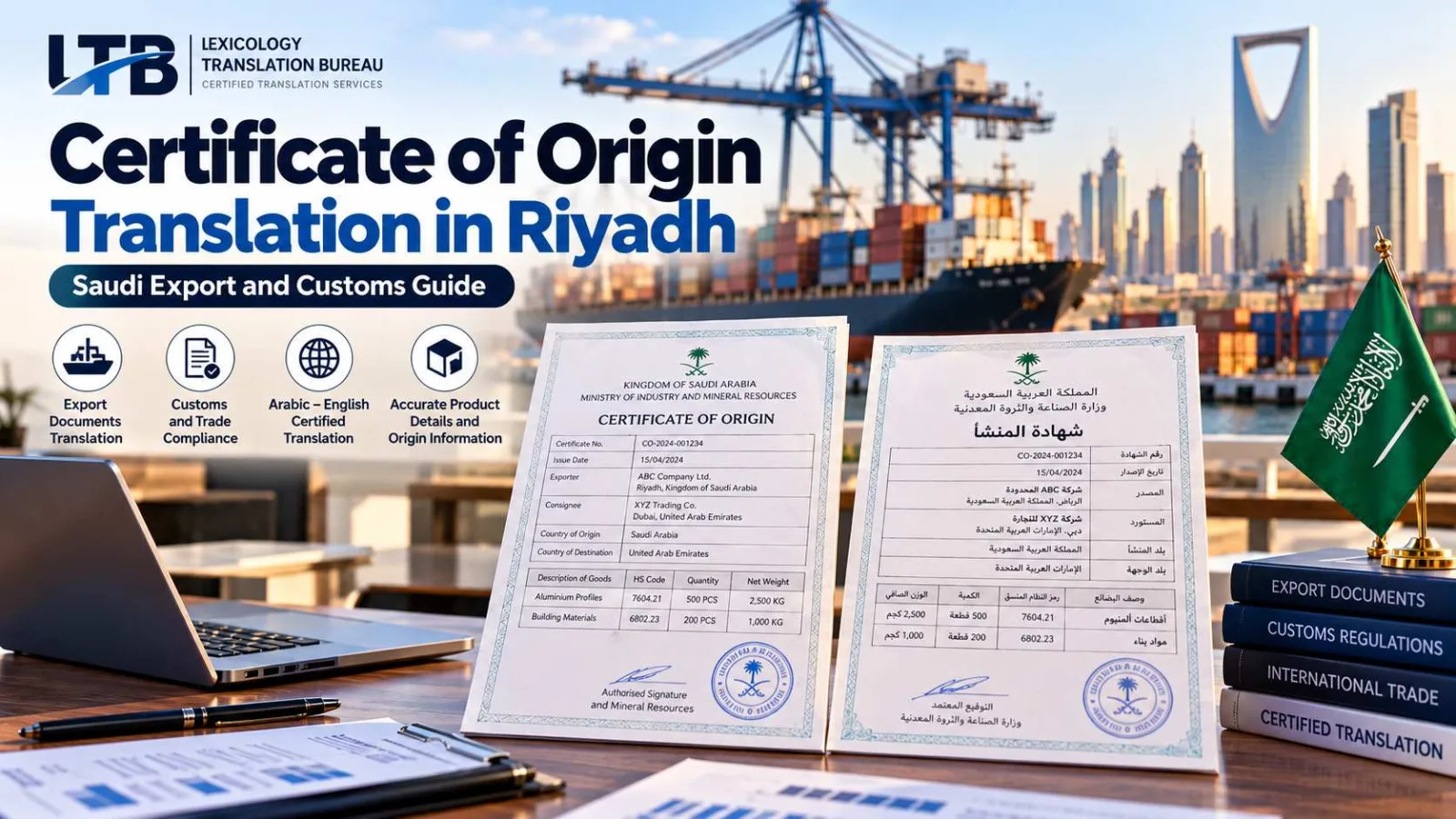
Need certificate of origin translation in Riyadh? Learn how to review exporter details, product descriptions, origin countries, certificate numbers and shipping references for accurate Arabic–English translation and international trade use.
Certificate of origin translation in Riyadh helps exporters, importers, manufacturers, logistics companies and business customers understand important information about where traded goods originate. When a certificate issued in Arabic must be reviewed by an English-speaking customer—or a foreign certificate must be presented to an Arabic-speaking organisation—accurate translation is essential.
A certificate of origin may include the exporter and consignee, country of origin, product descriptions, quantities, certificate references and official verification details. Errors in these fields can make commercial documents difficult to match and may create delays when a receiving organisation requests clarification.
This guide explains certificate of origin translation in Saudi Arabia, including official issuance systems, customs documentation, the difference between preferential and non-preferential origin, important translation checks and how to request Arabic–English commercial document translation in Riyadh.
What Is a Certificate of Origin?
A Certificate of Origin (COO) is a trade document used to identify the origin of goods. Depending on its purpose and the applicable rules, it may certify that goods originate in a particular country or qualify as originating under specified conditions.
It is important to distinguish the origin of a product from the country where it was shipped, sold or invoiced.
For example, a product manufactured in one country and dispatched through another country does not automatically acquire the origin of the transit country.
A certificate of origin can contain:
- Certificate number and issue date.
- Issuing authority.
- Exporter or producer name and address.
- Consignee or importer details.
- Country of origin.
- Country of destination, where shown.
- Product descriptions and identifying codes.
- Quantity, weight and packaging information.
- Transport or shipment references.
- Invoice reference and date.
- Declaration, signatures, stamps or electronic verification references.
Not every certificate includes every field. A translation should follow the actual source document, including its headings, qualifications and notes.
Why Translate a Certificate of Origin in Riyadh?
Translation may be useful when companies in an international transaction work in different languages or when a recipient requests a document in a specified language.
Saudi Export Transactions
Saudi manufacturers and exporters may need to share origin information with foreign buyers, customs agents, banks, distributors and shipping representatives.
Where the existing document is not in the recipient's accepted language, a translation may support review of the document.
The translation must preserve the recorded origin and all accompanying conditions. It cannot independently establish whether the goods satisfy the origin rules of the importing country.
Import and Customs-Related Documentation
A Saudi importer may receive an origin certificate from an overseas supplier in a language that requires translation for internal or external review.
Saudi Arabia's Zakat, Tax and Customs Authority (ZATCA) lists a commercial invoice and a bill of lading among the core import documents. Its published import instructions also mention a certificate of origin, with an exception where the country of origin is clearly established.
Requirements may vary according to the goods and circumstances. Importers should check the current instructions with ZATCA, Fasah or their customs broker rather than assuming every shipment needs the same documents.
Banking and Trade Finance
Banks and trade finance teams may review commercial invoices, transport documents and origin certificates as part of particular transactions.
A translated certificate can help explain the original document to the reviewing party. However, it must not modify the origin declaration or claim compliance with banking requirements that have not been independently confirmed.
Supplier Verification and Procurement
Businesses may review origin certificates alongside supplier registrations, product specifications, invoices and contracts.
Translation can improve communication but does not establish the authenticity of a certificate or independently verify a supplier's claims.
Certificate of Origin Issuance in Saudi Arabia
The Saudi Ministry of Industry and Mineral Resources operates an electronic Certificate of Origin service for eligible exporters and local producers.
The official service provides electronic application, issuance and follow-up facilities for relevant industrial, commercial and individual sectors.
The Ministry's portal also provides a certificate inquiry function using reference information.
Official website:
Saudi Ministry of Industry and Mineral Resources — Certificate of Origin Portal
The electronic service is for issuing and managing certificates. It should not be confused with professional translation of an existing certificate.
The ministry may offer certificates in Arabic, English or a bilingual format depending on the certificate model. Where an official version already meets the recipient's needs, a separate translation may be unnecessary.
Types of Saudi Certificates of Origin
Saudi official information describes several certificate models, including those associated with national products destined for Gulf Cooperation Council countries, Arab countries, preferential arrangements and general non-preferential use.
Certificates for GCC and Arab Markets
The relevant certificate model depends on the destination, product and applicable rules.
A translator should keep the name of the certificate and any stated destination category accurate, instead of replacing it with a generic title that could obscure its purpose.
Preferential Certificate of Origin
A preferential certificate of origin may be used within an applicable trade preference framework where the specified origin requirements are met.
The translation must preserve terms about preferential treatment and origin declarations. It does not independently determine eligibility for reduced customs duties.
General Certificate of Origin
A general certificate identifies origin information without automatically establishing entitlement to preferential tariff treatment.
A translation should preserve the actual model, certificate title and issued content. It must not change a general certificate into a preferential one.
Before selecting a form or applying for trade benefits, exporters should consult the relevant competent authority.
Important Details to Check During Translation
1. Exporter and Manufacturer Names
Confirm that business names are reproduced consistently and that the exporter is not confused with the manufacturer.
Check any available company-name references, addresses, commercial registration numbers and identification details.
If the source includes different names for the exporter, manufacturer and consignor, preserve those distinctions.
2. Country of Origin and Destination
The country of origin is one of the most important fields.
Do not confuse:
- Country of origin.
- Country of export.
- Country of shipment.
- Country of the seller.
- Country of destination.
These fields may identify different countries in the same transaction.
An origin statement should never be altered merely to match another shipping document.
3. Certificate Number and Issue Date
Certificate numbers, dates and official reference codes should be transferred accurately.
Pay attention to letters that resemble numbers, such as O and 0, or I and 1.
Where the original includes a Hijri or Gregorian date, preserve its meaning and identify any separately requested conversion.
A certificate number should not be reformatted in a way that changes its sequence.
4. Product Descriptions and Technical Details
Descriptions must identify the same goods as the source.
A certificate might refer to electrical components, packaged food, building materials, machinery or chemical products.
Review:
- Product name and category.
- Brand and model.
- Material or composition.
- Part or serial numbers.
- Technical descriptions.
- Packaging details.
- Any HS classification code appearing in the original.
If an HS code is shown, reproduce it exactly. Translation does not authorise the translator to assign a new customs classification.
5. Quantities, Weights and Units
Commercial certificates may include quantities, net weights, gross weights or other numerical details.
Check that all numbers remain attached to the correct products and units.
Kilograms must not be silently changed to tonnes, and carton counts must not be confused with individual item counts.
Any inconsistency should be referred to the client or issuer rather than silently corrected.
6. Invoice and Shipment References
An origin certificate may refer to a commercial invoice, transport document or shipment reference.
Check the following where present:
- Invoice number and issue date.
- Purchase order reference.
- Shipping document number.
- Container or transport identifiers.
- Consignee information.
- Destination details.
Reference codes should remain unchanged even when surrounding descriptions are translated.
7. Official Stamps and Electronic Verification
A certificate may include a stamp, declaration, signature, barcode, QR code or verification reference.
A translation can identify and reproduce visible information, but should not create a new official stamp or claim independent verification.
For Saudi electronic certificates, the appropriate official portal should be used to verify the underlying record where access is available.
Certificate of Origin vs Commercial Invoice vs Packing List
These documents serve different purposes.
Certificate of Origin: Identifies the declared origin of goods according to the issued document.
Commercial Invoice: Records commercial transaction details such as the seller, buyer, goods, prices and amounts.
Packing List: Describes how the goods are packed, including package counts, weights, dimensions and contents.
Translation does not change one document type into another.
For related checklists, see:
- Commercial Invoice Translation in Saudi Arabia
- Packing List Translation in Riyadh
- Proforma Invoice Translation in Saudi Arabia
Consistency Across Export and Shipping Documents
An import or export document package may contain multiple documents from different issuers.
The certificate of origin, commercial invoice and packing list should be compared for common fields such as product descriptions, exporter names, quantities and shipment identifiers.
However, comparing documents is not the same as changing their contents.
If the commercial invoice describes a different product origin or quantity from the certificate, the discrepancy should be brought to the client or document issuer for clarification.
The translation should not conceal the difference by modifying the original information.
Does a Certificate of Origin Need Certified Translation?
A certified translation may be requested by a bank, business customer, legal adviser or another receiving institution.
However, not every commercial transaction requires a separately certified translation of a certificate of origin.
The receiving organisation determines its language, certification and submission requirements.
It is important to distinguish three separate activities:
- Issuance: An authorised body issues the certificate of origin.
- Verification or authentication: The appropriate body checks or authenticates the underlying document.
- Translation: A translation office prepares a version in another language.
A certified translation does not replace official issuance or verification, and it does not establish preferential origin status.
Common Certificate of Origin Translation Mistakes
Confusing Origin with Shipping Location
Goods may be shipped from a different country than the one where they originate. The translation should preserve the correct distinction.
Incorrect Business Names
Exporter, producer and consignee names must not be interchanged.
Wrong Certificate Numbers
Even a single wrong digit or letter may prevent a reference from matching the original certificate.
Missing Product Details
Leaving out product codes, model numbers, footnotes or quantity units can make the translation incomplete.
Changing Preferential Terms
Do not add a preferential origin claim to a general certificate or remove a qualification appearing in the original.
Assuming a Translation Guarantees Customs Acceptance
Customs and other authorities determine whether documents satisfy their requirements. Translation cannot independently guarantee acceptance, tariff benefits or clearance.
Checklist Before Requesting Translation
Prepare:
- A clear and complete certificate of origin.
- All relevant pages and attachments.
- The source language and requested target language.
- The destination country or receiving organisation.
- Official company-name spellings, where available.
- Related commercial invoice or packing list if terminology consistency matters.
- Certification or formatting requirements.
- The requested delivery date.
- An editable file, where available, together with the final issued certificate.
If any part of the source is unclear, a better copy or confirmation from the issuer may be required.
Certificate of Origin Translation Cost in Riyadh
The cost of translating a certificate of origin depends on the language pair, number of pages, content, document quality, terminology and any formatting or certification needs.
Lexicology Translation Bureau provides starting prices for various document categories on its website. However, a dedicated certificate-of-origin rate is not displayed in the current document pricing directory.
For an accurate price, send the complete certificate and request a document-specific quotation.
Visit the LTB Translation Pricing Page for general starting prices. Displayed starting rates exclude VAT; the final quotation is confirmed after reviewing the file.
Request Certificate of Origin Translation in Riyadh
Lexicology Translation Bureau (LTB) provides Arabic–English and multilingual commercial document translation services from its office in As Sulimaniyah, Riyadh.
For a certificate of origin, send a complete copy, the required language and the recipient's instructions. The office can review the document's readability, terminology and formatting before confirming the service scope and quotation.
Office: Prince Abdulaziz Ibn Musaid Ibn Jalawi Street (Dabab Street), As Sulimaniyah, Riyadh, Saudi Arabia.
WhatsApp: +966 55 954 8756
Email: info@ltbtranslation.com
Website: https://ltbtranslation.com
Official sources for current requirements
Receiving-organization requirements can change. Check the relevant official source before submitting a document.
Frequently Asked Questions
Can I translate a Saudi certificate of origin into English?
Yes. An Arabic certificate of origin can be translated into English when a separate translation is needed. First check whether the issuing authority already provides an official English or bilingual certificate acceptable to the recipient.
Is a certificate of origin required for every Saudi import shipment?
Not necessarily. ZATCA's published import instructions mention a certificate of origin and indicate that it may be unnecessary where the country of origin is clearly established. Requirements depend on the goods and applicable procedures.
Can a certified translation replace the original certificate?
No. A translation explains the original document in another language. It does not replace the official certificate, establish the goods' origin or guarantee customs acceptance.
How much does certificate of origin translation cost in Riyadh?
The cost depends on the language pair, length, technical content and required formatting or certification. Send the complete certificate to LTB for a confirmed quotation.