Heirship Certificate Translation in Riyadh: Saudi Inheritance and Embassy Guide
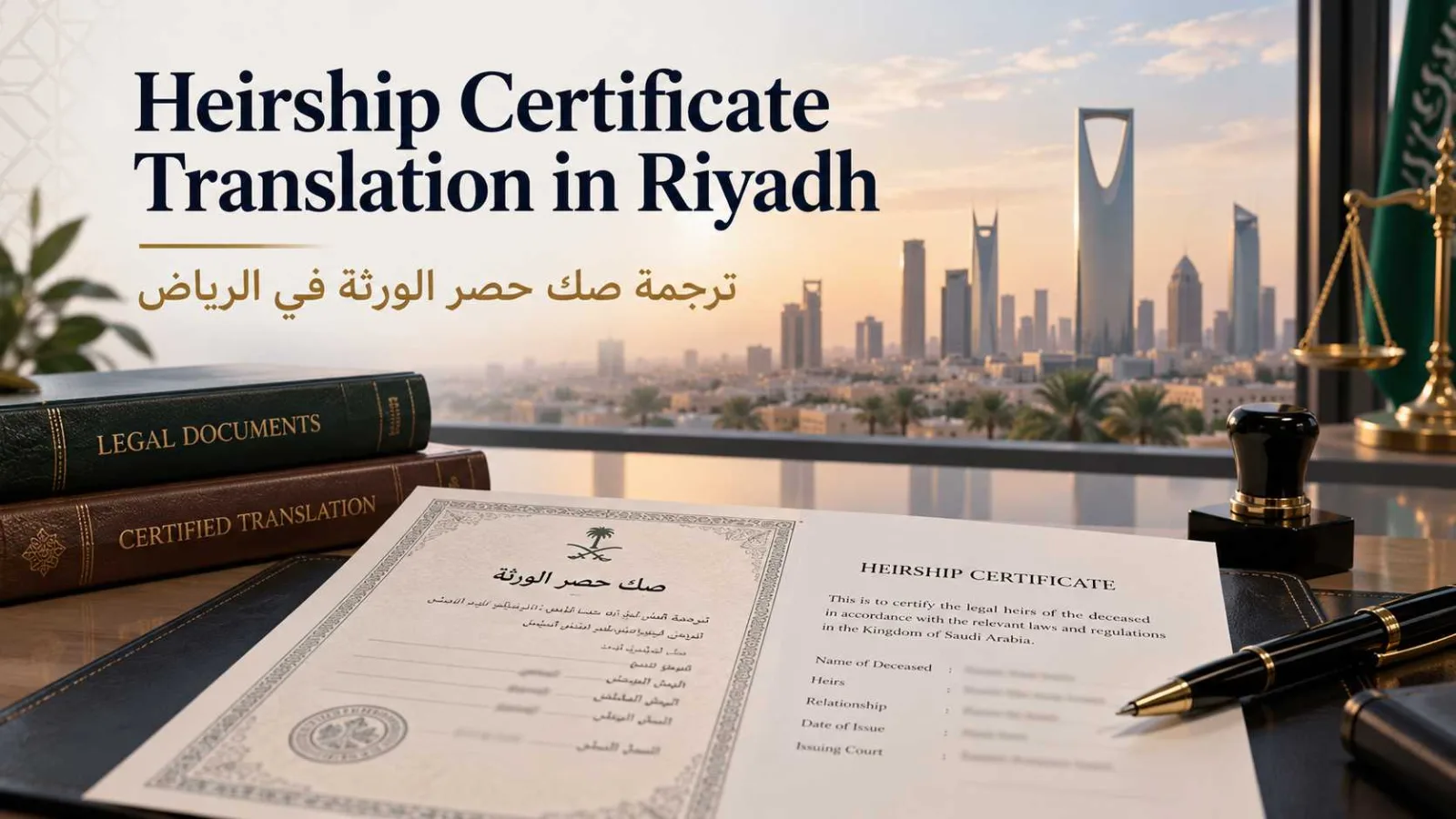
Need heirship certificate translation in Riyadh? Learn how to translate Saudi inheritance documents, verify heirs' names, review deed numbers, prepare certified Arabic–English translations and check embassy, court and attestation requirements.
Heirship Certificate Translation in Riyadh: Complete Guide
An heirship certificate is an important legal document used to identify the heirs of a deceased person. When inheritance matters involve different countries, languages or receiving authorities, an accurate translation may be required.
Heirship certificate translation in Riyadh requires careful review of the deceased person's identity, the names of heirs, family relationships, document references and legal terminology.
Lexicology Translation Bureau (LTB) provides Arabic–English legal translation services in Riyadh, helping clients prepare inheritance-related documents for submission to courts, banks, embassies and other organizations.
This guide explains how to prepare a Saudi heirship certificate for translation, which information must be checked and how to avoid common documentation errors.
1. What Is a Heirship Certificate?
A legal heirship certificate, commonly associated with صك حصر الورثة or وثيقة حصر الورثة in Saudi Arabia, is an official document identifying the legal heirs of a deceased person.
The exact terminology and document details may depend on its issuing date and the procedure under which it was issued.
Saudi Arabia's Ministry of Justice provides an electronic Legal Heirship Certificate service through the Merath Estates platform. It also provides services relating to older heirs determination deeds.
An heirship certificate may contain:
- The deceased person's full name.
- National identification or residence details.
- Date of death and other identifying information.
- Names and identification details of the heirs.
- Family relationships to the deceased.
- Legal capacity or status of parties where stated.
- Inheritance shares where included.
- Certificate or deed number.
- Issuing authority and issuance date.
- Electronic verification details, where available.
A translation must preserve the information recorded in the original document without adding legal conclusions.
2. When Is Heirship Certificate Translation Required?
A certified translation of an inheritance certificate may be requested when a document is being presented to an authority that does not accept the language of the original.
Common situations include:
International Inheritance Procedures
A Saudi heirship document may need translation into English or another language when inheritance proceedings involve assets or family members outside Saudi Arabia.
Embassy and Consular Submissions
An embassy or consulate may request translated documents to establish family relationships, identify heirs or process an inheritance-related application.
Banking and Financial Matters
A bank or financial institution may request evidence identifying the legal heirs when handling an estate-related matter. The required documents depend on the institution and procedure.
Property and Estate Matters
Translated heirship documentation may be relevant when dealing with property ownership, estate records or inheritance procedures in another jurisdiction.
Court and Legal Proceedings
An inheritance certificate issued in one country may need translation before it can be considered by a court or another legal authority elsewhere.
Important: Translation requirements are determined by the receiving authority. Not every inheritance procedure requires translation.
3. Documents Needed Before Translation
Before requesting inheritance certificate translation in Riyadh, prepare a clear and complete document package.
Depending on the purpose, useful documents may include:
- The complete issued heirship certificate or heirs determination deed.
- Every page and attachment forming part of the certificate.
- A clear PDF or readable scanned copy.
- The deceased person's identity information, when needed for verification.
- Passport or national identification references for heirs whose names must match another document.
- A death certificate if relevant to the submission.
- A power of attorney if the application is being handled by a representative.
- The receiving authority's translation or certification instructions.
The translation office may not need every supporting document for every request.
If the source is an electronic document, the complete issued version is generally preferable to a cropped screenshot.
4. Information That Must Be Reviewed Carefully
Inheritance documents often include several names, family relationships and official reference numbers. Even a small transcription error may create inconsistencies across an estate file.
Names of the Deceased and Heirs
Names should be checked against available identity references, particularly when translating Arabic names into English.
Review the spelling of every heir's name and avoid unnecessary differences between the translation and passports or other official records.
Family Relationships
Legal and family terms such as son, daughter, spouse, father, mother and other relationships must be translated according to the source document.
The translator must not assume a relationship that is not expressly recorded.
Certificate Numbers and Dates
Carefully check:
- Heirship deed or certificate number.
- Issue date.
- Date of death.
- Hijri and Gregorian dates.
- Identity and reference numbers.
- Electronic transaction or verification numbers.
- Page references.
If a document contains Hijri dates, their calendar identity should remain clear. Any requested Gregorian equivalent should be verified and identified appropriately.
Legal Shares and Entitlements
Where the source document includes inheritance shares or legal entitlements, these must be reproduced accurately.
A translator does not independently calculate inheritance shares, establish who qualifies as an heir or change the legal meaning of the certificate.
5. Saudi Electronic Heirship Documents: Merath and Najiz
Saudi Arabia provides official digital services for inheritance-related documents.
The Ministry of Justice's Legal Heirship Certificate service describes the electronic issuance of documents containing information about the deceased and the heirs.
The Merath Estates platform is used for the relevant certificate issuance process.
Separate Ministry of Justice services are available for certain older heirs determination deeds, including digitization and verification procedures associated with Najiz.
Before sending a document for translation:
- Confirm that it is the final issued document.
- Check whether it has been replaced or updated.
- Include the full document, not only a preview.
- Keep the available electronic verification details readable.
- Review names and reference numbers against the source.
Translation and electronic verification are different procedures. A translated document does not replace verification of the original certificate.
6. Arabic–English Legal Terminology
Inheritance certificate translation requires consistent legal terminology.
Examples include:
| Arabic term | Common English equivalent |
|---|---|
| صك حصر الورثة | Heirs Determination Deed |
| وثيقة حصر الورثة | Heirship Certificate |
| المتوفى | Deceased |
| الورثة | Heirs |
| التركة | Estate |
| نصيب الإرث | Inheritance Share |
| الوكيل | Authorized Agent |
| رقم الصك | Deed Number |
| تاريخ الإصدار | Issue Date |
These are general translation equivalents. The final wording must follow the meaning and context of the actual document.
Different jurisdictions may use terms such as legal heirship certificate, certificate of inheritance or heirs determination deed. These terms should not automatically be treated as legally identical.
7. Certified Translation, Authentication and Attestation
Certified translation, original-document verification and government attestation serve different purposes.
A certified translation communicates the document's contents in another language and may include the translation office's certification statement and stamp.
However, certification of a translation does not automatically:
- Authenticate the underlying original.
- Establish inheritance rights.
- Confirm the current legal validity of a deed.
- Replace electronic verification.
- Complete Ministry of Foreign Affairs attestation.
- Guarantee acceptance by an embassy or court.
Depending on the destination, additional document authentication or legalization may be required.
Applicants should confirm whether the receiving authority requires authentication of the original, certification of the translation, or both.
8. Common Mistakes in Inheritance Document Translation
Avoid these frequent problems:
Inconsistent names: An heir's English name differs from the spelling used in their passport.
Missing pages: The source contains additional heirs or legal information that is omitted from the submitted copy.
Incorrect dates: A Hijri date is mistaken for a Gregorian date, or a date is converted incorrectly.
Missing reference numbers: The certificate number or electronic verification information is not reproduced correctly.
Incorrect family terminology: A family relationship is translated imprecisely.
Outdated documents: An older document is translated without checking whether the receiving authority requires a later version.
Unverified submission requirements: Translation is completed before the requested language or attestation procedure is confirmed.
9. How LTB Prepares Inheritance Document Translations
Lexicology Translation Bureau follows a document-focused legal translation process.
Step 1: Review the Source
The document is reviewed for completeness, readability, issuing information and the required language pair.
Step 2: Confirm the Intended Use
The client identifies whether the translation is for a court, embassy, bank, estate proceeding or another purpose.
Step 3: Check Personal Information
Names, identity numbers and other details are reviewed against the original and any references supplied by the client.
Step 4: Translate Legal Terminology
The translator preserves family relationships, legal terminology, dates, shares and document references as recorded.
Step 5: Review and Format
The translation is checked for accuracy, consistency, missing information and readability before delivery.
Step 6: Certification and Delivery
The translation is prepared in the agreed format. Any additional attestation or legalization is handled separately according to the service requested.
10. Related Documents That May Need Translation
An inheritance case may involve several supporting records.
For example, applicants may also need a death certificate translation, particularly where the death was registered in another country.
If an heir has appointed a representative, our power of attorney translation guide explains how legal authorization and identity details are reviewed.
Inheritance involving real estate may also require careful examination of property records. Read our title deed translation guide.
Each document serves a different purpose and must be translated according to its own content.
11. Final Checklist Before Submission
Before submitting a translated heirship certificate, confirm:
- The original document is complete and readable.
- All heirs' names are translated accurately.
- Identity numbers match the source.
- Family relationships are correctly described.
- All relevant dates are preserved.
- Certificate numbers are accurate.
- Any legal shares are reproduced without alteration.
- The required language is confirmed.
- The receiving authority accepts the requested certification format.
- Any necessary attestation or verification has been addressed.
- The required printed or electronic delivery format is confirmed.
12. Frequently Asked Questions
Can I translate a Saudi heirship certificate into English?
Yes. An Arabic heirship certificate can be translated into English. The receiving authority should confirm whether a certified translation is required and whether additional authentication is necessary.
Is a death certificate the same as a heirship certificate?
No. A death certificate records the death of an individual, while an heirship certificate identifies legal heirs. Both documents may be requested in certain inheritance procedures.
Does certified translation replace MOFA attestation?
No. Translation certification and Ministry of Foreign Affairs document attestation are separate processes. The receiving authority determines which procedures are necessary.
How long does inheritance certificate translation take in Riyadh?
The delivery time depends on the document's length, readability, legal terminology, language pair and review requirements. LTB can confirm a quotation and delivery time after reviewing the document.
13. Request Certified Heirship Certificate Translation in Riyadh
If you need heirship certificate translation in Riyadh, Lexicology Translation Bureau provides Arabic–English legal translation services for official documents and inheritance-related records.
Our office is located in As Sulimaniyah, Riyadh, Saudi Arabia.
Send a clear copy of your document, specify the required language and explain where the translation will be submitted.
Contact Lexicology Translation Bureau (LTB)
- Website: https://ltbtranslation.com
- Online quotation: https://ltbtranslation.com/quote
- Phone/WhatsApp: 0559548756
For other legal documents, visit our legal translation services in Riyadh page.
Accurate inheritance documentation begins with careful review of names, dates, family relationships and the complete original record.
Official sources for current requirements
Receiving-organization requirements can change. Check the relevant official source before submitting a document.
Frequently Asked Questions
Can I translate a Saudi heirship certificate into English?
Yes. An Arabic heirship certificate can be translated into English. The receiving authority should confirm whether a certified translation is required and whether additional authentication is necessary.
Is a death certificate the same as a heirship certificate?
No. A death certificate records the death of an individual, while an heirship certificate identifies legal heirs. Both documents may be requested in certain inheritance procedures
Does certified translation replace MOFA attestation?
No. Translation certification and Ministry of Foreign Affairs document attestation are separate processes. The receiving authority determines which procedures are necessary.