How to Get a Professional Job in Saudi Arabia: 10 Careers, Document Translation and Attestation Guide
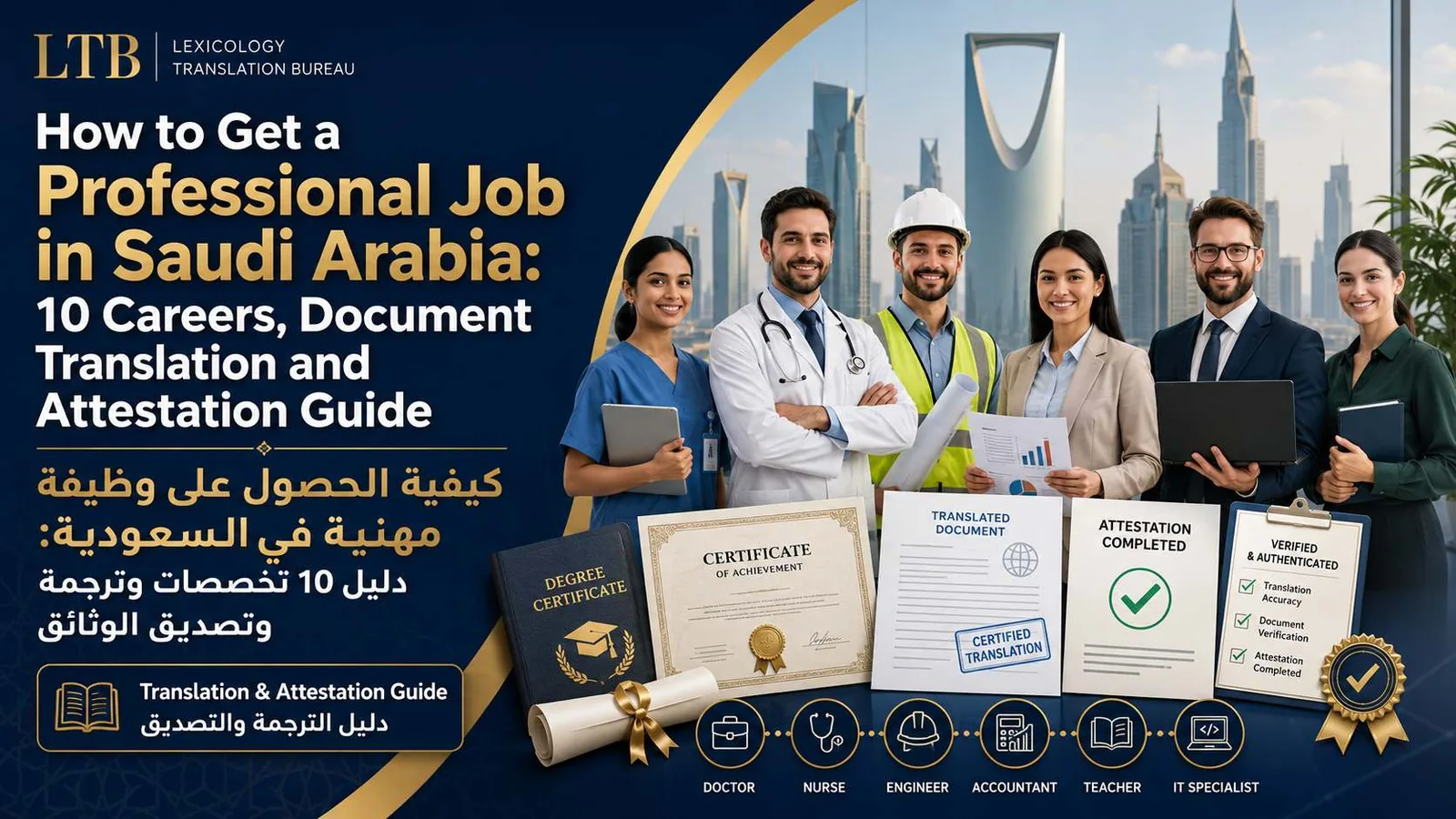
A complete guide for foreign doctors, nurses, engineers, accountants, teachers, IT specialists and other professionals seeking employment in Saudi Arabia, including job-search steps, professional licensing, required documents, certified translation, qualification verification and certificate attestation.
Saudi Arabia attracts doctors, engineers, nurses, pharmacists, teachers, accountants, IT specialists, technicians and other qualified professionals from around the world. However, getting a professional job in the Kingdom usually requires more than submitting a CV or attending an interview.
Depending on the occupation, a foreign applicant may need to verify academic qualifications, obtain professional classification, register with a Saudi professional authority, pass an examination, translate certificates, complete document attestation and receive an official employment offer from an eligible Saudi employer.
This guide explains how to get a professional job in Saudi Arabia and how applicants in ten different professional fields can prepare their qualifications, experience certificates, certified translations and attested documents.
Requirements can vary according to the applicant’s nationality, profession, country of qualification, employer and receiving authority. Applicants should obtain an updated checklist from the relevant authority before paying for translation, verification, licensing or attestation.
Can Foreign Professionals Work in Saudi Arabia?
Foreign professionals can work in Saudi Arabia when they meet the immigration, employment and professional requirements applicable to their occupation.
A non-Saudi worker normally needs:
- A genuine Saudi employer
- A written employment offer or contract
- A job title that matches the actual occupation
- An appropriate employment visa or legal employment status
- A valid work permit
- A valid residency permit after completing the required process
- Professional classification or registration when required
A visit visa is not a substitute for a work permit. Applicants should not begin working before the Saudi employer has completed the proper legal procedures.
The employer normally manages the official recruitment, work permit and residency process. Applicants should be cautious when an unknown recruiter requests a large payment for a guaranteed work visa, work permit or residency card.
First Step: Confirm the Correct Profession
Before applying, identify the exact professional title that matches your education and experience.
For example, a medical graduate may be classified as a general practitioner, resident, specialist or consultant depending on recognised qualifications and experience. An engineer may need a professional category that corresponds to the degree specialisation. A technician should be recruited under a job title that reflects the worker’s actual technical skill.
Using a job title that does not match the academic qualification or actual work may create problems during professional verification, licensing, visa processing or a future profession-change request.
Applicants should also check whether the profession is affected by current localisation requirements. Some occupations are restricted or subject to minimum percentages of Saudi employees within the establishment.
How to Prepare a Professional CV for Saudi Employers
A Saudi-focused CV should be clear, factual and relevant to the intended position.
Include:
- Full name exactly as shown in the passport
- Nationality and current country of residence
- Professional title and specialisation
- Academic qualifications
- Professional licences and registrations
- Work experience with accurate start and end dates
- Main responsibilities and achievements
- Technical and language skills
- Relevant certifications
- Availability or notice period
- Professional contact information
Doctors, nurses, engineers, accountants and other licensed professionals should mention their current professional registration status.
Do not include a qualification, licence or employment history that cannot be verified. Professional-verification procedures may involve checking information with universities, licensing bodies or former employers.
Documents Commonly Required for Saudi Professional Jobs
The exact file differs by profession, but foreign applicants may be asked to prepare:
- Valid passport
- Passport-size photograph
- Degree or diploma certificate
- Complete academic transcript
- Internship or practical-training certificate
- Professional licence from the applicant’s country
- Professional registration certificate
- Good-standing certificate
- Employment and experience certificates
- Training certificates
- Updated CV
- Police clearance certificate when requested
- Medical examination documents
- Job offer or employment contract
- Birth, marriage or name-change documents when relevant
Not every applicant needs every document. Healthcare professionals usually require more licensing, clinical-training and professional-status evidence than many general corporate professionals.
All documents should be scanned clearly and completely. Do not remove the reverse side of a certificate, university stamp, verification code, handwritten note or attached page.
Professional Verification in Saudi Arabia
Saudi professional-verification programmes aim to confirm that foreign workers possess the qualifications, experience or skills required for the occupations for which they are being recruited.
Depending on the occupation, the process may involve:
- Verification of a university or technical qualification
- Confirmation of the qualification level
- Confirmation that the field of study matches the occupation
- Verification of employment experience
- Review of professional registration
- A theoretical examination
- A practical skills assessment
Applicants should use only official platforms or service providers identified by the employer or Saudi authority. They should not send original documents or payments to an unknown person claiming to provide guaranteed verification.
How to Find a Professional Job in Saudi Arabia
Applicants can search through several reliable channels.
Apply Directly to Employers
Check the official career pages of:
- Hospitals and medical groups
- Engineering and construction companies
- Universities and schools
- Banks and accounting firms
- Technology companies
- Industrial and manufacturing companies
- Logistics and supply-chain companies
- Government contractors
- Large retail and hospitality groups
Submitting an application through the employer’s official website is safer than relying entirely on an unknown social-media account.
Use Professional Recruitment Platforms
Keep the CV and professional profile updated. Use the same spelling for the applicant’s name, degree, employer names and job titles across the CV and supporting documents.
Work With Licensed Recruitment Agencies
Confirm the agency’s legal identity and verify the employer before paying or sending personal documents.
Use Professional Referrals
A referral from a verified employee can help an applicant reach the correct recruitment team, but it does not replace professional licensing, interviews or official employment procedures.
Ten Professional Fields and Their Main Requirements
1. Doctors
Doctors usually need professional classification and registration through the Saudi Commission for Health Specialties.
The classification process determines the appropriate professional level based on the practitioner’s qualifications, recognised experience and assessment requirements.
A doctor may need:
- Medical degree
- Academic transcript
- Internship certificate
- Postgraduate or specialty qualification
- Medical registration or licence from the previous country
- Good-standing certificate
- Experience certificates
- Verification of qualifications
- Professional examination result when required
- Passport and personal photograph
The applicant should determine whether the intended category is general practitioner, resident, specialist or consultant.
Doctors can begin certain classification procedures from outside Saudi Arabia through the applicable official system. Professional registration must be completed before beginning professional practice when required.
Translation Requirements for Doctors
Medical degrees, internship certificates, specialisation certificates, medical licences, good-standing certificates and experience letters may require certified translation.
The translation should accurately show:
- Practitioner’s full name
- Qualification title
- Specialisation
- University or medical institution
- Graduation date
- Internship dates
- Licence number
- Registration status
- Experience period
Medical terminology and professional categories should be translated consistently throughout the file.
2. Nurses and Allied Health Professionals
Nurses and allied health professionals may also need classification and registration through the Saudi Commission for Health Specialties.
This group can include:
- Registered nurses
- Midwives
- Laboratory specialists
- Radiology professionals
- Physiotherapists
- Respiratory therapists
- Clinical nutrition professionals
- Dental assistants
- Other recognised health practitioners
The required file may include:
- Degree or diploma
- Academic transcript
- Clinical-training record
- Internship certificate
- Professional licence
- Good-standing certificate
- Experience certificates
- Qualification-verification result
- Professional examination result when applicable
The job title should correspond to the recognised qualification and professional category.
Translation Requirements for Nurses
The translation should preserve the exact qualification level, clinical field, training dates and scope of professional experience.
For example, a general nursing diploma should not be translated in a way that incorrectly presents it as a bachelor’s degree or specialist nursing qualification.
3. Pharmacists
Pharmacists normally need health-profession classification and registration before practising in Saudi Arabia.
Applicants may be asked to provide:
- Pharmacy degree
- Complete transcript
- Internship or practical-training certificate
- Professional registration
- Pharmacy licence
- Good-standing certificate
- Employment certificates
- Postgraduate clinical pharmacy qualification when applicable
- Verification and examination results
The degree title should be translated precisely. Bachelor of Pharmacy, Doctor of Pharmacy and postgraduate clinical pharmacy qualifications should not be treated as identical qualifications.
4. Engineers
Foreign engineers commonly need professional accreditation or membership with the Saudi Council of Engineers.
The relevant category may depend on:
- Recognised academic qualification
- Engineering specialisation
- Duration and level of study
- Professional experience
- Intended Saudi occupation
- Required professional assessment
Documents may include:
- Engineering degree
- Complete academic transcript
- Graduation certificate
- Passport
- Experience certificates
- Previous professional membership
- Engineering licence
- Professional examination or certification documents
A civil engineer, electrical engineer, mechanical engineer or chemical engineer should ensure that the intended occupation matches the recognised academic specialisation.
Translation Requirements for Engineers
Engineering translations should use accurate terminology for:
- Degree specialisation
- Technical subjects
- Project responsibilities
- Construction or design work
- Equipment and systems
- Professional grade
- Employment position
A generic or incorrect translation of the engineering specialisation can create unnecessary questions during accreditation.
5. Architects and Architectural Professionals
Architects and architectural technologists may fall within professional accreditation categories administered by the Saudi Council of Engineers.
Applicants may need:
- Architecture degree
- Academic transcript
- Design or technical qualifications
- Experience certificates
- Professional registration
- Passport and identification documents
A portfolio can help demonstrate design ability, but it does not replace the official qualification, transcript and professional-accreditation documents.
Architectural terminology, project titles, planning terms and building-related responsibilities should be translated by a translator familiar with technical language.
6. Accountants and Auditors
Foreign accountants may need professional registration, qualification verification or employer-specific approval depending on the job title.
Applicants may prepare:
- Accounting degree or diploma
- Academic transcript
- Professional membership certificate
- Experience certificates
- Audit or accounting qualifications
- ACCA, CPA, CMA or similar certificates when relevant
- Passport
- Verification documents
Applicants should also check current localisation requirements affecting accounting occupations. A company’s ability to appoint a foreign accountant may depend on the establishment’s size, existing workforce and applicable localisation percentage.
A foreign employee working as an accountant is different from a person applying for an independent regulated licence to provide public accounting or audit services. Separate professional and legal requirements may apply.
Translation Requirements for Accountants
Translations should accurately identify:
- Degree level
- Accounting specialisation
- Professional membership
- Audit experience
- Financial-reporting responsibilities
- Employment dates
- Professional certificate status
7. Teachers and University Lecturers
Foreign teachers can apply to licensed schools, colleges, universities and training institutions.
The employer may request:
- Education degree or subject-specialist degree
- Academic transcript
- Teaching qualification
- Teacher licence from the applicant’s country
- Employment certificates
- Reference letters
- Police clearance when required
- Research publications for university positions
- Master’s or doctoral qualifications for academic roles
Requirements differ between international schools, private schools, colleges and universities. The applicant should obtain the institution’s official document list.
The translation of an academic qualification should not alter the degree level, field of study or teaching specialisation.
8. Information Technology and Cybersecurity Professionals
This category includes:
- Software developers
- Web developers
- Database administrators
- Cloud engineers
- Network engineers
- Data analysts
- Cybersecurity specialists
- IT support professionals
- Systems administrators
- Artificial intelligence specialists
Not every IT role requires registration with one universal professional authority. However, the employer or verification process may still review the degree, experience and relationship between the qualification and the intended occupation.
Applicants should prepare:
- Computer science or IT degree
- Transcript
- Employment certificates
- Technical certifications
- Project portfolio
- Professional profile
- GitHub profile when relevant
- Cloud, networking, database or security certifications
A portfolio can help secure an interview, but it does not replace official visa, qualification or employment procedures.
9. Skilled Technicians
Technical occupations may include:
- Electrical technicians
- Mechanical technicians
- Refrigeration and air-conditioning technicians
- Automotive technicians
- Welding technicians
- Industrial-maintenance technicians
- Electronics technicians
- Machine operators
- Plumbing technicians
- Construction technicians
Some occupations may be subject to practical and theoretical skills assessment.
Applicants should prepare:
- Technical diploma
- Trade certificate
- Training certificate
- Experience letters
- Safety qualifications
- Equipment-specific certificates
- Skills-assessment results when required
The intended occupation should reflect the worker’s real technical ability. An unrelated or inaccurate occupation can cause problems during verification or work-permit processing.
10. Project Managers, Business Analysts and Operations Professionals
This category includes:
- Project managers
- Business analysts
- Operations managers
- Supply-chain specialists
- Procurement professionals
- Quality managers
- Logistics professionals
- Human-resources specialists
- Sales and business-development professionals
There may not be one universal licence for every corporate role. However, the employer may verify the applicant’s qualification and experience.
Professional certificates such as PMP, PRINCE2, supply-chain qualifications or quality-management certifications can support the application but do not replace a work visa, employment contract or qualification verification.
Experience certificates should clearly show:
- Job title
- Employer name
- Start and end dates
- Main responsibilities
- Full-time or part-time status when relevant
- Issuing department
- Signature or verifiable company details
Which Documents Should Be Translated?
Certified translation may be requested when a document is issued in a language that is not accepted by the employer, professional authority, embassy or government department handling the procedure.
Common documents include:
- Academic certificates
- Diplomas
- Academic transcripts
- Professional licences
- Professional registration certificates
- Good-standing certificates
- Internship certificates
- Training certificates
- Employment and experience letters
- Police clearance certificates
- Birth certificates
- Marriage certificates
- Name-change documents
- Medical reports
- Employment contracts
An applicant should translate the complete document, including relevant stamps, seals, signatures, handwritten information, back pages and attached authentication certificates.
For more information, applicants can review an academic certificate translation checklist before submitting degrees and transcripts.
How to Check Names and Dates Before Translation
The applicant’s English name should normally follow the passport spelling.
Before translation, compare:
- Passport name
- Degree-certificate name
- Academic-transcript name
- Professional-licence name
- Experience-certificate name
- Date of birth
- Graduation date
- Employment dates
When two documents contain different spellings, do not ask the translator to hide the difference. Provide the passport and any official document explaining the variation.
An unexplained name difference can delay professional verification or document acceptance.
Translation and Attestation Are Different
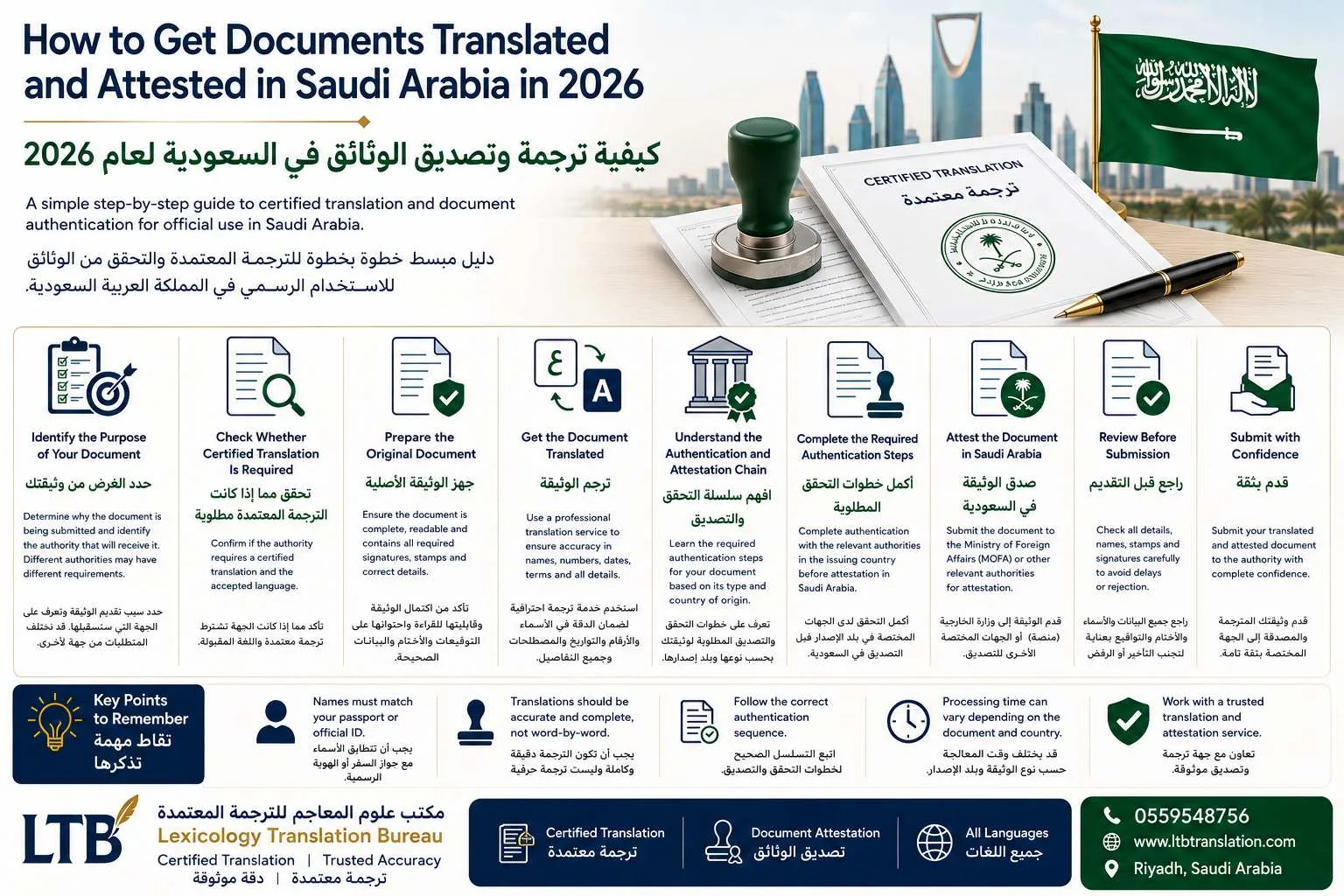
Certified translation and document attestation are not the same procedure.
Certified translation presents the document accurately in another language.
Attestation, legalisation or Apostille procedures confirm the authenticity of a public document, signature, seal or issuing authority according to the applicable process.
A translated document does not automatically become attested. Similarly, an attested foreign-language document may still require certified translation.
Should the Document Be Attested Before Translation?
A practical sequence is often:
- Ask the receiving authority for its current checklist.
- Confirm whether the original document requires verification.
- Confirm whether an Apostille or consular legalisation is accepted.
- Complete the required authentication.
- Translate the document with all final stamps and certificates.
- Submit the original or authenticated copy with the certified translation.
Completing attestation first can prevent the applicant from having to order another translation after a new stamp or Apostille is added.
However, some authorities or embassies may require a different order. Applicants should not assume that one sequence applies to every country or procedure.
Where Are Foreign Certificates Attested?
Depending on the country and type of document, the traditional route may involve:
- Verification by the university or issuing institution
- Authentication by an education authority
- Authentication by the foreign ministry or competent authority in the issuing country
- Saudi embassy or consulate legalisation when applicable
- Saudi Ministry of Foreign Affairs ratification when required
An Apostille may replace parts of the traditional consular process when it is legally applicable between the issuing country and Saudi Arabia and the document is eligible.
Professional verification, licensing and employer requirements may still apply even when a document carries an Apostille.
Applicants should never rely on a general social-media checklist without confirming the requirements for their particular country, profession and document.
Degree Equivalency and Professional Licensing
Degree equivalency, professional classification and document attestation are separate processes.
Degree certificate equivalency in Saudi Arabia concerns the recognition or assessment of an academic qualification for a particular official purpose.
Professional classification determines the professional level or category in regulated fields such as healthcare.
Professional accreditation may apply to engineering and other regulated occupations.
Document attestation confirms the authenticity of a document through the applicable authentication process.
An applicant may need one, several or none of these processes depending on the job and receiving authority.
Reviewing the Employment Contract
Before accepting a Saudi job, review:
- Employer’s legal name
- Job title
- Workplace and city
- Basic salary
- Allowances
- Working hours
- Weekly rest
- Probation period
- Contract duration
- Medical insurance
- Accommodation or housing allowance
- Transport or transport allowance
- Annual leave
- Air ticket terms
- Notice and termination clauses
- Professional-licence responsibilities
When the contract is issued in an unfamiliar language, employment contract translation can help the applicant understand the salary, job title, benefits and legal clauses before signing.
Translation helps the applicant understand the document but does not replace independent legal advice when a dispute or complex contractual issue exists.
Common Reasons for Delay or Rejection
Applications may be delayed because of:
- Different name spellings
- Missing transcript pages
- Unclear scans
- Untranslated stamps
- Missing internship evidence
- Expired professional licences
- Unverifiable experience certificates
- Incorrect job title
- Qualification not matching the occupation
- Incomplete attestation
- Translation completed before final stamps were added
- False documents
- Applications submitted through unauthorised agents
Keep high-quality colour scans of every document and preserve the original copies.
How to Avoid Fake Job Offers
A logo, stamp or professional-looking PDF does not prove that a job offer is genuine.
Before accepting:
- Check the employer’s official website.
- Contact the employer through verified contact details.
- Confirm the recruiter’s company email address.
- Request the complete employment contract.
- Verify the workplace and job title.
- Do not pay an unknown person for a guaranteed visa.
- Do not send original certificates through an unverified courier.
- Do not provide account passwords or one-time verification codes.
- Keep copies of all messages and payment requests.
- Do not submit altered or false documents.
The Saudi employer normally completes the official employment procedures through the relevant systems.
How Lexicology Translation Bureau Can Help
Lexicology Translation Bureau (LTB) Office provides certified translation services in Riyadh for professional employment, licensing, qualification verification and document-submission files.
Documents we can translate include:
- University degrees
- Academic transcripts
- Medical and professional licences
- Internship and training certificates
- Good-standing certificates
- Experience letters
- Professional-membership certificates
- Police clearance certificates
- Employment contracts
- Personal-status documents
Our review focuses on:
- Passport-consistent name spelling
- Accurate qualification titles
- Correct dates
- Complete translation of stamps and seals
- Consistent professional terminology
- Clear formatting
- Review of all submitted pages
Translation does not guarantee employment, professional classification, a work visa, attestation or acceptance by an authority. The final decision belongs to the employer, embassy, professional authority or government department receiving the documents.
Final Checklist
Before applying for or travelling to a professional job in Saudi Arabia:
- Confirm the correct job title.
- Check whether the profession is open to foreign applicants.
- Verify the employer.
- Obtain a written employment offer.
- Review the professional authority’s current requirements.
- Prepare complete qualifications and experience documents.
- Complete professional verification when required.
- Confirm whether attestation or an Apostille is required.
- Translate the complete document when requested.
- Ensure all names match the passport.
- Review the employment contract before signing.
- Keep copies of every submitted document.
Careful preparation can reduce delays and help a qualified professional submit a complete, consistent and verifiable employment file for a Saudi job.
Official sources for current requirements
Receiving-organization requirements can change. Check the relevant official source before submitting a document.
- Saudi Ministry of Human Resources: Employment of Non-Saudis
- Saudi Ministry of Human Resources: Professional Verification Service
- Saudi Commission for Health Specialties: Professional Classification Requirements
- Saudi Council of Engineers: Professional Accreditation
- Saudi Ministry of Foreign Affairs: Document Ratification Service
Frequently Asked Questions
Can a foreign professional work in Saudi Arabia without a Saudi employer?
A foreign professional normally needs a genuine employment offer and a Saudi employer that completes the required contract, visa, work permit and residency procedures. A visit visa does not authorize a person to begin regular employment.
Which documents usually need certified translation for a Saudi job?
Depending on the profession and receiving authority, documents may include degree certificates, academic transcripts, professional licences, experience certificates, internship records, good-standing certificates, police clearances and employment contracts.
Should I attest my certificate before translating it?
In many cases, completing the required attestation first allows the translation to include every final stamp and authentication. However, the correct order varies, so the applicant should obtain instructions from the employer, embassy or professional authority before beginning.
Does certified translation guarantee acceptance of my documents?
No. Certified translation accurately presents the document in the required language, but the final acceptance decision belongs to the employer, embassy, professional licensing body or government authority receiving the application.