How to Get Documents Translated and Attested in Saudi Arabia in 2026
Need to use a foreign document in Saudi Arabia? This 2026 guide explains how document translation and attestation work, when certified translation may be required, what documents you should prepare, and how to avoid common mistakes before submitting your documents to Saudi authorities.
Using a foreign document in Saudi Arabia can involve several steps. Depending on the type of document, the country where it was issued, and the authority that will receive it, you may need the original document, authentication or Apostille, certified translation, and official attestation.
The exact procedure is not identical for every document. Before starting, identify the purpose of the document and check the latest requirements of the authority that will receive it.
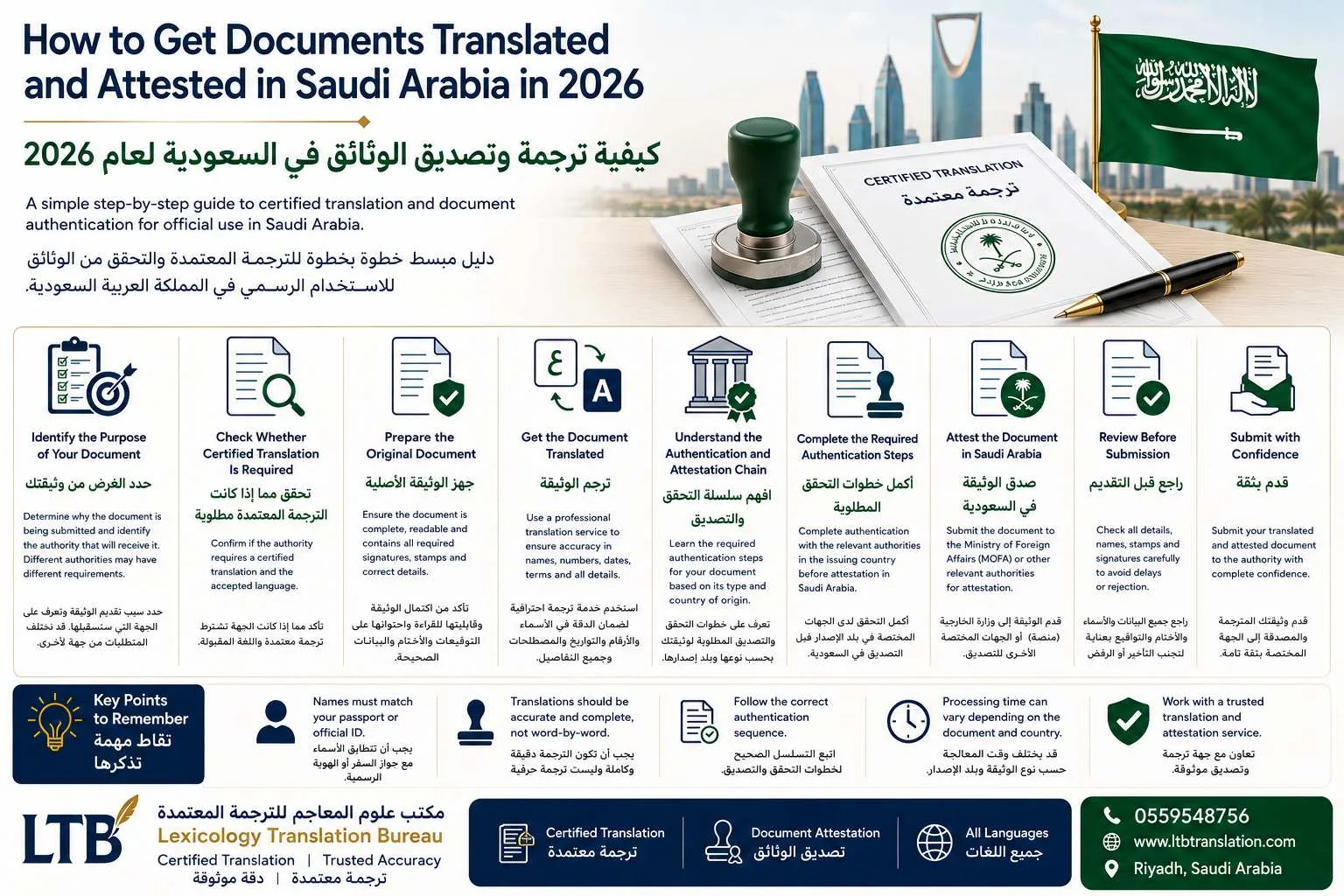
Step 1: Identify Why You Need the Document
First, determine why the document will be submitted.
Documents may be required for:
• Saudi visa applications
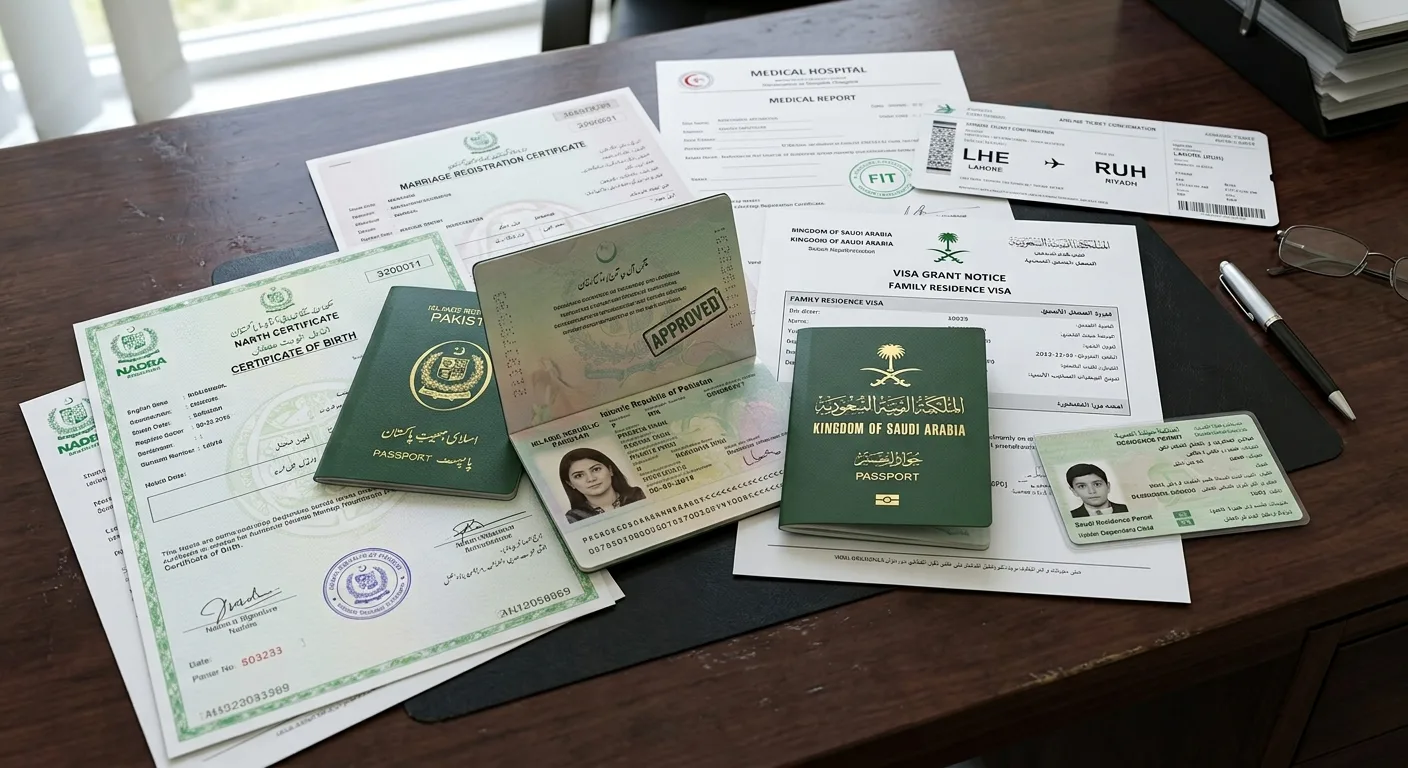
• Family residence or family visit procedures
• Employment
• University admission
• Degree or qualification procedures
• Marriage and personal-status matters
• Court and legal procedures
• Business activities
• Banking and financial procedures
• Government applications
• Embassy or consular procedures
The required documents and procedures can vary depending on the purpose.
Step 2: Check Whether Certified Translation Is Required
Not every document needs translation in every situation.
If the receiving authority requires Arabic, English, or another specific language, the document should be translated into the required language.
For official purposes, the authority may also require a translation from an accepted or certified translation provider.
If you are unsure, check the requirements of the receiving authority before ordering the translation.
Step 3: Prepare the Original Document
Before sending your document for translation or attestation, carefully check the original.
Make sure:
• The document is complete and readable.
• Your name matches your passport or official ID.
• Dates are correct.
• Document numbers are correct.
• Required signatures and stamps are present.
• There are no unexplained alterations or additions.
• The document is not damaged.
• Any required previous authentication has been completed.
Preparing the original correctly can help avoid unnecessary delays.
Step 4: Translate the Document Professionally
A professional translation should accurately reproduce the information contained in the original document.
Important information includes:
• Full names
• Dates of birth
• Passport numbers
• National ID or Iqama numbers
• Certificate numbers
• Registration numbers
• Institution names
• Company names
• Addresses
• Job titles
• Academic qualifications
• Legal terminology
• Commercial information
Names require particular attention. Even a small spelling difference between a translated document and a passport or Iqama can cause problems during official procedures.
Step 5: Understand the Difference Between Translation and Attestation
Translation and attestation are two different processes.
Translation means converting the content of a document from one language into another language accurately.
Attestation or authentication relates to verifying the document, signatures, stamps, or required authentication chain.
For some foreign documents, authentication may need to be completed in the country where the document was issued before it can be used in Saudi Arabia.
A general process may look like this:
Original Document → Authentication in Country of Origin → Appropriate Saudi Authentication Route → Certified Translation When Required → Saudi Authority or MOFA Procedure
This is only a general example. The actual process can vary depending on the document and country.
Step 6: Check Whether Apostille Applies
Apostille procedures may apply to eligible foreign public documents under the applicable international framework.
An Apostille can simplify certain traditional legalization procedures when the document and issuing country meet the relevant requirements.
However, an Apostille does not automatically mean that translation is unnecessary.
Before relying on an Apostille, check:
• Whether the issuing country is covered.
• Whether your document qualifies.
• Whether the Apostille is valid.
• Whether the Saudi receiving authority accepts it.
• Whether an Arabic translation is still required.
Step 7: Submit the Document for Attestation When Required
Saudi Arabia's Ministry of Foreign Affairs provides an electronic document-attestation service.
Applicants should review the latest requirements before submitting their documents.
Depending on the type of document, additional authentication may be required before the document reaches the final Saudi authority.
Some document-processing and delivery procedures may also be available through Saudi Post (SPL).
Step 8: Review the Translation Before Submission
Always compare the translated document with the original before submitting it.
Names
Check that the spelling of names matches the passport, Iqama, ID card, or other official document.
Dates
Check all dates carefully. If both Gregorian and Hijri dates appear, make sure they are represented correctly.
Numbers
Check passport numbers, ID numbers, certificate numbers, registration numbers, financial amounts, and other numerical information.
Stamps and Signatures
Review official stamps, signatures, certification information, and other important elements according to the requirements of the document.
Institution and Company Names
University, hospital, government department, and company names should be translated or transliterated consistently.
Documents Commonly Requiring Translation
Depending on the purpose and receiving authority, documents that may require translation include:
• Birth certificates
• Marriage certificates
• Divorce certificates
• Death certificates
• Academic certificates
• University transcripts
• Experience certificates
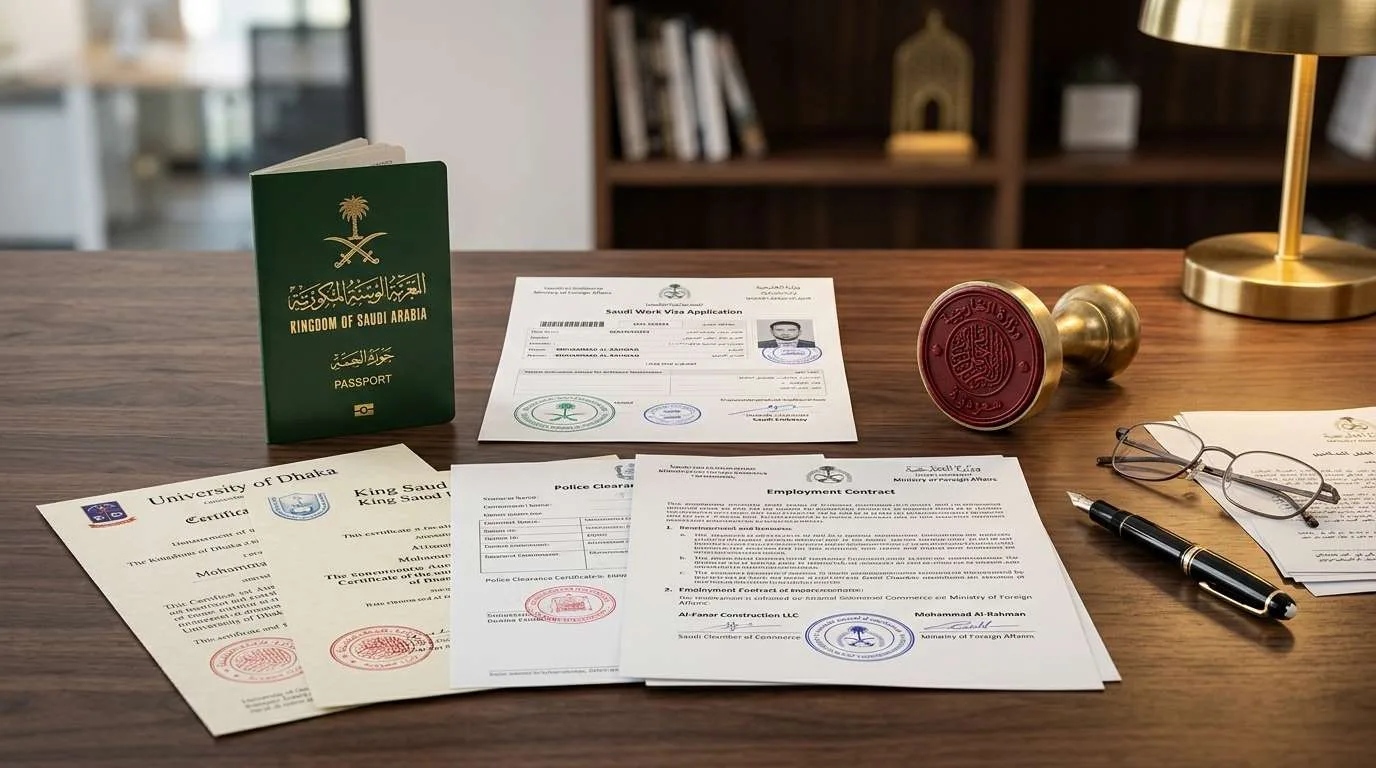
• Employment contracts
• Salary certificates
• Police clearance certificates
• Medical reports
• Bank statements
• Commercial registration documents
• Commercial invoices
• Articles of Association
• Powers of attorney
• Court documents
• Passports and identity documents
The exact requirements depend on the document and its intended use.
Common Mistakes to Avoid
Assuming Every Document Has the Same Procedure
A university certificate, marriage certificate, commercial document, and court document may have different requirements.
Translating Before Checking the Requirements
A translation can be linguistically accurate but still unsuitable if the receiving authority requires a specific format, language, or certification.
Ignoring Name Differences
Different spellings of the same person's name can create unnecessary problems.
Submitting Damaged or Altered Documents
Documents containing unexplained alterations or additions may create problems during official processing.
Confusing Translation with Attestation
A certified translation does not automatically mean that the original document has been officially attested.
Using Outdated Information
Government procedures can change. Always check the latest official requirements before submitting important documents.
How a Professional Translation Office Can Help
A professional translation office can help you prepare documents for official use by:
• Reviewing your document before translation
• Translating the document accurately
• Checking names, dates, and numbers
• Reviewing legal, academic, medical, or commercial terminology
• Preparing the translation professionally
• Identifying obvious inconsistencies before delivery
• Explaining the translation-related part of the process
For important official documents, careful translation and proofreading can help reduce errors and avoid unnecessary delays.
Certified Translation Services in Riyadh
If you need professional document translation in Riyadh, Lexicology Translation Bureau provides translation services for legal, academic, business, medical, and personal documents.
You can submit your document for review and request a quotation before proceeding.
Request a Quote to discuss your document, language pair, and intended use.
Final Checklist Before Submission
Before submitting your documents, check the following:
• The original document is complete and readable.
• Required authentication or Apostille has been completed, where applicable.
• The translation language matches the receiving authority's requirements.
• Names match the passport or official identity document.
• Dates and numbers have been checked.
• Stamps and signatures have been reviewed.
• Translation certification requirements have been checked.
• The latest instructions of the receiving authority have been reviewed.
• Copies of the original and translated documents have been kept.
Conclusion
Getting documents translated and attested in Saudi Arabia in 2026 requires careful preparation.
The correct procedure depends on the document type, country of origin, and authority that will receive the document.
The safest approach is to identify the purpose of the document first, check the current official requirements, prepare the original document correctly, use a suitable certified translation service when required, and complete the applicable authentication or attestation procedures.
If you are unsure about the correct translation or document preparation process, consult a professional translation office before submitting your documents.
.jpg.webp)