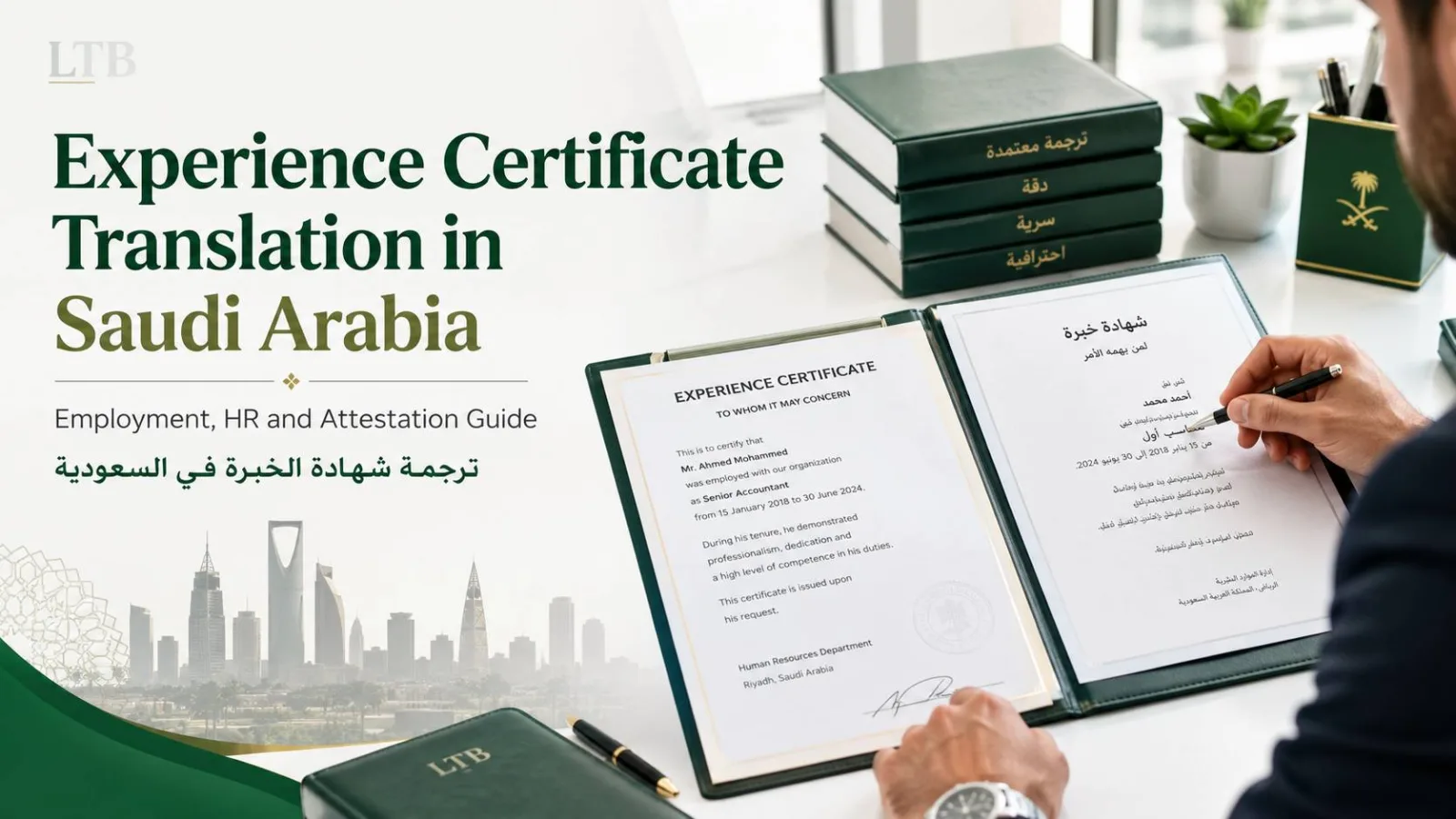
Experience Certificate Translation in Saudi Arabia: Employment, HR and Attestation Guide
A practical guide to experience certificate translation in Saudi Arabia, covering Qiwa service certificates, company-issued letters, job titles, employment dates, duties, salary details, certified translation and attestation checks.
Experience Certificate Translation in Saudi Arabia
An experience certificate records important information about a person’s previous employment. It may be requested by a new employer, recruitment agency, professional licensing authority, embassy, university, bank or government organization.
When the certificate is issued in a language that the receiving organization does not accept, experience certificate translation in Saudi Arabia may be required. The translation must accurately reproduce the employee’s name, employer, job title, employment dates, duties, salary information and other visible statements.
A fluent translation is not enough if a date, name, position or company registration detail is incorrect. The source document and the final translation should therefore be checked field by field before delivery.
Guide Contents
What Is an Experience Certificate?
Experience Certificate, Service Certificate and Salary Certificate
When Is Experience Certificate Translation Required?
Documents to Send for Translation
Important Information That Must Be Checked
Qiwa Experience Certificates and Company-Issued Letters
Arabic-to-English Experience Certificate Translation
English-to-Arabic Experience Certificate Translation
Reviewing Job Titles and Professional Duties
Company Names, Departments and Registration Details
Salary and Employment Benefit Information
Employment Dates and Duration of Service
Signatures, Stamps and Electronic Verification
Certified Translation and Attestation Are Different
Using a Saudi Experience Certificate Abroad
Using a Foreign Experience Certificate in Saudi Arabia
Translation and Review Workflow
Common Problems and Preventable Errors
Frequently Asked Questions
Conclusion
What Is an Experience Certificate?
An experience certificate is a document confirming that an employee worked for a particular employer during a specified period.
Depending on the issuing organization and the purpose of the document, it may include:
• Employee’s full name
• Nationality or identification number
• Employer or establishment name
• Department or branch
• Job title or profession
• Employment commencement date
• Employment termination date
• Total period of employment
• Main duties and responsibilities
• Last salary or compensation information
• Employment status
• Performance statement
• Reason for leaving, when included
• Name and position of the signatory
• Company stamp or electronic verification details
• Issue date and document reference number
The translator should reproduce only the information visible in the source. Missing duties, dates or employment information must not be invented or added to improve the certificate.
Experience Certificate, Service Certificate and Salary Certificate
These documents are related, but they are not always identical.
Experience Certificate
An experience certificate generally confirms previous employment and may describe the employee’s position, work period, duties, skills or performance.
Service Certificate
A service certificate commonly confirms the basic employment relationship, including the employment dates, profession and other official employment details.
Saudi labor regulations address the worker’s right to request a certificate of service at the end of the employment relationship. Saudi employees and residents may also find experience certificate services through the Qiwa platform, depending on their recorded employment information.
Salary Certificate
A salary certificate generally confirms current employment and salary information. It may include the basic salary, allowances, employment date, job title and employer information.
The receiving organization may request one particular document. An experience certificate should not automatically be treated as a salary certificate or an employment contract.
When Is Experience Certificate Translation Required?
Translation may be requested when an experience certificate will be used for:
• Applying for a new job
• Verifying previous employment
• Applying for professional classification or licensing
• Submitting documents to an embassy or consulate
• Immigration or visa procedures
• Overseas employment applications
• University or postgraduate applications
• Professional membership applications
• Government tenders or employee qualification files
• Banking or financial procedures
• Internal company transfer or promotion
• Background screening and compliance checks
The required language depends on the receiving organization. Applicants should confirm whether Arabic, English or another language is required before requesting the translation.
Documents to Send for Translation
The client should normally provide:
• A complete and readable experience certificate
• Every page, attachment and reverse side
• The employee’s passport or official identity reference
• The registered English or Arabic name of the employer, when available
• The employment contract if job titles or dates require comparison
• The target language
• The name of the receiving organization
• Any official submission instructions
• The required delivery date
• Information about certification or printed-copy requirements
A clear PDF is preferable. A mobile photograph may be reviewed when all text, edges, stamps and verification information are visible.
Important Information That Must Be Checked
The review should focus on information that can affect the employee’s application.
Employee Name
The English spelling should normally match the passport or other official identity document. A different spelling can create a mismatch between the experience certificate, CV, employment contract, visa application and professional licence.
Employer Name
The company name should follow a reliable official reference where available. Brand names, legal entity names and translated trading names should not be mixed without verification.
Job Title
The job title should reflect the source accurately. It should not be upgraded, simplified or changed to make the employee appear more qualified.
Employment Dates
The commencement date and end date must be checked carefully. Reversing the day and month or confusing Hijri and Gregorian dates can change the recorded period of experience.
Duties and Responsibilities
Technical duties should be translated consistently and in the correct professional context. Duties should not be added or removed.
Salary Information
Salary figures, currencies, allowances and payment periods must be reproduced accurately when they appear in the certificate.
Reference and Verification Details
Document numbers, QR codes, verification links, stamps, signatures and issue dates should be reviewed and represented appropriately.
Qiwa Experience Certificates and Company-Issued Letters
An applicant may receive employment evidence through Qiwa or directly from a former employer.
A Qiwa experience certificate may contain standardized information connected to employment records on the platform. A company-issued experience letter may contain additional details such as duties, department, project experience, performance or a recommendation statement.
The translator should first identify which type of document was supplied.
A Qiwa-issued document should not be described as a privately written company recommendation letter. Similarly, a company letter should not be presented as a Qiwa certificate unless that is clearly shown in the source.
Electronic certificates may contain QR codes, validation information or digital references. These elements should remain visible and should not be cropped from the translation package.
Arabic-to-English Experience Certificate Translation
Arabic-to-English experience certificate translation often requires careful decisions concerning personal names, company names, job titles and Saudi administrative terminology.
The translator should check:
• Passport spelling of the employee’s name
• Official English name of the employer
• Correct translation of the department
• Profession and job-title terminology
• Hijri and Gregorian dates
• Salary figures and Saudi riyal references
• Company legal form
• Branch or project location
• Government and platform terminology
• Signatory’s title and authority
Arabic job titles can have more than one possible English translation. The selected title should reflect the duties and the original wording without exaggerating the employee’s seniority.
English-to-Arabic Experience Certificate Translation
English-to-Arabic translation may be needed for submission to Saudi employers, government organizations, professional authorities or other Arabic-speaking recipients.
The translation should preserve:
• Employee identity information
• Official company name
• Job title and employment level
• Employment dates
• Duties and responsibilities
• Salary and benefit information
• Reason for issuance
• Recommendation or performance wording
• Signature and certification information
Technical abbreviations should be expanded or translated only when their meaning can be established reliably. An unclear abbreviation should not be guessed.
Reviewing Job Titles and Professional Duties
Job titles are among the most important parts of experience certificate translation.
Examples include:
• Project Manager
• Civil Engineer
• Electrical Technician
• Registered Nurse
• Medical Laboratory Specialist
• Accountant
• Financial Controller
• Human Resources Officer
• Sales Representative
• Software Developer
• Quality Control Inspector
• Administrative Assistant
A title used by one employer may not have exactly the same meaning at another company. The translator should use the source wording, employment context and available reference documents.
Professional duties also require subject knowledge. Medical, engineering, financial, technical and legal responsibilities should be translated using terminology appropriate to the employee’s field.
The translation office does not determine whether the experience qualifies the applicant for a particular profession or licence. That decision belongs to the employer or receiving authority.
Company Names, Departments and Registration Details
A company may use a brand name that differs from its registered legal name.
Before completing the translation, the reviewer may compare the source with:
• Commercial registration information
• Company letterhead
• Employment contract
• Official company website
• Previous approved translation
• Company-issued English documents
The translation should preserve legal forms such as company, establishment, branch, limited liability company or single-person company when they appear in the source.
Department names and project names must also remain consistent throughout the document.
Salary and Employment Benefit Information
Some experience or service certificates include the employee’s last salary. Other letters include allowances, bonuses, accommodation, transportation or total compensation.
The translator should check:
• Salary amount
• Currency
• Monthly or annual payment period
• Basic salary
• Allowances
• Total salary
• Numeric and written amounts
• Decimal points and separators
Confidential salary information should be handled through the translation office’s official communication channels.
The translation should not add salary information from an employment contract when it does not appear in the experience certificate.
Employment Dates and Duration of Service
The employee’s period of service may be important for recruitment, licensing and professional classification.
The reviewer should verify:
• Joining date
• Last working date
• Certificate issue date
• Hijri or Gregorian calendar
• Day, month and year order
• Total years and months of experience
• Any probation or training period
• Periods shown in attached schedules
When the certificate states only the start and end dates, the translation should not add a calculated service duration unless the client or receiving authority specifically requests it and the calculation is clearly identified.
Signatures, Stamps and Electronic Verification
The translation should account for visible authentication elements without claiming that they have been legally verified when they have not.
These may include:
• Company stamp
• Human resources signature
• Manager’s signature
• Chamber of Commerce stamp
• Ministry attestation
• Embassy legalization
• QR code
• Electronic signature
• Verification URL
• Document reference number
A translator can translate visible stamps and annotations. However, translation does not prove that a stamp or signature is genuine.
Certified Translation and Attestation Are Different
Translation, certified translation and document attestation are separate procedures.
Translation
Translation transfers the visible content from the source language into the target language.
Certified Translation
A certified translation is issued with the translation office’s identification and certification details according to the requested service.
Chamber Attestation
Certain company-issued letters or commercial documents may follow a Chamber of Commerce attestation route. Eligibility and procedures depend on the issuing organization, its Chamber status and the receiving authority’s instructions.
MOFA Ratification
The Saudi Ministry of Foreign Affairs provides document ratification services for eligible document categories intended for use across national borders.
Embassy or Consular Legalization
A destination-country embassy or consulate may require further legalization according to that country’s procedures.
Not every experience certificate requires all these stages. The applicant should obtain the current checklist from the receiving organization before paying fees or arranging attestation.
Using a Saudi Experience Certificate Abroad
A Saudi-issued experience certificate may be required abroad for employment, immigration, licensing or study.
The applicant should confirm:
• Required target language
• Whether the original certificate needs company authentication
• Whether Chamber attestation is required
• Whether MOFA ratification is required
• Whether the destination embassy requires legalization
• Whether an Apostille route applies
• Whether the translation should be completed before or after attestation
• Whether a printed certified translation is required
The process can vary by destination country and document type. A procedure used for one country should not automatically be applied to another.
Using a Foreign Experience Certificate in Saudi Arabia
A foreign experience certificate may be submitted in Saudi Arabia for employment, professional licensing, recruitment or qualification review.
Before translation, check:
• Whether the certificate was issued by the employer
• Whether the complete document has been supplied
• Whether foreign authentication is required
• Whether the Saudi embassy in the issuing country is involved
• Whether Saudi MOFA ratification is required after arrival
• Whether Arabic translation is required
• Whether the employer or professional authority requires additional evidence
• Whether duties must be shown in detail
Certified translation does not replace authentication of the original foreign document.
Translation and Review Workflow
A controlled workflow helps reduce corrections.
- Receive the Complete Document
The office checks whether all pages, stamps, signatures and attachments are visible.
- Confirm the Intended Use
The client states the receiving organization, country, language and deadline.
- Check Identity References
The employee’s name is compared with the passport or other official record.
- Establish Company and Job Terminology
Company names, job titles, departments and technical duties are checked against reliable references.
- Complete the Translation
The document is translated in its original order without changing the meaning.
- Perform a Separate Review
Names, dates, numbers, salary details, duties and verification information are checked again.
- Prepare Certification and Delivery
The agreed electronic or printed version is prepared.
- Complete the Client Review
The client checks the name spelling and any organization-specific instructions before submission.
Common Problems and Preventable Errors
Common problems include:
• Sending a cropped screenshot
• Omitting the second page or attachment
• Using a name spelling different from the passport
• Translating the brand name instead of the legal company name
• Changing the employee’s job level
• Confusing the joining date and issue date
• Reversing day and month
• Mixing Hijri and Gregorian dates
• Misreading salary figures
• Omitting duties or project names
• Removing a QR code or verification reference
• Assuming every document needs the same attestation route
• Treating a salary certificate as an experience certificate
• Adding information that does not appear in the source
• Submitting a draft letter instead of the final signed certificate
Sending a complete final document and reliable identity references before translation can prevent most of these problems.
How Lexicology Translation Bureau Can Assist
Lexicology Translation Bureau provides experience certificate translation in Saudi Arabia for employment, HR, embassy, professional, immigration and official-document requirements.
The translation team can:
• Review the document for completeness and readability
• Confirm the required language pair
• Match the employee’s name with an official identity reference
• Review job titles and specialist terminology
• Translate duties, salary details, stamps and annotations
• Check dates, numbers and employment duration
• Prepare a certified translation
• Provide electronic or printed delivery according to the agreed request
The office does not issue experience certificates, change employment records, access private Qiwa accounts or guarantee acceptance by an employer, embassy, licensing authority or government organization.
Final document and attestation requirements are determined by the receiving authority.
Frequently Asked Questions
Can a Qiwa experience certificate be translated?
Yes. A complete and readable Qiwa experience certificate can be reviewed and translated into the language required by the receiving organization. Any QR code, reference number or electronic verification information should remain visible.
Does an experience certificate translation need Chamber attestation?
Not in every case. Chamber attestation may be requested for certain company-issued documents, but the requirement depends on the issuing company, document type, destination and receiving authority.
Which name spelling should be used in the translation?
The employee’s name should normally follow the spelling shown in the passport or another official identity document used for the application.
Does certified translation replace MOFA or embassy attestation?
No. Certified translation, Chamber attestation, MOFA ratification and embassy legalization are separate procedures. The receiving organization decides which stages are required.
Conclusion
Accurate experience certificate translation in Saudi Arabia requires more than translating a short employment letter.
The employee’s name, employer, job title, dates, duties, salary information, stamps and electronic verification details must be checked carefully. The translation should distinguish between an experience certificate, service certificate and salary certificate, and it should never add information that is missing from the source.
Before submitting the document, the applicant should confirm the required language, certification format and attestation route with the receiving organization.
A complete source document, a reliable passport reference and a separate quality review can significantly reduce name mismatches, date errors, incorrect job titles and avoidable delays.
Official sources for current requirements
Receiving-organization requirements can change. Check the relevant official source before submitting a document.
Frequently Asked Questions
Can a Qiwa experience certificate be translated?
Yes. A complete and readable Qiwa experience certificate can be reviewed and translated into the language required by the receiving organization. Any QR code, reference number or electronic verification information should remain visible.
Does an experience certificate translation need Chamber attestation?
Not in every case. Chamber attestation may be requested for certain company-issued documents, but the requirement depends on the issuing company, document type, destination and receiving authority.
Which name spelling should be used in the translation?
The employee’s name should normally follow the spelling shown in the passport or another official identity document used for the application.
Does certified translation replace MOFA or embassy attestation?
No. Certified translation, Chamber attestation, MOFA ratification and embassy legalization are separate procedures. The receiving organization decides which stages are required.