Affidavit Translation in Saudi Arabia: Court, Embassy and Official Use Guide
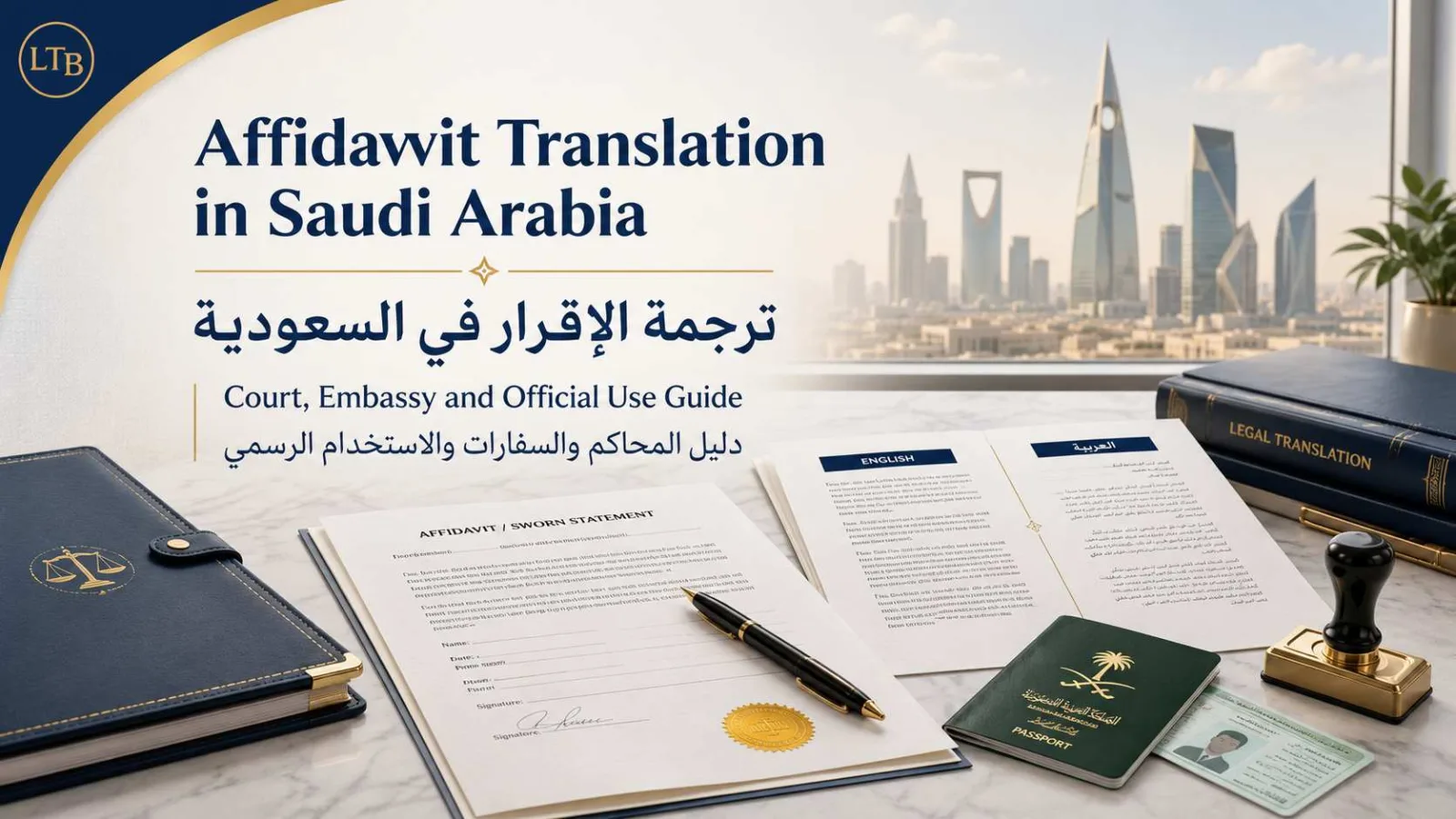
A practical guide to affidavit translation in Saudi Arabia, covering sworn statements, declarations, identity details, names, dates, signatures, legal terminology, notarization, attestation, embassy use and certified translation checks.
Affidavit Translation in Saudi Arabia
If you need affidavit translation in Saudi Arabia for a court, embassy, government authority, company, bank or another official purpose, accuracy is especially important. An affidavit can contain legally significant statements about identity, family relationships, finances, property, employment, authorization or other facts, so even a small translation error may create confusion during submission or review.
An affidavit is generally a written statement or declaration in which a person confirms certain facts. Depending on the country where the document was prepared, it may be called an Affidavit, Sworn Statement, Statutory Declaration, Declaration, Statement of Facts or another similar legal term.
When an affidavit issued in another language is submitted to an authority in Saudi Arabia, an Arabic translation may be requested. Likewise, a declaration prepared in Saudi Arabia may require English or another-language translation when it will be used abroad.
Because terminology and procedures vary between jurisdictions, the translation should reproduce the meaning of the original document accurately without adding, omitting or changing legally relevant information.
This guide explains the main points to review before requesting certified affidavit translation in Saudi Arabia, including names, identification details, dates, legal terminology, signatures, notarization wording, attestation and official-use requirements.
When May an Affidavit Need Translation in Saudi Arabia?
Affidavits and written declarations can be required for many legal, administrative and personal matters.
Common uses may include:
- Court and legal proceedings
- Embassy and consular applications
- Family and personal-status matters
- Confirmation of identity
- Proof of family relationship
- Marriage or divorce-related matters
- Financial declarations
- Property and inheritance matters
- Business and corporate procedures
- Immigration and visa applications
- Employment-related declarations
- Authorization statements
- Supporting documents for government applications
- Statements accompanying foreign official documents
The exact requirement depends on the authority receiving the document.
Before starting the translation, it is therefore useful to identify the receiving authority, purpose of submission and destination country, if applicable.
1. Identify the Exact Type of Affidavit or Declaration
The word “affidavit” does not always have one identical legal equivalent in every country.
Depending on the document, jurisdiction and legal context, possible Arabic terminology may include:
- إقرار
- إفادة
- إفادة خطية
- إقرار خطي
- إقرار مشفوع باليمين
The appropriate translation should be chosen after reviewing the actual wording and function of the document.
For example, a simple declaration of facts may not have the same legal character as a statement formally sworn before a notary or another authorized official.
For this reason, legal terminology should not be selected only by translating the document title literally.
2. Match the Declarant’s Name With Official Identification
The name of the person making the affidavit or declaration is one of the most important details to check.
Whenever possible, compare the spelling with supporting documents such as:
- Passport
- Saudi Iqama
- National ID
- Visa documents
- Previous certified translations
- Court documents
- Embassy documents
- Marriage or birth certificates
- Other related official records
Arabic names can often be written in several valid ways in English.
For example, the same Arabic name may have two or more possible transliterations. In an official translation, consistency with the spelling already used in the passport or primary identification document is usually more important than introducing a new spelling.
This is especially important when an affidavit will be submitted with several supporting documents.
3. Review Passport, Iqama and Identification Details
Affidavits may contain important personal information, including:
- Passport number
- National ID number
- Saudi Iqama number
- Nationality
- Date of birth
- Place of birth
- Residential address
- Occupation
- Employer name
- Civil-status information
- Contact or reference information
Every number should be reviewed carefully.
A single incorrect digit in a passport number, identification number or date can create a mismatch with the supporting documents.
The translator should not guess unclear information or silently change information appearing in the source document.
If a scan is unclear, obtaining a clearer copy is preferable to assuming what the missing information says.
4. Check Dates, Places and Important Events
Affidavits frequently describe events that occurred on specific dates.
These may include:
- Date the affidavit was prepared
- Date of signature
- Date of notarization
- Date of birth
- Marriage or divorce date
- Employment dates
- Financial transaction dates
- Court-related dates
- Property-related dates
- Dates of agreements or authorizations
The translation should preserve the correct meaning and sequence of these dates.
Care should also be taken when the original document uses a date format that could be interpreted in more than one way.
Place names should be checked carefully as well, particularly when cities, provinces or countries have different established spellings in Arabic and English.
5. Translate Legal Statements Without Changing Their Meaning
The central part of an affidavit is usually the declarant’s statement.
These statements may concern:
- Confirmation of facts
- Declaration of truth
- Legal responsibility
- Ownership
- Authorization
- Consent
- Waiver
- Family relationship
- Financial obligations
- Employment circumstances
- Witness information
- Property rights
- Court proceedings
- Immigration matters
Legal statements should not be shortened, softened or rewritten in a way that changes their meaning.
A professional translation should communicate what the original document actually states.
The translator’s role is not to improve the legal argument or replace the wording with what might appear more appropriate.
6. Review Sworn, Affirmed and Declaration Wording
Foreign affidavits may include formal statements indicating that the declarant swore, affirmed or declared the information before an authorized individual.
The document may refer to officials such as:
- Notary Public
- Commissioner for Oaths
- Solicitor
- Lawyer
- Court Officer
- Justice of the Peace
- Consular Officer
- Other legally authorized officials
These professional titles should be translated according to their actual role in the issuing country.
A foreign legal title should not automatically be replaced with the name of a Saudi authority simply because the functions appear similar.
Maintaining the distinction between jurisdictions helps preserve the meaning of the original document.
7. Check Signatures, Stamps and Notarial Information
An affidavit may contain several certification elements, including:
- Declarant’s signature
- Witness signature
- Notary signature
- Official stamp or seal
- Registration number
- Document reference number
- Date of notarization
- Notarial certificate
- Verification statement
- QR code
- Electronic verification reference
These details may be important to the receiving authority.
The translation should reflect relevant visible information in the source document while avoiding invented descriptions of text or seals that cannot be read clearly.
If part of a stamp or handwritten note is illegible, it is better to identify the limitation than to guess its content.
Translation, Notarization and Attestation Are Different Procedures
A common source of confusion is assuming that certified translation, notarization and document attestation are the same service.
They are different processes.
Certified Translation
A certified translation communicates the content of a document accurately in another language and is prepared for professional or official use.
Notarization or Documentation
Notarization or another documentation procedure may confirm a signature, declaration, legal act or the identity of the person appearing before an authorized official.
Attestation or Legalization
Attestation, legalization or another authentication process may be required when a document issued in one jurisdiction will be used in another.
The process required for a particular affidavit depends on:
- Country of issue
- Type of document
- Receiving authority
- Purpose of submission
- Destination country
- Whether the original has already been notarized
- Whether additional authentication is requested
A translated document should therefore not automatically be treated as a substitute for notarization, attestation or legalization.
Foreign Affidavit Translation for Use in Saudi Arabia
A foreign affidavit may need to be translated into Arabic before submission to a Saudi authority.
Depending on the case, additional requirements may relate to:
- Country where the affidavit was issued
- Authority that issued or notarized it
- Type of declaration
- Purpose of submission
- Existing notarization
- Embassy or consular procedures
- Attestation requirements
- Apostille applicability
- Requirements of the Saudi receiving authority
The exact procedure can differ significantly between documents.
For this reason, confirm current requirements directly with the organization that will receive the affidavit before completing unnecessary authentication procedures.
Saudi Declaration Translation for Use Abroad
A declaration prepared or officially documented in Saudi Arabia may also need translation when it is submitted outside the Kingdom.
Before requesting translation, check:
- Which language the foreign authority accepts.
- Whether a certified translation is required.
- Whether the original Saudi document requires authentication.
- Whether an Apostille or another procedure applies.
- Whether the translated name must exactly match the passport.
- Whether the receiving authority has a specific translation format.
- Whether all supporting documents must also be translated.
Requirements vary by country and authority, so confirmation with the destination authority is important.
Common Problems in Affidavit Translation
Name Mismatch
One of the most common issues is inconsistent spelling of a person’s name.
A passport may show one English spelling while another supporting document uses a different transliteration.
Providing the passport before translation helps the translator follow the required spelling consistently.
Missing Pages
Some affidavits include an additional notarization, witness or certification page.
Submitting only the main statement can result in an incomplete translation.
Send the complete document, including all attachments or certification pages relevant to the affidavit.
Unclear Stamp or Signature
Low-quality photos or scans may make handwritten information, stamps and dates difficult to read.
Use a clear scan whenever possible.
Incorrect Legal Terminology
A literal dictionary translation may not accurately communicate a legal term in context.
Legal terminology should be interpreted according to the complete sentence and nature of the document.
Incorrect Numbers
Passport numbers, dates, ID numbers and reference numbers should receive the same attention as ordinary text.
Confusing Translation With Attestation
A certified translation does not automatically replace:
- Notarization
- Embassy legalization
- Consular authentication
- MOFA attestation
- Apostille
- Other procedures required by the receiving authority
Always determine which services are actually required for your specific case.
Documents to Send for Affidavit Translation
To receive an accurate review and quotation, it is helpful to provide:
- A complete and readable copy of the affidavit
- All pages of the document
- Notarial or certification pages
- Passport copy when name matching is required
- Iqama or ID copy when relevant
- Source language
- Required target language
- Country of issue
- Name of the receiving authority
- Country where the document will be used
- Any instructions issued by the receiving authority
Providing complete information at the beginning can reduce corrections and delays later.
If you are unsure which documents are relevant, use the Request a Quote page to send the complete file for initial review.
Affidavit Translation Quality Checklist
Before a translated affidavit is delivered or submitted, review the following points:
- Document title has been translated appropriately
- Declarant’s full name matches the required identification
- Passport number is correct
- Iqama or ID number is correct
- Dates have been reviewed carefully
- Nationality is accurate
- Place names are consistent
- Legal statements preserve the original meaning
- No paragraphs are missing
- Signatures are represented appropriately
- Visible stamps and seals are handled clearly
- Notarial wording is included where relevant
- Certification pages are included
- All document pages have been translated
- Numbers and reference codes have been checked
- Formatting allows comparison with the source document
This review is particularly useful when the translation will be submitted with a passport, court file, embassy application or another set of official records.
Certified Affidavit Translation in Riyadh
If you need certified affidavit translation in Riyadh for a court, embassy, company or other official purpose, the document should be reviewed before translation begins.
Lexicology Translation Bureau (LTB) Office provides professional document translation services in Riyadh for legal, personal, commercial and official documents.
For affidavit or declaration translation, provide a clear copy of the complete document and specify:
- Original language
- Required translation language
- Country of issue
- Receiving authority
- Intended purpose
- Required name spelling, if applicable
The document can then be reviewed for names, dates, identification information, legal terminology and visible certification details.
You can also review our certified translation services in Riyadh for other official document translation requirements.
Related Documents That May Require Certified Translation
An affidavit is often submitted together with other supporting documents.
Depending on the purpose of the application, these may include:
- Power of Attorney
- Court judgment
- Marriage certificate
- Divorce certificate
- Birth certificate
- Death certificate
- Passport
- Iqama
- Employment contract
- Salary certificate
- Bank statement
- Academic certificate
- Commercial registration
- Company documents
When several documents belong to the same application, using consistent names, dates and terminology across all translations is important.
For related legal documentation, you may also review our guides on Power of Attorney Translation in Riyadh, Court Judgment Translation in Saudi Arabia, and Saudi Apostille, MOFA Attestation and Certified Translation.
How to Request Affidavit Translation in Riyadh
The process can usually begin with a clear digital copy of the document.
Step 1: Send the Complete Affidavit
Include every page and any visible notarization or certification section.
Step 2: Confirm the Languages
State the original language and the language required by the receiving authority.
Step 3: Provide Name-Matching Documents
If exact spelling is important, provide the passport or other relevant identification.
Step 4: State the Receiving Authority
Tell the translation office whether the document is intended for a court, embassy, government department, company, bank or another organization.
Step 5: Review the Translation
Names, numbers, dates, legal terminology and visible certification details should be checked before final delivery.
To begin, use the Request a Quote page and send a readable copy of the affidavit for review.
Why Accuracy Matters in Legal Document Translation
Affidavit translation is not simply word-for-word language conversion.
Legal documents often contain information that must remain consistent across several records.
An error in a name, date, ID number, financial amount or legal statement can make the translated document inconsistent with the original or with other supporting documents.
A careful translation workflow should therefore include:
- Source-document review
- Terminology review
- Name matching
- Number checking
- Date checking
- Legal-context review
- Final proofreading
This approach helps produce a clearer and more reliable translation for official use.
Final Advice Before Submitting an Affidavit
Before submitting a translated affidavit, confirm three things:
- The translation accurately reflects the complete original document.
- Names, dates and identification details match the supporting records.
- The receiving authority’s current requirements for translation, notarization, attestation, legalization or Apostille have been confirmed.
Requirements can vary according to the document, issuing country and receiving authority.
For affidavit translation in Saudi Arabia or certified affidavit translation in Riyadh, send a complete readable copy of the document together with the intended use and receiving authority so the translation requirements can be reviewed before work begins.
Official sources for current requirements
Receiving-organization requirements can change. Check the relevant official source before submitting a document.
Frequently Asked Questions
Do affidavits need certified translation in Saudi Arabia?
A certified translation may be requested when an affidavit written in another language is submitted to a Saudi court, embassy, government authority or other organization. The exact requirement should be confirmed with the receiving authority.
Should the name in an affidavit translation match the passport?
When the document relates to an identified person, using the same spelling shown in the passport or other required identity document helps maintain consistency across official records.
Is certified translation the same as notarization or MOFA attestation?
No. Translation, notarization and attestation are different processes. The receiving authority determines which procedures are required for a particular document.