Court Judgment Translation in Saudi Arabia: Najiz, Appeals and Official Use Guide
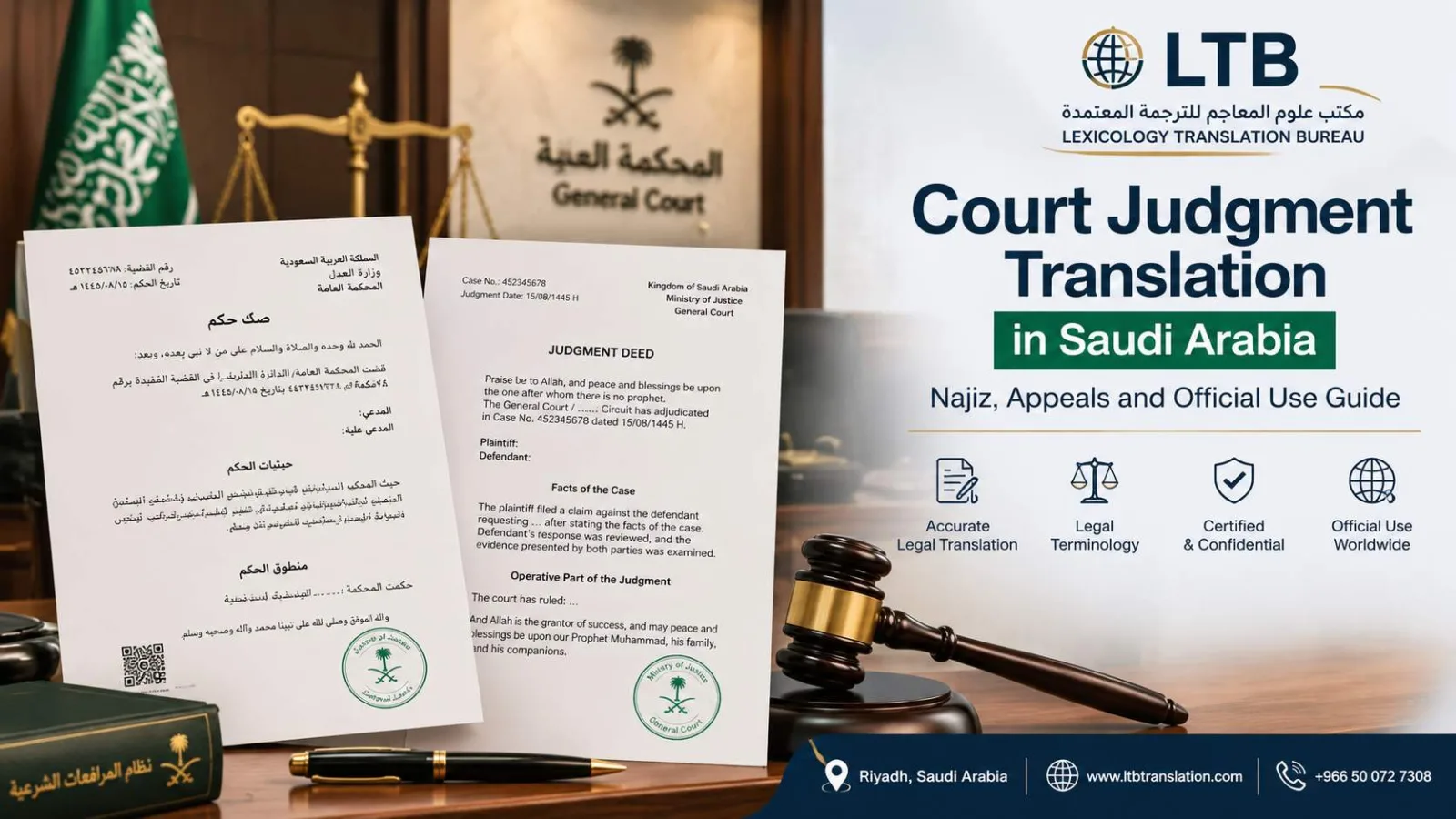
A practical guide to court judgment translation in Saudi Arabia, covering Najiz judgment deeds, case numbers, parties’ names, legal terminology, appeal decisions, certified translation and official-use checks.
Court judgments contain legally significant information such as the names of the parties, case numbers, court details, claims, legal reasoning, orders, dates and the final judgment. When a Saudi judgment needs to be submitted to an organization that requires another language, or when a foreign court decision is used in Saudi Arabia, accurate legal translation may be required.
Court judgment translation in Saudi Arabia requires careful handling because even a small change in wording can affect the apparent meaning of a judicial decision. The translator should preserve the distinction between claims, findings, reasoning and the operative part of the judgment without adding personal interpretation.
The receiving authority determines whether a certified translation, original judgment deed, verification information, legalization or other supporting documents are required.
When May a Court Judgment Need Translation?
A judgment may need translation for several purposes, including:
• Cross-border legal proceedings
• Enforcement-related documentation
• Embassy or consular procedures
• Immigration or family-status matters
• Divorce or custody documentation
• Commercial disputes
• Corporate and contractual disputes
• Banking or inheritance procedures
• Applications before foreign authorities
• Legal review by an overseas lawyer or institution
The purpose should be stated before translation begins because the receiving organization may require a particular language, format or certification.
Saudi Court Judgments and Najiz
Saudi Ministry of Justice services are available through the Najiz platform.
Najiz provides electronic judicial services related to cases and judgments. The Ministry of Justice also provides a service that allows beneficiaries to verify the data and status of certain judgment deeds.
When a judgment document is obtained through Najiz, the complete judgment should be provided for translation whenever possible.
Do not send only the first page if the reasoning, orders, signatures, verification details or other relevant information appears on later pages.
What Should Be Checked Before Translating a Judgment?
A court judgment should be reviewed carefully before translation.
Court Name
The exact court name and, where shown, the judicial circuit or department should be translated consistently.
Case Number
Case numbers, judgment numbers, deed numbers and reference numbers must be copied exactly.
One incorrect digit can create a mismatch between the translation and the original judicial record.
Names of the Parties
Names of plaintiffs, defendants, claimants, respondents, representatives and other parties should be checked carefully.
If the English spelling of a person's name is important, a passport, Iqama or other official reference can help maintain consistency.
Dates
Court documents may contain:
• Filing dates
• Hearing dates
• Judgment dates
• Notification dates
• Appeal dates
• Hijri dates
• Gregorian dates
Dates should be reproduced accurately without guessing or changing the source information.
Legal Capacity of Each Party
Terms describing a person's legal capacity should be translated accurately.
Examples may include:
• Plaintiff
• Defendant
• Appellant
• Respondent
• Claimant
• Representative
• Attorney
• Guardian
The translator should determine the appropriate equivalent from the context of the judgment rather than relying only on literal word substitution.
Claims and Requests
The parties' claims and requests should remain separate from the court's findings and final orders.
A statement made by a claimant should not appear in translation as though it were a factual finding made by the court.
Legal Reasoning
Judgments may contain legal reasoning, references to laws, regulations, evidence and procedural history.
The translation should preserve the structure and meaning of this reasoning without attempting to rewrite or simplify the court's legal analysis.
The Operative Part of the Judgment
The operative section states what the court decided.
This can be one of the most important parts of the document and requires particularly careful review.
Amounts, obligations, dismissals, orders and other outcomes must match the source exactly.
Appeal Status
If the judgment refers to an appeal, appellate decision, finality or another procedural stage, that wording should be preserved accurately.
Saudi Ministry of Justice provides an electronic service through Najiz for appealing judgments issued by courts of first instance, subject to the applicable procedure and requirements.
Translation itself does not determine whether a judgment is appealable or final.
Judgment Verification
The Ministry of Justice provides a Verify Judgment Decree service that allows beneficiaries to check judgment-deed data and status.
Where verification details appear in the source judgment, they should be reproduced carefully.
A translation should not create or alter a verification number, QR code, case number or official reference.
Translation of Legal Terminology
Court judgments often contain terminology that does not have a perfect one-word equivalent in another legal system.
For this reason, context is essential.
The translator should consider:
• The type of court
• The nature of the case
• The procedural stage
• The role of each party
• The legal effect of the phrase
• Terminology used consistently throughout the document
Literal translation can sometimes distort legal meaning.
The goal is to reproduce the meaning of the source text accurately while remaining faithful to the original judgment.
Translating Saudi Legal Terms into English
Some Arabic legal terms can have more than one possible English rendering depending on context.
The translator should avoid switching terminology unnecessarily throughout the same document.
If an established translation appears in an official reference supplied by the client or receiving authority, that terminology can be followed where appropriate.
Translating Foreign Judgments into Arabic
Foreign court judgments may also need Arabic translation for use in Saudi Arabia.
The translator should preserve:
• Court names
• Case references
• Names of parties
• Legal roles
• Dates
• Monetary amounts
• Orders
• Appeal information
• Stamps or relevant document notes
However, translation does not convert a foreign legal concept into an identical Saudi legal concept.
The translation should reflect what the foreign judgment actually states.
Names Must Match Supporting Documents
Name consistency is especially important in legal documents.
A person's name may appear in a judgment together with a passport, Iqama, commercial registration, marriage certificate, power of attorney or another supporting document.
If the official English spelling is already established, the same spelling should generally be used in the translation.
Clients should provide a reliable name reference when needed.
Numbers and Monetary Amounts
Legal judgments may contain:
• Compensation amounts
• Debt amounts
• Fees
• Contract values
• Percentages
• Dates
• Identity numbers
• Case numbers
These details should be checked independently against the original.
A translation can read fluently and still be incorrect if one amount or reference number is wrong.
Judgment Correction or Clarification
Saudi Ministry of Justice also provides a service for requesting correction or clarification of a judgment in certain circumstances.
This service concerns the judicial document itself.
A translation office should not silently correct an apparent error in an original judgment.
If the source contains a number, name or wording that appears inconsistent, the translation should follow the source or request clarification rather than changing the judicial document independently.
Certified Court Judgment Translation
A receiving organization may require a certified translation of the judgment.
Before ordering, confirm whether the recipient requires:
• Certified translation
• Original stamped copy
• Electronic PDF
• Complete judgment attachment
• Verification information
• Legalization or attestation
• Translation into a specific language
The translation office prepares the translation according to the agreed scope, but the receiving authority determines final acceptance requirements.
Court Judgments for Embassy or Overseas Use
When a Saudi judgment will be used abroad, the receiving country's requirements should be checked before submission.
Depending on the purpose, an organization may ask for the original judgment, a certified translation or additional authentication.
Translation, verification and legalization are separate procedures.
Do not assume that translation alone completes every international submission requirement.
Commercial Judgment Translation
Commercial judgments can include company names, commercial-registration data, contracts, invoices, financial obligations and specialized business terminology.
Company names should be checked against official English references where available.
Amounts, percentages and contract references must be reviewed carefully.
Family and Personal-Status Judgments
Family-related judgments may involve:
• Divorce
• Custody
• Maintenance
• Marriage-related disputes
• Guardianship
• Other personal-status matters
These documents can contain sensitive personal information.
Names, family relationships, dates and final orders require close review.
The translation should remain factual and should not add commentary about the case.
How to Prepare a Judgment for Translation
Before sending a judgment:
- Provide the complete document.
- Make sure every page is readable.
- Do not crop QR codes, reference numbers or important margins.
- State the target language.
- State the receiving authority or intended use.
- Provide official name spellings where relevant.
- Send supporting documents if terminology or names must match them.
- Confirm whether a certified hard copy is required.
- State the required delivery date.
A complete PDF is generally preferable to incomplete screenshots.
Common Court Judgment Translation Mistakes
Guessing Unclear Text
Blurred, damaged or incomplete judicial text should not be guessed.
A clearer source should be requested.
Confusing Party Roles
Plaintiff, defendant, appellant and respondent should not be used interchangeably.
Changing the Court's Meaning
The translator should not rewrite the court's reasoning to make it sound clearer or stronger.
Incorrect Numbers
Case numbers, dates and financial amounts require exact review.
Inconsistent Names
Different spellings of the same person's or company's name can create problems when the judgment is compared with supporting documents.
Omitting Sections
Legal reasoning, annexes or operative orders should not be removed simply because they appear repetitive.
Final Review Before Delivery
Before delivery, the translated judgment should be compared against the source.
Important review points include:
• Court name
• Case and judgment numbers
• Names of all parties
• Identity information
• Dates
• Claims
• Procedural history
• Legal terminology
• Monetary amounts
• Court reasoning
• Final orders
• Appeal references
• Page completeness
• Verification information
The final review should focus on both linguistic accuracy and source-document consistency.
Court Judgment Translation in Riyadh
Clients in Riyadh can request court judgment translation by sending a complete and readable copy of the document together with the required language and intended recipient.
Lexicology Translation Bureau (LTB) Office provides legal translation services in Riyadh for court judgments, contracts, powers of attorney, corporate documents and other legal materials.
The document should be reviewed before the price, delivery time and scope are confirmed.
Frequently Asked Questions
Can a Saudi court judgment be translated into English?
Yes. A Saudi court judgment can be translated from Arabic into English when an English translation is required. The complete judgment should be provided so that names, case details, legal reasoning and final orders can be reviewed in context.
Does a Najiz judgment need certified translation?
This depends on where the judgment will be submitted. The receiving authority determines whether a certified translation, original document or additional verification is required.
Can a foreign court judgment be translated into Arabic for Saudi use?
Yes, foreign judgments can be translated into Arabic. However, the receiving Saudi authority determines whether additional authentication, legalization or procedural requirements apply.
Should the translator correct an error found in the original judgment?
No change should be invented silently. If the original appears to contain unclear or inconsistent information, the issue should be raised for clarification. Saudi Ministry of Justice also provides procedures for requesting correction or clarification of judgments in applicable cases.
Conclusion
Court judgment translation in Saudi Arabia requires careful review of legal terminology, party names, court information, case numbers, dates, monetary amounts, reasoning and final orders.
The translation should reflect the original judicial document without adding interpretations, changing uncertain information or altering the legal effect of the text.
Providing a complete and readable judgment together with official name references and clear submission instructions helps reduce inconsistencies and supports a more reliable legal translation.
Official sources for current requirements
Receiving-organization requirements can change. Check the relevant official source before submitting a document.
Frequently Asked Questions
Can a Saudi court judgment be translated into English?
Yes. A Saudi court judgment can be translated from Arabic into English when an English translation is required. The complete judgment should be provided so names, case details, legal reasoning and final orders can be reviewed in context.
Does a Najiz judgment need certified translation?
It depends on where the judgment will be submitted. The receiving authority determines whether a certified translation, original judgment or additional verification is required.
Can a foreign court judgment be translated into Arabic for Saudi use?
Yes. Foreign court judgments can be translated into Arabic, but the receiving Saudi authority determines whether additional authentication, legalization or other procedural requirements apply.
Should a translator correct an error in the original judgment?
A translator should not silently change information in the source judgment. If a name, number or passage appears unclear or inconsistent, clarification or a clearer official document should be requested.
.jpg.webp)