How to Bring Your Family from Pakistan to Saudi Arabia: Family Residence Visa Guide 2026
Are you a Pakistani resident working in Saudi Arabia and planning to bring your wife and children from Pakistan? This complete 2026 guide explains the Saudi family residence visa process, sponsorship, required documents, translation, attestation, application steps, medical requirements and what to do after your family arrives in Saudi Arabia.
Bringing your family from Pakistan to Saudi Arabia is an important step for Pakistani employees and professionals who want to live together with their wife and children in the Kingdom.
If you have a valid Saudi residence permit and meet the applicable requirements, you may be able to apply through the Saudi family residence and family sponsorship procedures.
This guide explains the process from start to finish, including document preparation in Pakistan, marriage and birth certificates, Arabic translation, document attestation, family sponsorship, visa procedures, medical requirements and the steps to complete after your family arrives in Saudi Arabia.
The rules and requirements can change, so applicants should always verify the latest requirements through official Saudi government channels before submitting an application.
Saudi Family Residence Visa and Family Visit Visa
Before starting the process, understand that a family residence visa and a family visit visa are not the same.
A family visit visa is intended for visiting eligible relatives for a temporary period. A family residence visa is intended for eligible family members who will reside in Saudi Arabia according to the applicable residence regulations.
If your goal is to bring your wife and children from Pakistan to Saudi Arabia and keep your family with you for the long term, you should check the family residence and sponsorship route rather than assuming that a family visit visa is sufficient.
Who Can Bring Family Members to Saudi Arabia?
Eligibility depends on several factors, including your Saudi residence status, employment information, family relationship and the current Saudi regulations.
The Saudi Ministry of Interior provides a service through which eligible residents can book an appointment with the Istiqdam office for a Family Members Sponsorship Request for their wife and children.
The availability of the procedure and the documents required can depend on the individual applicant's circumstances.
Step 1: Check Your Saudi Iqama and Employment Information
Before preparing your family's documents, check your own Saudi documents.
Make sure your:
Saudi Iqama is valid
Passport is valid
Employment information is correct
Registered profession is correct
Employer information is up to date
Absher account is active
Family relationship information is accurate
You should also check whether your current employment and residency status meet the requirements for family sponsorship.
Step 2: Prepare Your Family Documents in Pakistan
The next step is to collect the important documents of your wife and children.
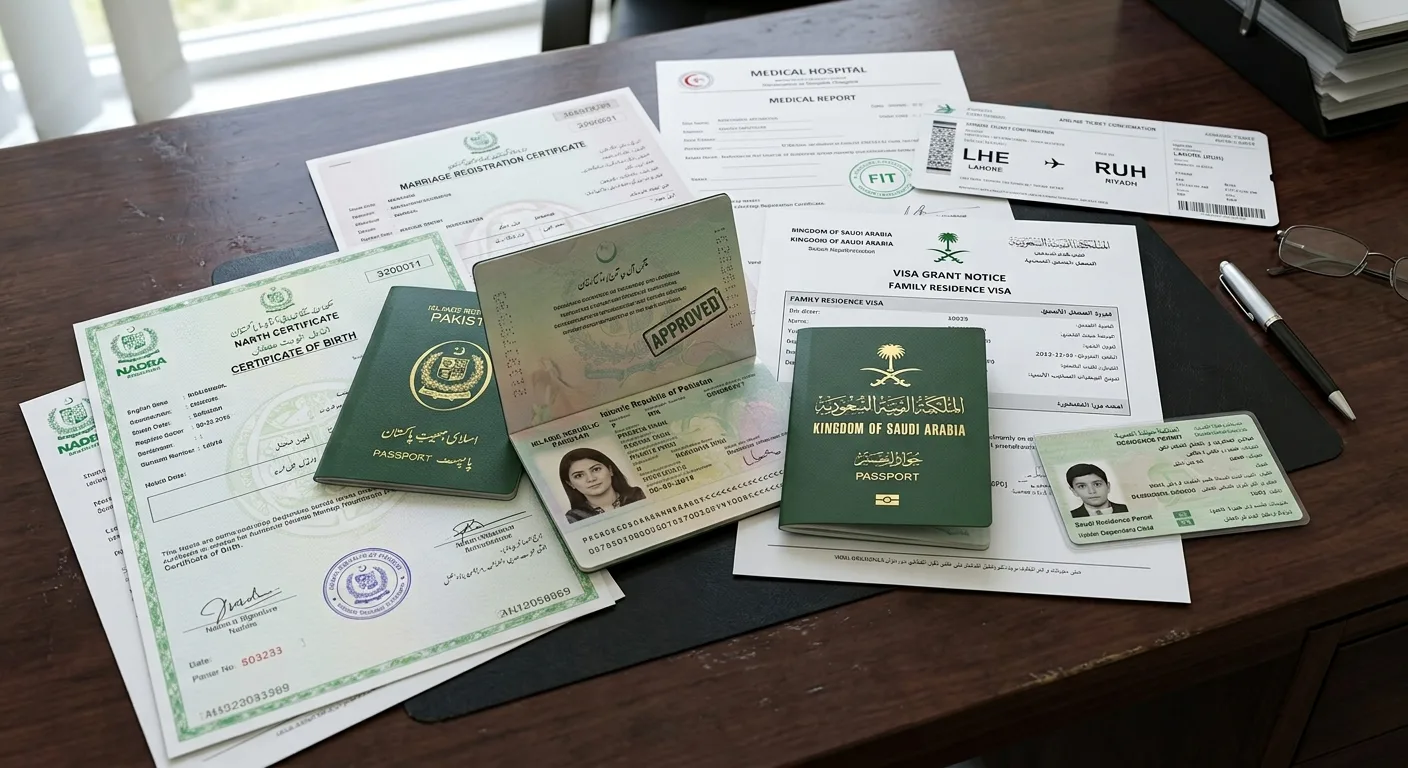
Depending on your situation and the current requirements, you may need documents such as:
Wife's passport
Children's passports
Marriage certificate
Nikah Nama
Children's birth certificates
Family relationship documents
Pakistani identity or civil-status documents
Passport-size photographs
Sponsor's Saudi Iqama copy
Sponsor's passport copy
Employment or salary documents if requested
Additional documents requested by the relevant authority
Do not submit documents without checking their validity and accuracy.
Step 3: Make Sure All Names Match
One of the most important steps in a family visa application is checking the spelling of names.
Compare the names on:
Passport
Marriage certificate
Nikah Nama
Birth certificate
Family documents
Other identity documents
The spelling should be consistent wherever possible.
For example, if your wife's name appears differently on the passport and marriage certificate, it is better to identify the issue before submitting the documents.
The same applies to children's names.
Check dates of birth, passport numbers, document numbers and other important information carefully.
Step 4: Translate Pakistani Documents into Arabic When Required
Some Pakistani documents may need Arabic translation for official use in Saudi Arabia.
Depending on the requirements, documents that may need translation can include:
Marriage certificate
Nikah Nama
Birth certificates
Family documents
Civil-status documents
Other official documents
When certified translation is required, the translation should accurately preserve the information contained in the original document.
Special attention should be given to:
Names
Dates
Passport numbers
Document numbers
Official terminology
Stamps
Seals
Signatures
A small mistake in a person's name or document number can create unnecessary problems during official processing.
Step 5: Complete Document Attestation When Required
Translation and attestation are different procedures.
Depending on the document and its intended use, a Pakistani document may require authentication, attestation or legalization before it can be accepted for official purposes.
Do not assume that every document follows exactly the same process.
Check the current requirements for each specific document and the authority that will receive it.
Step 6: Apply for Family Sponsorship
After preparing the necessary documents, check the appropriate Saudi family sponsorship procedure.
The Saudi National Portal currently lists a Ministry of Interior service that enables residents to book an appointment with the Istiqdam office to request sponsorship for family members, specifically the wife and children.
The official service lists these appointment steps:
Log in to the Absher platform.
Select My Appointments.
Choose the General Department of Expatriate Affairs.
Select Book an Appointment.
Choose Family Members Sponsorship Request.
Select a suitable appointment.
Confirm the appointment.
The exact availability and process may depend on your current status and Saudi government systems.
Step 7: Submit the Required Information and Documents
Before submitting your application, check every detail carefully.
Make sure:
Your Iqama number is correct.
Your passport information is correct.
Your wife's passport information is correct.
Your children's passport information is correct.
Names match the passports.
Dates of birth are correct.
Marriage information is accurate.
Required translations are attached.
Required attestations have been completed.
Uploaded documents are clear.
A clear and complete document file can help reduce avoidable delays.
Step 8: Wait for the Application Review
After submitting the application, the relevant Saudi authority may review the information and documents.
If the application is approved, the family members can continue with the required visa procedures through the appropriate Saudi embassy, consulate or authorized visa-processing channel in Pakistan.
According to the current Saudi National Portal residence visa service, applicants use the Saudi visa platform, enter information exactly as shown in the passport, attach required documents, submit the application electronically and wait for Ministry of Foreign Affairs approval.
After approval, the visa number is issued and the visitor completes the required procedures through the Saudi embassy or consulate.
Step 9: Complete Medical Procedures When Required
Depending on the visa process and the applicant, a medical examination or other additional procedures may be required.
Follow the current instructions provided by the relevant Saudi authorities, Saudi embassy or authorized visa-processing channels in Pakistan.
If a medical examination is required, use the approved medical center or provider specified by the applicable procedure.
Step 10: Check the Visa Before Your Family Travels
When the visa is issued, carefully compare the information on the visa with each person's passport.
Check:
Full name
Passport number
Date of birth
Visa number
Visa type
Validity
Entry information
Other important details
If you notice an error, try to resolve it through the appropriate official channel before travelling.
Step 11: Prepare Your Family for Travel from Pakistan
Before your wife and children travel to Saudi Arabia, prepare a document folder.
Keep copies of:
Passports
Visas
Marriage certificate
Nikah Nama
Birth certificates
Family documents
Arabic translations
Attestation documents
Sponsor's Iqama
Sponsor's passport
Travel information
It is also recommended to keep secure digital copies of important documents.
Step 12: After Your Family Arrives in Saudi Arabia
After your family enters Saudi Arabia, additional residence procedures may be required depending on the visa and the circumstances of each family member.
Make sure all required procedures are completed and that family information is correctly registered.
Follow the current instructions of the Saudi authorities and use the applicable government platforms for any required residence services.
How Long Does the Saudi Family Residence Visa Process Take?
There is no single processing time that applies to every family.
The total time can depend on:
Sponsor eligibility
Iqama status
Employment information
Document preparation
Translation
Attestation
Application review
Medical procedures
Embassy procedures
Additional verification
The current Saudi National Portal lists a service level of 4 working days for its residence visa service. However, this should not be considered a guaranteed total processing time for every family because applicants may need to complete additional procedures before and after the visa application.
How Much Does It Cost to Bring Family to Saudi Arabia?
The total cost can vary depending on the family size, document requirements and services required.
Possible costs may include:
Document translation
Document attestation
Medical examination
Visa-related fees
Travel costs
Residence-related government fees
Other required services
Always verify the latest government fees before making payments because fees and procedures may change.
What Documents Should Pakistani Families Prepare?
A Pakistani family planning to move to Saudi Arabia should organize all documents before starting the application.
A useful preparation checklist includes:
Valid passports
Marriage certificate
Nikah Nama
Children's birth certificates
Proof of family relationship
Sponsor's Iqama
Sponsor's passport
Required photographs
Employment documents if requested
Arabic translations when required
Attestation or legalization documents when required
Additional documents requested by the authorities
Why Is Accurate Translation Important for Saudi Family Visa Documents?
Family visa applications depend heavily on accurate personal information.
Translation problems can occur when:
A wife's name is different from her passport.
A child's name is written differently in different documents.
Dates are incorrectly translated.
Passport numbers are copied incorrectly.
Document numbers contain mistakes.
Official stamps are not correctly represented.
Arabic spelling is inconsistent.
Professional document translation can help reduce avoidable errors when translated documents are required for official use.
Common Mistakes to Avoid
Using a Family Visit Visa for Long-Term Residence
A family visit visa and family residence visa have different purposes. If your goal is to have your wife and children live with you in Saudi Arabia, check the appropriate residence sponsorship route.
Submitting Documents With Different Names
Always compare the names on the marriage certificate, birth certificates and other family documents with the passports.
Ignoring Attestation Requirements
Translation does not automatically mean that a document has been authenticated or attested.
Using an Unprofessional Translation Provider
If certified translation is required, choose a professional translation office experienced in official documents.
Uploading Unclear Documents
Make sure every scan or photograph is clear enough to read names, dates, numbers, stamps and seals.
Following Old Information
Saudi visa and residence procedures can change. Always verify the latest requirements through official Saudi government sources before applying.
Can a Pakistani Employee Bring His Wife and Children to Saudi Arabia?
A Pakistani employee who legally resides and works in Saudi Arabia may be able to apply for family sponsorship if he meets the applicable requirements.
Nationality alone does not guarantee approval.
The application can depend on the sponsor's residency status, employment information, family relationship, documents and the current Saudi regulations.
How LTB Translation Can Help With Your Family Visa Documents
Preparing Pakistani family documents for official use in Saudi Arabia can involve several documents, languages and verification procedures.
LTB Translation Bureau can assist with professional translation of documents such as:
Marriage certificates
Nikah Nama
Birth certificates
Family documents
Civil-status documents
Other official documents
Our translation review focuses on important information such as names, dates, document numbers and official terminology.
If your Pakistani documents require Arabic translation or certified translation for official use in Saudi Arabia, professional document review can help identify inconsistencies before submission.
Final Checklist
Check your Saudi Iqama.
Check passport validity.
Confirm your family sponsorship eligibility.
Prepare your wife's passport.
Prepare your children's passports.
Prepare the marriage certificate or Nikah Nama.
Prepare children's birth certificates.
Check all names against the passports.
Check dates of birth and document numbers.
Complete required Arabic translation.
Complete required attestation or legalization.
Submit the appropriate family sponsorship application.
Complete required medical procedures.
Check the issued visa before travel.
Keep copies of all documents.
Complete required residence procedures after arrival.
Final Advice
If you are a Pakistani employee working in Saudi Arabia and your goal is to keep your wife and children with you, start by preparing your documents carefully instead of applying with incomplete or inconsistent paperwork.
The most important things to check are your Saudi residency status, family relationship documents, passport information, name matching, translation and any required attestation.
Because Saudi immigration and residence procedures can change, always verify the latest requirements through official Saudi government sources before submitting your application.
This article is for general information only and does not guarantee visa approval.
Visa and immigration translation: consistency across the complete application
Immigration files bring together identity, family, employment, financial, and civil-status documents. The main quality requirement is consistency: the same person, company, place, and date should appear in a stable form throughout the application.
Organize the source package
- The complete documents requested by the destination authority
- Passport pages for applicant and dependants
- Existing application forms or reference spellings
- The destination country, visa type, and submission deadline
Cross-document checks
- Names match passports
- Family relationships match civil records
- Employment and company names are consistent
- Dates do not conflict across documents
- All requested pages, seals, and endorsements are included
Official sources for current requirements
Receiving-organization requirements can change. Check the relevant official source before submitting a document.
Frequently Asked Questions
Can a Pakistani resident in Saudi Arabia bring his wife and children to Saudi Arabia?
An eligible Pakistani resident may apply for family sponsorship for his wife and children, subject to Saudi regulations, residency status and approval by the relevant authorities.
What documents are needed to bring a family from Pakistan to Saudi Arabia?
Depending on the case, documents may include valid passports, marriage documents, Nikah Nama, children's birth certificates, proof of family relationship, the sponsor's Iqama and passport, photographs and any required translation, attestation or additional documents.
What is the difference between a Saudi family residence visa and a family visit visa?
A family visit visa is intended for visiting eligible relatives for a limited period, while a residence visa is intended for eligible family members to reside in Saudi Arabia according to the applicable regulations.
Do Pakistani marriage and birth certificates need Arabic translation for Saudi Arabia?
Yes. Foreign documents written in languages other than Arabic—including Pakistani Nikahnama/marriage certificates and Nadra birth certificates issued in Urdu or English—require a certified Arabic translation when submitted to Saudi Arabian government entities.