Saudi Family Visit Visa: Documents, Translation and Application Checks
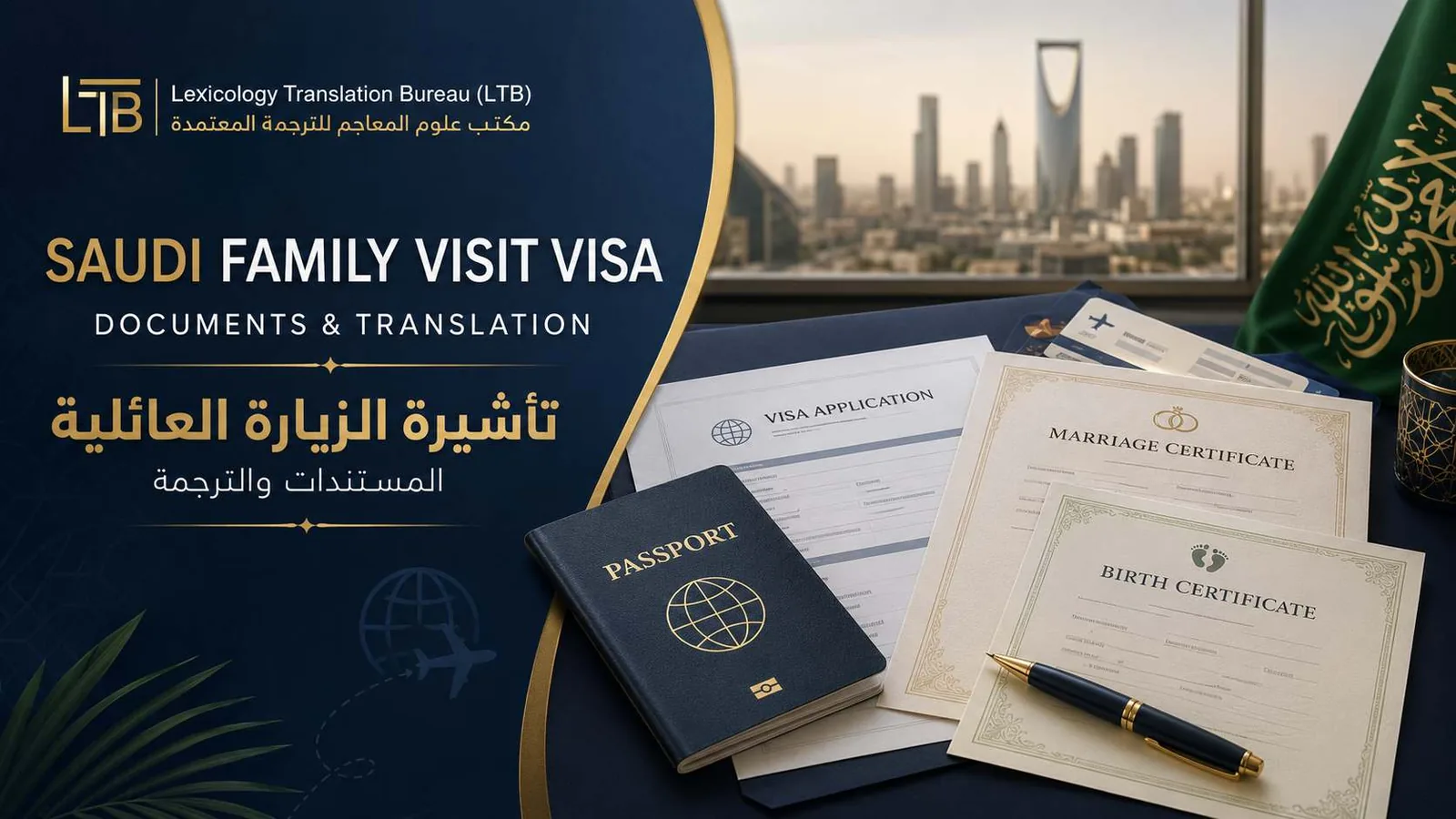
A practical guide to the Saudi family visit visa, covering the host’s request, visitor passport details, proof of family relationship, certified translation, document attestation, name matching, application preparation and the checks required after the visa is issued.
Saudi Family Visit Visa: A Practical Document Guide
A Saudi family visit visa allows an eligible family member to enter Saudi Arabia temporarily to visit a relative who is legally living in the Kingdom. The request may be initiated by a Saudi citizen or an eligible resident, depending on the applicant’s status, the relationship with the visitor and the current rules displayed on the official visa platform.
Preparing a successful file involves more than entering names in an online form. The host and visitor may need to review passport information, invitation details, proof of relationship, document language, certified translation, attestation and instructions issued by the Saudi diplomatic mission handling the visitor’s application.
Requirements can differ according to nationality, country of application, family relationship, host status and the specific Saudi mission or visa-service center. Applicants should therefore confirm the current official checklist before paying for services, translating documents or arranging travel.
Lexicology Translation Bureau provides certified translation services in Riyadh for marriage certificates, birth certificates, family records, passports, identity documents and supporting papers that may be used in a Saudi family visit visa file.
What Is a Saudi Family Visit Visa?
A family visit visa is intended for temporary entry to Saudi Arabia for the purpose of visiting qualifying family members. It does not by itself create dependent residence status, issue an Iqama or authorize the visitor to take paid employment in the Kingdom.
The period during which the visa can be used, the permitted length of stay and whether it allows one or more entries must be checked on the visa that is actually issued. Applicants should not assume that every family visit visa has the same validity or entry conditions.
The category selected in the application must match the genuine purpose of travel. A family visit request should not be used as a substitute for employment, residence, study or another visa category requiring different approval.
Family Visit Visa and Family Residence Visa Are Different
A family visit visa is for a temporary visit. A family residence visa, sometimes informally described as a permanent family visa, is intended for qualifying dependents who will reside with a sponsor in Saudi Arabia and complete the required residence procedures.
This difference affects the application route, supporting documents and procedures after arrival. A person planning only a temporary family visit should not follow a residence-visa checklist without confirming that the documents are also required for the visit application.
Applicants considering residence for a spouse or children should review the separate family residence visa guide rather than treating the two categories as interchangeable.
Family Visit and Personal Visit Are Not the Same
A family visit request is based on a qualifying family relationship. A personal visit request is a separate service generally used when the visitor does not have a family or business relationship with the person requesting the visit.
The applicant should select the category shown by the official platform and should not describe a friend, business contact or unrelated visitor as a family member. Incorrect relationship information can create questions during review and may require a new application under the appropriate category.
Who Begins the Family Visit Request?
The process normally begins with the host in Saudi Arabia.
The host may be required to:
- Sign in to the official Saudi visa platform.
- Select the correct family visit service.
- Enter the host’s identity, residence and contact information.
- Enter each visitor’s passport and nationality details.
- State the correct family relationship.
- Complete any electronic authentication required by the current service.
- Save the request or invitation reference for the visitor.
Saudi Ministry of Foreign Affairs guidance states that eligible resident applicants should hold valid work residence status rather than dependent residence status. It also describes the service as covering qualifying close relatives, such as parents, a spouse and children. Eligibility should always be checked against the current platform instructions.
The Application Usually Has Two Document Stages
It is useful to separate the process into two stages.
The first stage is the host-side request in Saudi Arabia. The host submits the family visit information and completes any required authentication or approval process.
The second stage is the visitor-side procedure. After obtaining the relevant request, invitation or approval reference, the visitor follows the instructions applying in the country where the visa is processed. This stage may involve an online form, passport submission, photographs, insurance, payment, a visa-service center, a Saudi embassy or additional supporting documents.
Approval of the initial request should not automatically be treated as completion of every visitor-side procedure. The visitor should follow the instructions linked to the application and the responsible Saudi mission.
Information the Host Should Check Before Submission
Errors in the first request may continue into later stages. Before submitting, the host should review:
- The visitor’s full name exactly as shown in the passport.
- Passport number without missing or additional characters.
- Nationality shown in the current passport.
- Date of birth.
- Passport issue and expiry dates.
- Correct family relationship.
- Host’s identity or Iqama information.
- Host’s occupation and employer details where requested.
- Contact information and address.
- Number of visitors included in the request.
- Purpose of the visit.
For visitors whose names are not originally Arabic, the spelling entered in the application should follow the passport. A commonly used spelling, nickname or older passport spelling should not replace the current official passport name.
Documents the Visitor May Need to Prepare
The exact document list must be obtained from the official platform or processing mission. A visitor’s preparation file may include:
- A valid passport with sufficient remaining validity.
- A clear copy of the passport identity page.
- Recent photographs meeting the requested specifications.
- Family visit request, invitation or approval information.
- Completed visa application information.
- Proof of the relationship with the host.
- Marriage certificate for a visiting spouse.
- Birth certificate for a visiting child or parent-child relationship.
- Family register or equivalent civil-status document when relevant.
- Name-change, divorce, custody or guardianship documents in special cases.
- Certified translation when required.
- Document attestation when required.
- Medical insurance or other platform-generated documents.
- Additional documents requested by the Saudi mission.
Not every applicant will need every item. Documents should not be translated or attested only because they appear on an unofficial checklist. The current receiving-authority instructions should be confirmed first.
Proof of Family Relationship
The relationship between the host and visitor should be supported by official civil-status records when the processing authority requests evidence.
Common examples include:
- A marriage certificate or marriage contract for a spouse.
- A birth certificate showing the child and parents.
- A family register.
- A civil-status extract.
- A legal name-change certificate.
- Divorce, custody or guardianship documents where relevant.
The names across these records should form a clear and consistent connection. For example, the spouse’s passport name should correspond with the marriage certificate, while the parents’ names on a child’s birth certificate should correspond with the parents’ passports.
A genuine relationship document can still cause difficulty when names, dates or document numbers are inconsistent. These differences should be identified before submission rather than concealed or silently changed in translation.
When Certified Translation May Be Required
Certified translation may be requested when a marriage certificate, birth certificate or other supporting document is written in a language that is not accepted by the Saudi mission or processing authority.
Translation may also be useful when:
- A relationship document contains foreign-language entries.
- An official seal or annotation must be understood.
- A name-change document explains a difference between records.
- Custody or guardianship papers are submitted.
- The processing mission specifically asks for an Arabic or English translation.
- A foreign authority requires a translated copy during a related procedure.
The required target language should be confirmed before translation. An applicant should not assume that Arabic is always required or that an existing English translation will always be accepted.
A certified translation should reproduce the full visible document, including headings, names, dates, registration numbers, issuing authorities, seals, signatures, stamps, handwritten notes and relevant electronic references.
Passport Name Matching for Non-Arabic Visitors
Name matching is one of the most important checks in a family visit application.
The following records should be compared:
- Visitor’s current passport.
- Online family visit request.
- Invitation or approval document.
- Marriage or birth certificate.
- Certified translation.
- Previous passport where an older spelling is relevant.
- Name-change document when applicable.
The passport spelling should normally be used as the official reference for the visitor’s name in the application. The translator must still translate the source document accurately and should not alter a name in the original merely to hide a discrepancy.
When a civil document uses a materially different spelling, the client may be asked to provide the passport, a clearer record, an amended certificate or an official name reference.
Checking Dates, Numbers and Document Validity
Names are not the only critical data. The following details should be reviewed separately:
- Passport number.
- Date of birth.
- Passport issue date.
- Passport expiry date.
- Marriage date.
- Child’s date of birth.
- Civil-document registration number.
- Application or invitation reference.
- Host’s identity or Iqama number.
- Hijri and Gregorian dates where both appear.
Day and month reversal is a common risk when documents use different date formats. Numbers should be checked character by character rather than copied from memory.
Applicants should also avoid submitting an expired passport or an old civil document when the authority has requested a current or recently issued version.
Certified Translation and Document Attestation Are Different
Translation and attestation perform different functions.
Certified translation changes the language of the document while preserving its information. Attestation or ratification confirms the document or signature through the required official chain.
A translated document is not automatically attested, and an attested foreign-language document is not automatically translated. Depending on the country and receiving authority, both processes may be required.
The correct order can vary. In some cases the document is attested first so that the final translation includes the visible attestation stamps. In other cases the authority may require a different sequence. Applicants should confirm the required order before paying for multiple versions.
Recommended Preparation Process
A careful preparation process can reduce avoidable corrections.
- Confirm that family visit is the correct visa category.
- Check the host’s current eligibility on the official platform.
- Obtain clear copies of all visitor passports.
- Enter visitor names directly from the current passports.
- Confirm the relationship category for each visitor.
- Submit and authenticate the host-side request as required.
- Review the visitor-side checklist for the relevant country.
- Collect the final marriage, birth or family documents.
- Complete required attestation in the correct order.
- Obtain certified translation only in the required language.
- Compare the application, passports and translations together.
- Follow the mission or visa-center submission instructions.
- Check the issued visa before arranging final travel.
Copies should be readable and complete. A page with a cut-off stamp, missing reverse side or blurred number can prevent an accurate review.
Review the Visa After It Is Issued
The issued visa should be checked immediately. The visitor should review:
- Full name.
- Passport number.
- Nationality.
- Date of birth where displayed.
- Visa category.
- Entry type.
- Valid-from and valid-until dates.
- Permitted duration of stay.
- Number of entries.
- Any special notes or restrictions.
The validity period and permitted duration of stay are not necessarily the same thing. The visitor should follow the information printed or displayed on the issued visa and the current official instructions.
Any material error should be reported through the responsible official channel before travel rather than being ignored at the airport.
Preparation Before Travelling to Saudi Arabia
Before departure, the visitor should keep accessible copies of:
- Current passport.
- Issued visa.
- Host’s name and contact number.
- Address in Saudi Arabia.
- Relevant invitation or application reference.
- Insurance information where applicable.
- Return or onward travel details when requested.
- Important family documents used in the application.
- Certified translations when they may be requested.
The visitor should also check the latest entry, health, airline and baggage requirements. Visa approval does not remove the need to comply with airline and border procedures.
Common Causes of Document Problems
Frequent avoidable issues include:
- Visitor name not matching the passport.
- Incorrect passport number.
- Using an expired or cancelled passport.
- Selecting the wrong family relationship.
- Translating an incomplete scan.
- Omitting the reverse side of a certificate.
- Missing attestation stamps in the translated copy.
- Confusing a temporary visit visa with a residence visa.
- Submitting inconsistent birth or marriage dates.
- Using an unofficial translation where certified translation is requested.
- Assuming that an older approval can be used without checking its status.
- Booking non-refundable travel before completing the required procedures.
A final comparison of the complete file is usually more effective than reviewing each document separately.
Cases That Need Additional Review
Some family situations may require additional evidence or instructions.
These can include:
- A spouse whose current surname differs from the marriage certificate.
- A child from a previous marriage.
- Divorced parents.
- A child travelling with one parent.
- Custody or guardianship arrangements.
- A recently born child.
- Dual nationals using different passports.
- A reissued marriage or birth certificate.
- Handwritten or damaged civil records.
- Documents containing several attestation stamps.
- Records issued in different countries.
The translation office should not decide the legal sufficiency of these documents. Its role is to translate the supplied records accurately and identify visible inconsistencies that may require clarification.
How Lexicology Translation Bureau Can Assist
Lexicology Translation Bureau provides certified translation in Riyadh for documents commonly associated with family visit files, including:
- Marriage certificates and marriage contracts.
- Birth certificates.
- Family registers.
- Passports and identity documents.
- Divorce and custody records.
- Name-change certificates.
- Invitation and supporting letters.
- Attestation stamps and official annotations.
Before translation, the team reviews the document language, page count, image clarity, names, dates, stamps and intended use. The client may be asked to provide passport copies or official spelling references where identity data is unclear.
The office provides translation services and document review within the agreed scope. Visa eligibility, approval, processing time and final acceptance remain decisions of the relevant Saudi authorities and processing mission.
Conclusion
A Saudi family visit visa application requires consistent information across the host’s request, the visitor’s passport, relationship documents, certified translations and final visa record.
The most reliable approach is to confirm the correct visa category, enter names directly from current passports, prepare only the documents requested by the responsible authority, complete attestation and translation in the correct order, and review the issued visa before travel.
Careful document preparation cannot guarantee approval, but it can reduce avoidable errors, correction requests and delays during the application process.
Official sources for current requirements
Receiving-organization requirements can change. Check the relevant official source before submitting a document.
Frequently Asked Questions
Is a Saudi family visit visa the same as a permanent family visa?
No. A family visit visa is intended for temporary visits. A family residence visa is intended for qualifying family members who will reside in Saudi Arabia and complete dependent residence procedures.
Does every marriage or birth certificate require certified translation?
Not necessarily. Translation depends on the document language and the instructions of the Saudi mission or processing authority. Applicants should confirm the required language before ordering translation.
Which spelling should be used for the visitor’s name?
The visitor’s name in the application should match the current passport. Civil documents and translations should be reviewed against the passport, and any significant difference should be clarified before submission.
Can a translation office issue or guarantee the family visit visa?
No. A translation office can translate and review documents but cannot issue a visa or guarantee approval. Visa decisions are made by the relevant Saudi authorities.