Death Certificate Translation in Saudi Arabia: Inheritance, Embassy and Official Use Guide
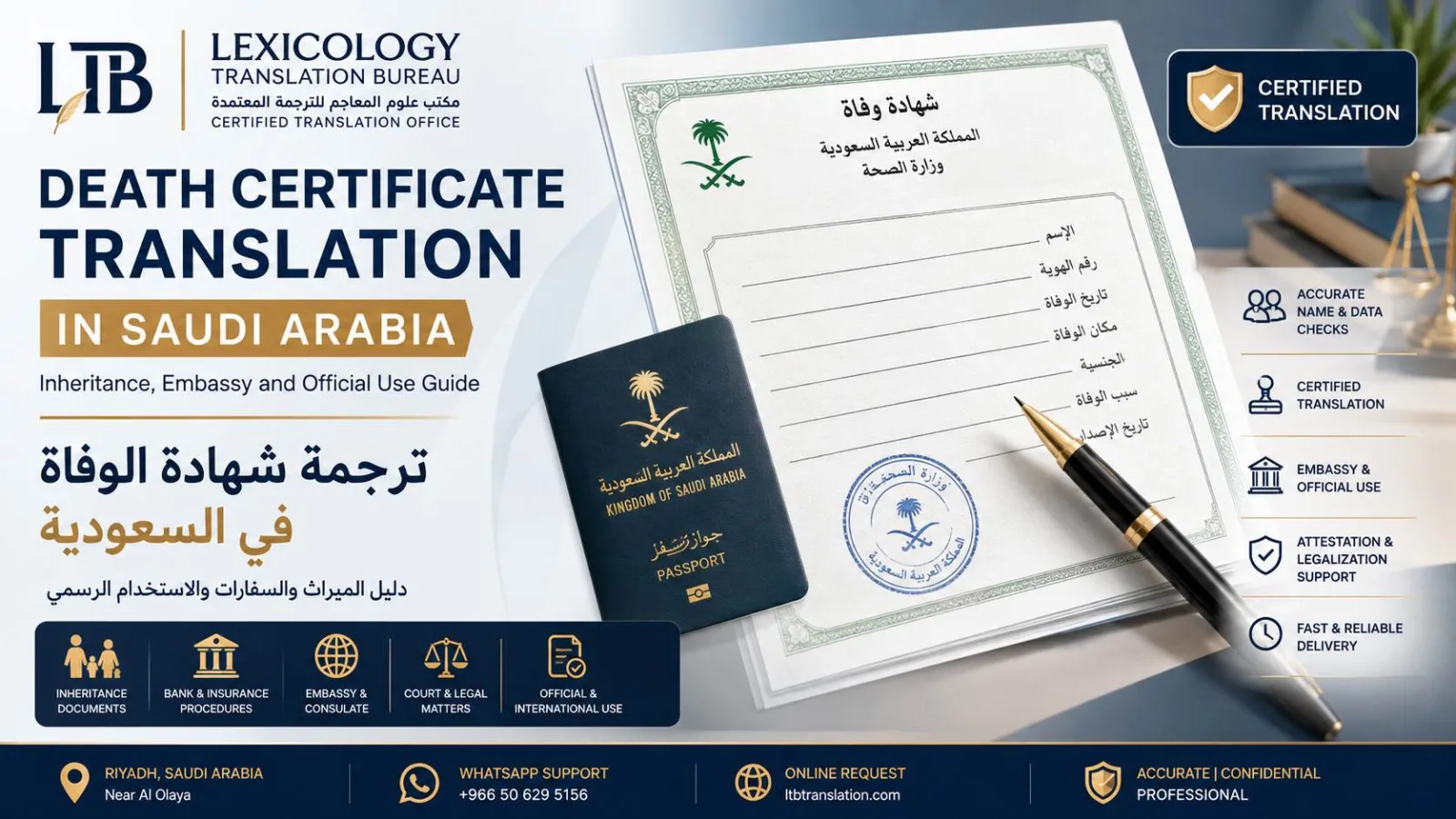
A practical guide to death certificate translation in Saudi Arabia, covering name and date checks, inheritance and banking files, embassy use, certified translation, attestation and document preparation.
Death Certificate Translation in Saudi Arabia: What This Guide Covers
A death certificate is an important civil-status document that records information about a deceased person and the officially registered death. Depending on where the document was issued and where it will be submitted, a certified translation may be requested for inheritance, banking, insurance, embassy, court, administrative or international procedures.
Death certificate translation in Saudi Arabia requires more than translating a few lines of text. The translator must carefully review names, identity numbers, dates, places, medical wording, registration details, stamps, signatures and handwritten annotations.
The receiving authority determines whether translation, attestation, legalization or additional supporting documents are required. Applicants should therefore confirm the current requirements directly with the relevant bank, embassy, court, insurance provider, government authority or other receiving organization.
Why a Death Certificate May Need Translation
A death certificate may require translation when the language of the original document is different from the language accepted by the receiving authority.
Common situations include:
• Using a foreign death certificate in Saudi Arabia.
• Using a Saudi death certificate in another country.
• Applying for an inheritance or legal heirship procedure.
• Contacting a bank about a deceased customer’s account.
• Submitting documents to an embassy or consulate.
• Processing an insurance or employment benefit claim.
• Updating family, immigration or civil-status records.
• Handling property, investment or estate-related matters.
• Preparing documents connected with burial or repatriation procedures.
Translation does not by itself prove that a document is authentic. It provides an accurate version of the document in the required language. The receiving authority may separately request verification, attestation, legalization or an official electronic certificate.
Which Death Certificate Should Be Translated?
The applicant should normally provide the complete certificate intended for submission. This may be a paper certificate, an officially downloaded digital certificate or another official civil-status record.
Before translation begins, check that the document shows:
• The full page without cropped edges.
• All printed information.
• Any second page or reverse side containing information.
• Official stamps, seals and signatures.
• QR codes or verification references.
• Handwritten notes and amendments.
• Authentication or attestation stamps.
• Attachments that form part of the certificate.
A screenshot that hides part of the document may not be sufficient. When an official digital certificate is available, it is generally better to provide the complete downloaded file rather than a compressed messaging-app image.
Information Checked in Death Certificate Translation
Personal Name and Identity Details
The deceased person’s name is one of the most important parts of the translation. Every name component should be compared with the source document and, when available, with a passport, national ID, Iqama or another official spelling reference.
The review may include:
• Full name of the deceased.
• Father’s and grandfather’s names.
• Family name or surname.
• Nationality.
• Gender.
• National ID, Iqama or passport number.
• Date and place of birth.
• Names of parents, spouse or informant when shown.
The translation office should not invent a spelling when the source is unclear. The client may be asked to provide a passport copy or another official record showing the preferred English or Arabic spelling.
Date, Time and Place of Death
The date and place of death must be transferred accurately. A certificate may show a Gregorian date, a Hijri date or both.
The translator should check:
• Date of death.
• Time of death when recorded.
• Place of death.
• Hospital, medical facility or city.
• Date of registration.
• Date of certificate issuance.
• Burial information when included.
Dates should not be silently converted or changed. When both Hijri and Gregorian dates appear, both should normally be reproduced as shown.
Cause-of-Death and Medical Wording
Some certificates include a cause of death, medical classification, hospital reference or physician information. Medical terminology must be translated carefully and without changing the level of certainty stated in the original.
The translator should not:
• Add a medical diagnosis that is not written in the certificate.
• Simplify a technical expression in a way that changes its meaning.
• omit qualifying words.
• Replace an unclear term with an assumption.
• Translate an abbreviation without checking its context.
When medical wording is unclear, a better-quality copy or supporting medical report may be requested.
Registration and Issuing-Authority Details
A death certificate may contain administrative information that is essential for verification.
This can include:
• Certificate number.
• Registration or record number.
• Civil registry details.
• Notification or report number.
• Issuing authority.
• Place of registration.
• Name or position of the authorized official.
• Issue date.
• Electronic verification information.
These details should be copied and translated accurately because a small number error may prevent the receiving authority from matching the translated certificate with the original record.
Stamps, Seals, Signatures and QR Codes
Visible stamps, seals and official annotations should not be ignored. They can identify the issuing body, authentication stage or authorized signatory.
A certified translation may describe a visible element using wording such as:
• Official seal.
• Signature.
• Illegible signature.
• Embossed stamp.
• Electronic verification code.
• QR code.
• Handwritten annotation.
A translator normally describes a QR code rather than reproducing its hidden digital content unless that information is visibly displayed or officially verified.
Name Matching with Passport and Other Documents
Differences in name spelling are common when names move between Arabic and Latin scripts. For example, one Arabic name may have several reasonable English spellings.
Problems can arise when the death certificate, passport, Iqama, marriage certificate, birth certificate and heirship documents use different spellings.
Before certification, applicants should compare:
• The order of name components.
• Spaces and hyphens.
• Given name and family name.
• Passport spelling.
• Identity numbers.
• Nationality.
• Date of birth.
• Names of related persons.
The translation should follow the source document while using an official identity document as a spelling reference when appropriate. It should not silently alter the original record.
Using a Foreign Death Certificate in Saudi Arabia
A death certificate issued outside Saudi Arabia may need Arabic translation when submitted to a Saudi authority, court, bank, insurance provider or other institution.
The file may involve:
• The original foreign death certificate.
• A certified Arabic translation.
• Passport or identity documents.
• Proof of relationship.
• A legal heirship certificate or equivalent document.
• Attestation or legalization records when requested.
• Additional documents required by the receiving authority.
Requirements differ according to the country of issue, document type and purpose of submission. Translation should be prepared only after confirming the intended use and receiving authority.
Using a Saudi Death Certificate Outside Saudi Arabia
A Saudi-issued death certificate may need translation into English or another language for use abroad.
Possible uses include:
• Embassy or consular procedures.
• Foreign inheritance matters.
• Closing accounts or services abroad.
• Insurance claims.
• Pension or employment benefits.
• Updating foreign civil-status records.
• Property or estate matters.
• Family immigration files.
The foreign authority may require a certified translation, document attestation, apostille or consular legalization. The applicant should verify the exact process with the authority in the destination country.
Certified Translation and Document Attestation Are Different
Certified translation and attestation serve different purposes.
A certified translation confirms the translation office’s responsibility for translating the visible content accurately and completely.
Document attestation or legalization concerns the authenticity or official status of the original document, signature, seal or certification chain.
A translated death certificate does not automatically become attested simply because it carries a translation-office stamp. Similarly, an attested original document is not automatically translated.
Depending on the case, the applicant may need:
• An original or officially issued death certificate.
• A certified translation.
• Attestation of the original document.
• Attestation connected with the certified translation.
• Embassy or consular legalization.
• Verification through an official digital service.
The required sequence should be confirmed before paying for multiple procedures.
Death Certificates in Inheritance and Banking Files
Death certificates are commonly connected with inheritance and estate procedures. However, a death certificate alone may not establish who the legal heirs are or authorize a person to manage the deceased’s assets.
A receiving body may also request:
• A legal heirship or determination-of-heirs document.
• IDs or passports of the heirs.
• Proof of relationship.
• A power of attorney.
• A court order or distribution decision.
• Bank-specific forms.
• Certified translations of foreign documents.
• Attestation when applicable.
The translation office translates the submitted records but does not determine legal heirs, calculate inheritance shares or replace legal advice.
Embassy, Insurance and Repatriation Files
Embassies, insurers, employers, airlines, hospitals and other organizations may request death-related documents for different purposes.
The required documents may vary according to:
• The deceased person’s nationality.
• Country of death.
• Destination country.
• Whether burial occurred locally or abroad.
• Insurance policy requirements.
• Employer benefit rules.
• Embassy or consulate procedures.
• Health and transport requirements.
The death certificate may be only one part of a larger file. Medical reports, passports, permits, letters or relationship documents may also require translation.
Applicants should obtain an official checklist from the responsible authority instead of relying only on a general online list.
How to Prepare a Death Certificate for Translation
Send a Clear and Complete Copy
The entire certificate should be readable. Avoid shadows, glare, folded sections, cropped edges and low-resolution screenshots.
Provide the Intended Language
Specify whether the translation is needed in Arabic, English or another language.
Explain the Intended Use
Tell the translation office whether the document will be used for a bank, court, embassy, insurance company, inheritance file or another purpose.
Provide an Official Name Reference
A passport, ID or Iqama copy can help maintain consistent spelling. Only relevant information should be shared.
Include Attestation Pages
If the certificate contains embassy, consular, apostille or ministry stamps, include every relevant page.
Confirm the Submission Format
Ask whether the receiving authority needs a printed original, digitally signed PDF, stamped copy or another format.
Review Process Before Delivery
A careful death certificate translation review normally includes several separate checks.
Document Completeness Check
The office confirms that the full source document, attachments and visible stamps have been received.
Identity Data Check
Names, dates of birth, nationalities and identity numbers are checked separately.
Death Record Check
The date, time, place and registered cause-of-death wording are compared line by line.
Administrative Data Check
Certificate numbers, registration details, issuing authority and issue dates are reviewed.
Terminology Check
Medical, legal and civil-status terminology is checked for consistency.
Formatting Check
The translated document is organized so that the relationship between the source fields and translated fields remains clear.
Final Certification Check
The translation is reviewed before the office applies its certification statement, stamp and authorized signature.
Common Mistakes to Avoid
• Sending an incomplete screenshot.
• Translating from a typed summary instead of the official certificate.
• Using a different name spelling from the passport without explanation.
• Omitting stamps or handwritten information.
• Confusing the date of death with the registration date.
• Changing Hijri dates into Gregorian dates without showing the source date.
• Assuming certified translation replaces attestation.
• Submitting a machine translation for official use.
• Translating only the front page when the reverse side contains information.
• Requesting translation before confirming the receiving authority’s language and format.
Frequently Asked Questions
When is death certificate translation needed in Saudi Arabia?
It may be needed when a foreign death certificate is submitted to a Saudi authority or when a Saudi death certificate is submitted to an overseas authority. It may also be requested for inheritance, banking, insurance, embassy or other official procedures.
What information is checked in a death certificate translation?
The review normally covers the deceased person’s name, identity number, nationality, dates, place of death, cause-of-death wording, registration number, issuing authority, stamps, signatures and official annotations.
Does certified translation replace attestation?
No. Certified translation and document attestation are separate procedures. The receiving authority determines whether translation, attestation, legalization or electronic verification is required.
Can a blurred or incomplete death certificate be translated?
A reliable certified translation should be prepared from a clear and complete source. When important information is blurred, cropped or missing, the client may be asked for a clearer copy or an official spelling reference.
Requesting Death Certificate Translation in Riyadh
Before requesting death certificate translation in Riyadh, send the complete document and state:
• The required language.
• The receiving authority.
• The country where it will be used.
• Whether stamps and attestations must be translated.
• The required delivery format.
• Any official reference for name spelling.
Lexicology Translation Bureau reviews the source document before confirming the scope, delivery format and quotation. Unclear information is not invented, and any important discrepancy should be resolved before certification.
Final Checklist
Before submitting the translated death certificate, confirm that:
• The full name matches the intended identity reference.
• All dates and numbers match the source.
• The issuing authority is correctly identified.
• Visible stamps and signatures are addressed.
• Every page has been translated when required.
• The translation is certified in the requested format.
• The receiving authority’s attestation requirements have been checked.
• Supporting inheritance, identity or relationship documents are ready when required.
A complete and carefully reviewed death certificate translation can reduce avoidable corrections and inconsistencies. However, final acceptance always remains subject to the rules of the receiving authority.
Official sources for current requirements
Receiving-organization requirements can change. Check the relevant official source before submitting a document.
Frequently Asked Questions
When is death certificate translation needed in Saudi Arabia?
It may be needed when a foreign death certificate is submitted to a Saudi authority or when a Saudi death certificate is submitted to an overseas authority. It may also be requested for inheritance, banking, insurance, embassy or other official procedures.
What information is checked in a death certificate translation?
The review normally covers the deceased person’s name, identity number, nationality, dates, place of death, cause-of-death wording, registration number, issuing authority, stamps, signatures and official annotations.
Does certified translation replace attestation?
No. Certified translation and document attestation are separate procedures. The receiving authority determines whether translation, attestation, legalization or electronic verification is required.
Can a blurred or incomplete death certificate be translated?
A reliable certified translation should be prepared from a clear and complete source. When important information is blurred, cropped or missing, the client may be asked for a clearer copy or an official spelling reference.
.webp)