Bill of Lading Translation in Riyadh: Sea Freight, Containers and Saudi Customs Guide
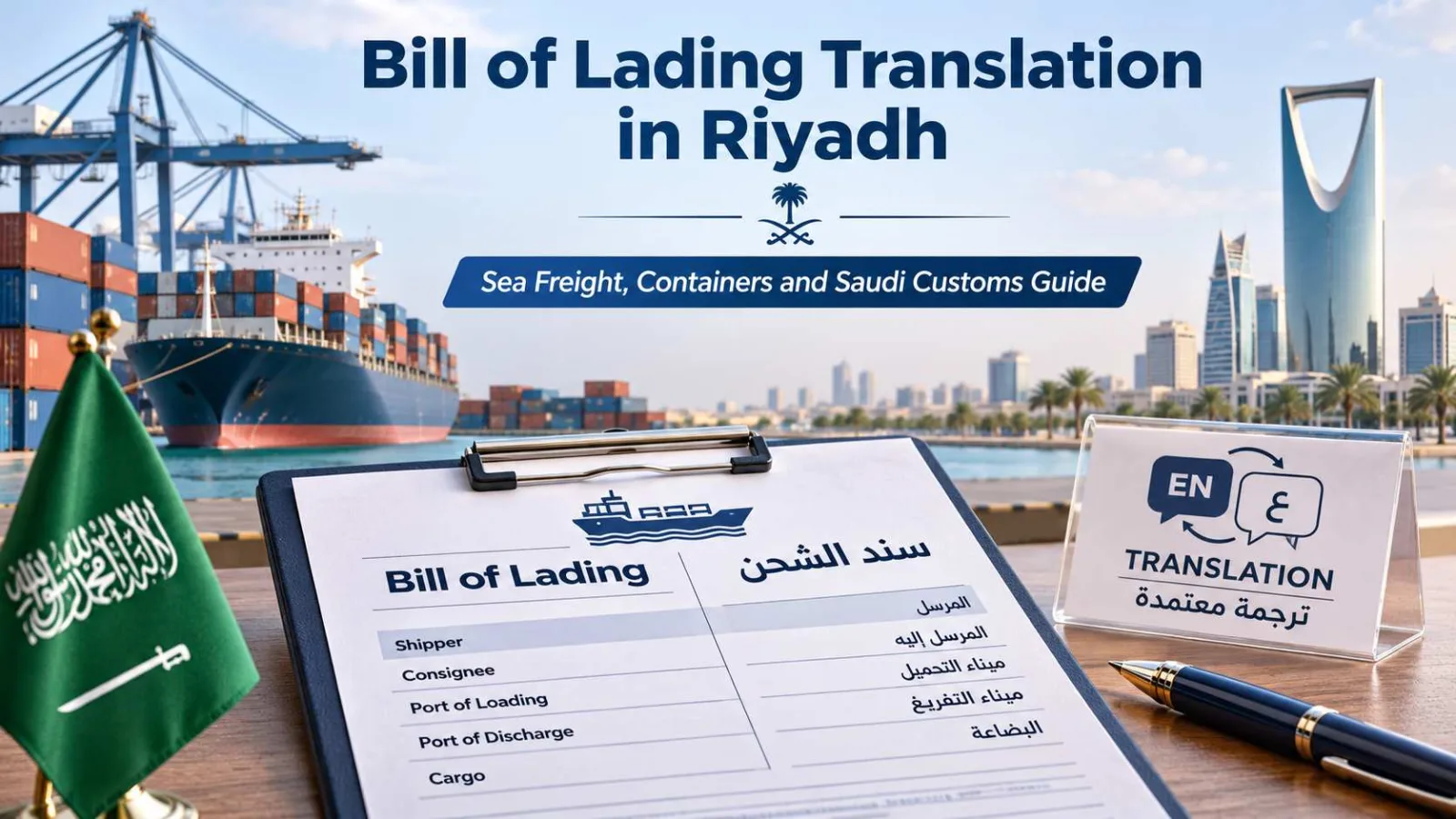
Need bill of lading translation in Riyadh? Learn how to review shipment references, shipper and consignee details, container numbers, ports, freight terms and Saudi customs documentation for accurate Arabic–English translation.
Bill of Lading Translation in Riyadh: Sea Freight, Containers and Saudi Customs Guide
International trade depends on accurate shipping documents. When goods move between countries, businesses may need to present shipping records to importers, freight forwarders, banks, insurers, customs brokers and other organizations. If those records are issued in a language the recipient cannot use, professional translation can support document review and communication.
Bill of lading translation in Riyadh is particularly useful for Saudi importers, exporters, logistics providers and companies dealing with overseas suppliers. A bill of lading can contain shipment details that must be reproduced precisely, including names, reference numbers, ports, container identifiers, cargo descriptions and freight conditions.
Lexicology Translation Bureau (LTB) provides Arabic–English business and commercial document translation services in Riyadh. This guide explains what a bill of lading contains, when translation may be required, how to prepare shipping documents and which details deserve special attention before delivery.
What Is a Bill of Lading?
A bill of lading, commonly abbreviated as B/L or BL, is a shipping document issued by a carrier or its authorized representative in connection with the carriage of goods.
Depending on its terms and type, it can perform several functions:
- Acknowledging receipt of goods for shipment.
- Recording the contract or evidence of the contract of carriage.
- Identifying parties involved in transportation.
- Recording the shipment route, goods and freight information.
- Acting as a document of title in certain circumstances.
Not every transport document has the same legal function. A translator must preserve the specific document title and clauses rather than treating all transport records as interchangeable.
Why Is Bill of Lading Translation Important in Saudi Arabia?
Businesses importing or exporting goods may receive documents in English, Arabic, Chinese, French or other languages. Translation helps the intended reader understand the recorded shipment information.
Common situations include:
- Import documentation review.
- Communication with Saudi customs brokers.
- International purchase and supply contracts.
- Shipping claims and commercial disputes.
- Banking and trade finance reviews.
- Marine cargo insurance documentation.
- Internal logistics and accounting records.
- Document submission to overseas customers or organizations.
Translation is not automatically mandatory for every shipment. The need for a translated or certified copy depends on the receiving organization, document language and applicable procedure.
Bill of Lading and Saudi Customs Requirements
Saudi Arabia's Zakat, Tax and Customs Authority (ZATCA) identifies the bill of lading among the principal documents used in import procedures.
Its published import instructions also refer to the commercial invoice, certificate of origin where applicable, and additional documents according to the nature of the imported goods.
For companies preparing customs files, the translated bill of lading should be checked against the original and related shipment documents.
Important references may include:
- Bill of lading number.
- Importer and consignee details.
- Carrier or shipping line.
- Shipment route and destination.
- Container and seal numbers.
- Cargo description and package count.
- Related invoice and shipping references.
Customs processing takes place through the relevant official channels, including the Fasah platform. Current declaration deadlines, permits and documentation requirements should always be confirmed with ZATCA and the authorized customs broker.
A translation does not replace an original shipping document, customs declaration, carrier authorization or required government approval.
Types of Shipping Documents and Their Translation
Original Bill of Lading
An original bill of lading may have specific legal and delivery implications depending on its terms. Words such as "Original," "Negotiable," "To Order" and endorsement-related instructions must be translated carefully.
The translation must not change the document's legal character or imply that a translated copy grants possession of cargo.
Sea Waybill
A sea waybill is commonly used to record sea carriage without functioning as a negotiable document of title.
It should be identified as a sea waybill, not automatically renamed as an original negotiable bill of lading.
House and Master Bills of Lading
Freight forwarding arrangements may involve a House Bill of Lading (HBL) and a Master Bill of Lading (MBL).
These documents can identify different issuing parties and contractual relationships. Their references and party details should remain distinct during translation.
Air Waybill
An air waybill (AWB) is associated with air transportation. It should not be confused with a sea bill of lading, even when some fields appear similar.
Critical Information to Check During Translation
Shipper, Consignee and Notify Party
A bill of lading may identify the shipper, consignee and notify party.
The translator should check:
- Full legal company names.
- Registered or stated addresses.
- Country and city names.
- Consignee designation.
- Notify-party contact details.
- Any company registration references shown.
Official Arabic and English company-name spellings should be followed when reliable references are available.
Bill of Lading and Booking Numbers
Bill of lading numbers, booking references and shipment codes should normally be reproduced exactly.
Letters, digits, hyphens and leading zeros must not be omitted or changed.
A small reference-number error may make it difficult for a reader to match the translation to the source shipment.
Vessel, Voyage and Ports
Sea freight records can identify the vessel name, voyage number, port of loading, port of discharge and place of delivery.
The port of loading is not necessarily the same as the country of origin. Likewise, the port of discharge may differ from the final destination.
These distinctions should be preserved in Arabic–English translation.
Container and Seal Numbers
Container numbers and seal numbers are important shipment identifiers.
A reviewer should compare every character with the source. Common visual confusion between letters and digits, such as O and 0 or I and 1, requires particular attention.
Do not guess characters that are unclear in a scanned document.
Goods Description, Quantity and Weight
A bill of lading may contain:
- Cargo or commodity description.
- Number and type of packages.
- Container quantity.
- Gross weight.
- Measurement or volume.
- Shipping marks and numbers.
- Dangerous-goods information, where shown.
Product descriptions should reflect the source. A translator should not independently change a commodity classification, cargo quantity, measurement or technical specification.
Freight and Release Instructions
Some documents include expressions such as "Freight Prepaid," "Freight Collect," "Shipped on Board," "Clean on Board" or references to surrender and release arrangements.
These terms have commercial or operational significance. Their meaning must be preserved according to the source and context.
Translation does not authorize the release of goods or change the carrier's instructions.
Bill of Lading vs Commercial Invoice vs Packing List
Three documents often appear together in international shipping, but they serve different purposes.
Bill of Lading: Records information about carriage, shipment parties, cargo and transport arrangements.
Commercial Invoice: Records commercial transaction information such as seller, buyer, goods, prices and currency.
Packing List: Describes how the goods are packed, including package quantities, weights, dimensions and item details.
When these documents are translated together, important shared references should be reviewed for consistency.
For further information, see:
- Commercial Invoice Translation in Saudi Arabia
- Packing List Translation in Riyadh
- Certificate of Origin Translation in Riyadh
A difference between original documents should be reported for clarification, not silently corrected in the translation.
Does a Bill of Lading Require Certified Translation?
Not every bill of lading requires certified translation.
An ordinary professional translation may be sufficient for internal communication or document understanding. A bank, court, government organization, insurer or overseas authority may request a certified translation or another specified format.
Before placing an order, confirm:
- Who will receive the translation?
- Which language is required?
- Is certified translation specifically requested?
- Must every page, stamp or attachment be translated?
- Is an electronic file acceptable, or is a printed copy needed?
- Are there any additional attestation requirements?
Certification, document authentication and customs clearance are separate processes. A translation certificate does not automatically establish the authenticity of the original shipment document or guarantee acceptance by a receiving authority.
Common Bill of Lading Translation Mistakes
Errors may occur when important shipping information is overlooked.
Examples include:
- Reversing the shipper and consignee.
- Confusing the consignee with the notify party.
- Changing a container number or seal reference.
- Mixing the port of loading with the port of discharge.
- Omitting freight terms or release instructions.
- Translating a sea waybill as a negotiable bill of lading.
- Misreading gross weight, package count or measurement units.
- Removing annotations, stamps or handwritten details.
- Using inconsistent company names across documents.
- Omitting a second page containing transport conditions.
A reliable translation review should focus on these operational details as well as grammar and terminology.
How to Prepare a Bill of Lading for Translation
For a smoother review process, prepare:
- A complete, readable PDF or high-quality scan.
- All pages and relevant attachments.
- The required source and target languages.
- The intended use and receiving organization.
- Any official company-name references.
- Related invoice or packing list, when consistency is important.
- The requested delivery format and deadline.
If the document is incomplete, blurred or inconsistent, clarification should be requested rather than inventing missing information.
Bill of Lading Translation Services in Riyadh
Lexicology Translation Bureau (LTB) assists businesses and individuals with Arabic–English commercial and shipping document translation in Riyadh.
Depending on the document and agreed scope, the review can cover shipper and consignee names, shipping references, vessel details, container numbers, freight terminology and consistency with other supplied commercial documents.
Our office is located in As Sulimaniyah, Riyadh, Saudi Arabia.
Request a translation quotation:
- Website: https://ltbtranslation.com
- Translation services: https://ltbtranslation.com/services
- Online quotation: https://ltbtranslation.com/quote
- Phone / WhatsApp: 0559548756
- Email: info@ltbtranslation.com
Send a readable copy of your bill of lading and specify the target language, intended use and required delivery date for a document review and quotation.
Final Checklist Before Submission
Before submitting a translated bill of lading, verify the shipper and consignee, document number, vessel and voyage, loading and discharge ports, container and seal references, cargo description, quantities, weights and freight instructions.
Accurate translation is most useful when it preserves the actual document without making unsupported corrections or promises about customs acceptance.
For professional bill of lading translation in Riyadh, contact Lexicology Translation Bureau and confirm the receiving organization's current requirements before submission.
Official sources for current requirements
Receiving-organization requirements can change. Check the relevant official source before submitting a document.
Frequently Asked Questions
Can a bill of lading be translated from English to Arabic in Riyadh?
Yes. English-to-Arabic and Arabic-to-English bill of lading translation can be requested from a professional commercial translation office in Riyadh. Provide the complete document and recipient requirements.
Is certified translation mandatory for Saudi customs?
Not every shipment automatically requires a certified translation of its bill of lading. Requirements depend on the applicable customs procedure and receiving party. Confirm the current rules with ZATCA and your customs broker.
Can container numbers and shipping references be translated?
Their labels may be translated, but container numbers, seal numbers and shipment references should normally be reproduced exactly as recorded in the source.
Does a translated bill of lading replace the original?
No. A translation communicates the source information in another language. It does not replace an original transport document, establish title to goods or authorize cargo release.