Arabic to English Translation Services in Riyadh: Complete Guide
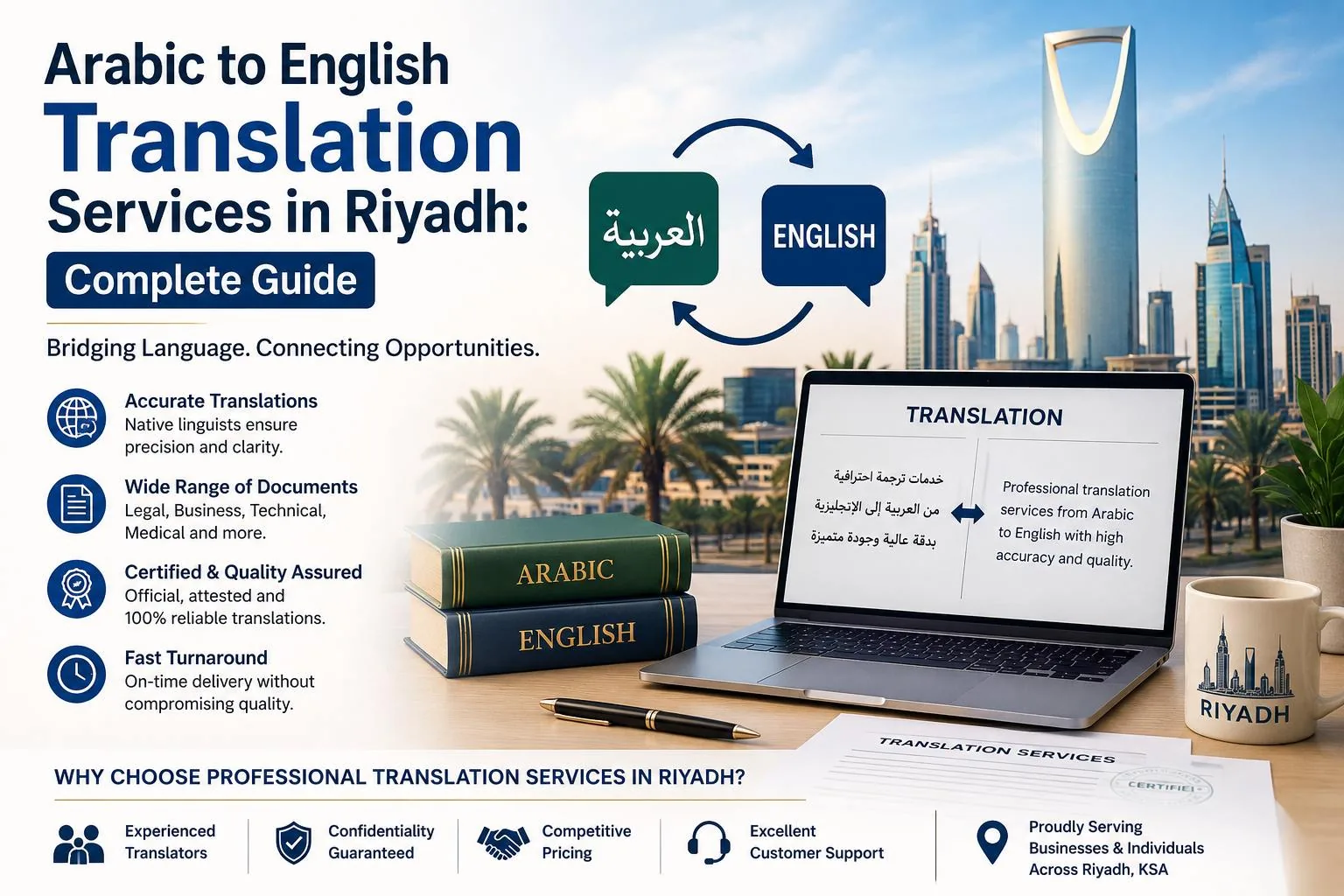
A practical guide to professional Arabic-to-English and English-to-Arabic translation services in Riyadh, covering certified, legal, commercial, medical, academic and personal documents.
Arabic and English are widely used across government, business, education, healthcare and international communication in Saudi Arabia. Individuals and companies frequently need documents translated between these two languages for official submissions, contracts, employment, visas, medical treatment, university admission and commercial transactions.
Professional translation involves more than replacing Arabic words with English words or English words with Arabic words. Names, dates, identification numbers, legal terminology, document structure, stamps and handwritten notes must be reviewed carefully.
Lexicology Translation Bureau (LTB) Office provides professional Arabic-to-English and English-to-Arabic translation services in Riyadh for individuals, companies and organizations. Each request is reviewed according to the document type, intended use, language pair and required delivery format.
Guide Contents
When Arabic–English Translation Is Required
Documents Translated Between Arabic and English
Certified and General Translation
Arabic-to-English Translation Challenges
English-to-Arabic Translation Challenges
Translation Services for Companies
Translation and Review Process
Information Required for a Quotation
How to Choose a Translation Office
Request Arabic–English Translation in Riyadh
When Arabic–English Translation Is Required
Arabic-to-English translation may be required whenever an Arabic document must be understood or submitted to an English-speaking organization. English-to-Arabic translation may be needed when an English document will be presented to a Saudi organization, company, court, hospital, university or another Arabic-speaking recipient.
Common purposes include:
• Embassy and visa applications
• International university admission
• Employment and professional licensing
• Overseas medical treatment
• Immigration and family applications
• International contracts and agreements
• Company registration and due diligence
• Banking and insurance procedures
• Export, shipping and commercial transactions
Before requesting translation, the client should identify the receiving organization and the intended use of the document. Requirements may differ according to the country, institution and procedure.
Documents Translated Between Arabic and English
Personal and Identity Documents
Personal documents contain important identity information that must remain consistent across the complete application.
These documents may include:
• Passports
• National identity cards
• Iqamas and residence permits
• Birth certificates
• Marriage certificates
• Divorce certificates
• Death certificates
• Family cards
• Police clearance certificates
• Driving licenses
For official documents, the English spelling of a person’s name should normally match the passport or another reliable identity document supplied by the client.
Legal Documents
Legal translation requires careful attention to the meaning, obligations, defined terms and relationships between the clauses of the original document.
Common legal documents include:
• Contracts and agreements
• Powers of attorney
• Court documents
• Legal notices
• Affidavits and declarations
• Settlement agreements
• Authorization letters
• Terms and conditions
• Memoranda of understanding
• Company resolutions
Legal terms should be translated according to their context. A word-for-word translation may be inaccurate when two legal systems use different concepts or terminology.
Commercial and Corporate Documents
Businesses operating in Saudi Arabia often require Arabic and English versions of corporate records and commercial communications.
Documents may include:
• Commercial registrations
• Articles of association
• Company profiles
• Business licenses
• Financial and audit reports
• Tenders and proposals
• Invoices and purchase orders
• Policies and procedures
• Employment contracts
• Human resources documents
• Marketing materials
• Website and application content
Companies can provide an approved terminology list so that their names, departments, products, job titles and technical terms remain consistent across different documents and projects.
Medical Documents
Medical translation requires accurate terminology and appropriate handling of private information.
Medical files may include:
• Medical reports
• Laboratory results
• Prescriptions
• Discharge summaries
• Radiology reports
• Insurance documents
• Patient records
• Medical certificates
• Treatment plans
Abbreviations, tables and handwritten notes must be interpreted in context. If any part of the source is unclear, the translation office should request a clearer copy instead of guessing.
Academic Documents
Students and professionals may need academic translation for admission, scholarships, employment, equivalency procedures or professional licensing.
Examples include:
• Graduation certificates
• Academic transcripts
• School certificates
• Training certificates
• Experience letters
• Recommendation letters
• Course descriptions
• Research summaries
• Professional licenses
Course names, grades, credit hours, dates and institutional details should be checked separately before delivery.
Certified Translation and General Translation
Not every translation has the same purpose. A general translation may be used for internal communication, research, understanding or business reference. A certified translation is normally prepared for an official or formal purpose and delivered using the translation office’s approved format.
Depending on the intended use, the receiving organization may also request:
• An original document
• A certified copy
• Notarization
• Chamber attestation
• Embassy legalization
• Ministry attestation
• A printed translation
• A specific electronic format
Translation certification does not automatically replace notarization, attestation or legalization. The client should confirm the current requirements directly with the receiving organization.
Arabic-to-English Translation Challenges
Personal Names
One Arabic name can have several acceptable English spellings. For official files, the translation should follow the spelling shown in the passport or another recognized identity document whenever possible.
Hijri and Gregorian Dates
A document may contain Hijri dates, Gregorian dates or both. The translator must identify the calendar correctly and should not change or convert a date without a clear instruction.
Official Titles and Authorities
Government entities, administrative terms and job titles may have recognized English equivalents. Official wording should be used when a reliable reference is available.
Stamps and Handwritten Notes
Visible stamps, seals, signatures and handwritten annotations may affect the meaning of a document. They should be identified or translated when appropriate. Unreadable information must not be invented.
Document Layout
Arabic is written from right to left, while English is written from left to right. Tables, fields, headings and numbered clauses may require careful reformatting to preserve the structure of the source document.
English-to-Arabic Translation Challenges
English-to-Arabic translation requires natural and grammatically correct Arabic rather than mechanical word-for-word substitution.
The translator must consider:
• Correct Arabic grammar
• Gender and number agreement
• Formal administrative wording
• Appropriate legal terminology
• Consistent company and product names
• Arabic punctuation and formatting
• Right-to-left document layout
• The intended Saudi or regional audience
Website and marketing content may require localization in addition to translation. The objective is to preserve the original message while making the Arabic content clear and natural for the intended audience.
Arabic and English Translation Services for Companies
Companies may require continuing translation services rather than the translation of a single document.
Corporate translation projects may include:
• Contracts and legal correspondence
• Human resources files
• Financial and administrative reports
• Tenders and project proposals
• Technical manuals
• Product catalogues
• Policies and procedures
• Website localization
• Application localization
• Marketing campaigns
• Internal communications
• Training materials
For recurring work, a company should establish an approved terminology list containing:
• The company’s official Arabic and English names
• Department names
• Product and service names
• Employee job titles
• Frequently used legal terms
• Technical abbreviations
• Preferred formatting rules
This approach improves consistency and reduces corrections across future projects.
Translation and Review Process
Send a Readable Source Document
Send a clear PDF, Word file or complete image of every required page. Avoid cropped edges, glare, shadows and heavily compressed screenshots.
Identify the Language Pair and Purpose
Confirm whether the document is being translated from Arabic to English or from English to Arabic. State where the translation will be submitted and how it will be used.
Confirm the Quotation
The quotation should clarify:
• Document or page count
• Source and target languages
• Intended use
• Required delivery format
• Price
• Expected completion time
• Any additional service requested
Translation and Formatting
The translator prepares the target text while preserving the meaning, hierarchy and relevant structure of the source document.
Data and Terminology Review
A separate review should check:
• Names
• Identification numbers
• Dates
• Financial figures
• Document references
• Legal clauses
• Technical terminology
• Missing or repeated text
Final Delivery
The completed translation is delivered in the agreed electronic or printed format. The client should review names and any supplied reference information before final submission.
Information Required for a Quotation
To receive an accurate quotation, provide:
• A clear copy of every required page
• The source language
• The target language
• The intended use
• The receiving organization, if known
• The required delivery date
• The preferred file format
• Passport spelling of relevant names
• Any approved terminology or previous translation
Sensitive documents should only be sent through the translation office’s published communication channels.
How to Choose a Translation Office in Riyadh
When comparing translation providers, consider more than price. Check whether the office:
• Provides verifiable contact and location information
• Reviews the complete document before quoting
• Handles the relevant document category
• Explains what the quotation includes
• Checks names, numbers and dates
• Protects confidential information
• Provides a clear delivery time
• Offers electronic or printed delivery
• Has a defined correction and review process
• Avoids guaranteeing acceptance by every authority
The nearest or cheapest translation office is not automatically the most suitable. Accuracy, confidentiality, document experience and a transparent scope of work are equally important.
Request Arabic–English Translation in Riyadh
Lexicology Translation Bureau (LTB) Office provides Arabic-to-English and English-to-Arabic translation services for personal, legal, medical, academic and commercial documents.
To request an accurate quotation:
1. Send a clear copy of the document.
2. State the required target language.
3. Explain where the translation will be used.
4. Confirm the required delivery date and format.
Review our translation services or send your document through the request-a-quotation page. You can also check the published contact page for the current office location and communication details.
Documents are reviewed before the price and delivery time are confirmed. Final acceptance, certification and attestation requirements remain subject to the rules of the receiving organization.
Frequently Asked Questions
Do you translate documents from Arabic to English and English to Arabic?
Yes. LTB provides translation in both directions for personal, legal, commercial, medical, academic and official documents.
Can I send my document online for translation?
Yes. You can send a clear PDF, Word file or complete image for review and quotation. Printed delivery can be arranged when required.
How long does Arabic-to-English translation take?
The completion time depends on the document type, number of pages, source quality, formatting and review requirements. The delivery time is confirmed after the complete file has been reviewed.
Does a certified translation guarantee acceptance by every authority?
No. The receiving organization determines its current certification, attestation and submission requirements. Clients should confirm those requirements before final submission.
.jpg.webp)