Professional Translation: Legal, Medical, Business and More
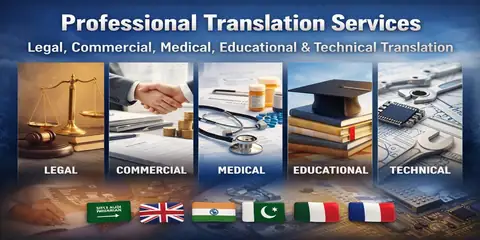
An overview of legal, commercial, medical, academic and technical translation, highlighting the specialist knowledge, terminology, review and formatting each field requires.
Each specialist field has its own terminology and document conventions. This article compares legal, medical, business, academic and technical translation controls.
The main avoidable risk in professional translation across legal, medical, commercial, academic and technical fields is assigning every document to the same general workflow without subject expertise or terminology control. A short intake check of the terminology, data fields, abbreviations, tables, references and formatting conventions specific to each subject prevents version confusion and reduces corrections after the translation has been formatted.
Different subject areas require different terminology and review controls. A legal contract, laboratory report, technical manual and academic record should not be handled as interchangeable text.
Clarify scope at the beginning
The comparison shows why legal, medical, business, academic and technical content cannot share one reviewer or one terminology list.
The intended use of professional translation across legal, medical, commercial, academic and technical fields should be recorded before work begins. A file prepared for contracts, healthcare, business, education, engineering and technical communication may require different pages, annotations, annexes or delivery arrangements, even when the source document is the same.
- legal and regulatory communication
- medical and pharmaceutical documentation
- commercial, financial and corporate material
- academic, educational and technical content
Send a final and readable file
For professional translation across legal, medical, commercial, academic and technical fields, scan quality must reveal the terminology, data fields, abbreviations, tables, references and formatting conventions specific to each subject. Glare, cropping or compression can hide a decisive detail, so the office should request a clearer source instead of inferring it.
- the complete source and editable files when available
- the target audience and intended use
- approved terminology or style references
- formatting and delivery requirements
Review points that protect accuracy
For professional translation across legal, medical, commercial, academic and technical fields, the practical focus is the terminology, data fields, abbreviations, tables, references and formatting conventions specific to each subject. This matters when the document is used for contracts, healthcare, business, education, engineering and technical communication, and it directly reduces the risk of assigning every document to the same general workflow without subject expertise or terminology control.
- subject expertise and terminology
- meaning, tone and audience suitability
- numbers, units and references
- tables, diagrams and formatting
- independent review appropriate to the field
From source inspection to final copy
- Receive the file through the official channel and log the request.
- Confirm the target language, purpose, price and schedule.
- Complete translation and formatting without altering source meaning.
- Check omissions, identifiers, dates, values and consistency.
- Send the final copy using the agreed secure method.
Avoidable mistakes in the source package
- assigning technical work as general translation
- ignoring client terminology
- removing uncertainty from medical or legal text
- delivering without format review
Schedule, price and separate formalities
Before approving professional translation across legal, medical, commercial, academic and technical fields, identify the receiving organisation and share its current instructions. This helps the office determine whether the complete source, intended audience, reference glossary and any required output format is complete and whether the file is intended for contracts, healthcare, business, education, engineering and technical communication.
Next step for this document
Official sources for current requirements
Receiving-organization requirements can change. Check the relevant official source before submitting a document.
Frequently Asked Questions
Why does subject specialization matter?
It reduces terminology errors and helps the text follow the conventions of its audience.
Can one translator handle every field?
Highly specialized material should be assigned according to proven subject competence.
What is the reviewer’s role?
The reviewer checks meaning, terminology, consistency, numbers and format independently.
How is a terminology list used?
Approved terms are recorded and applied consistently across related projects.