Purchase Order Translation in Riyadh: Supplier Details, Prices and Delivery Terms Guide
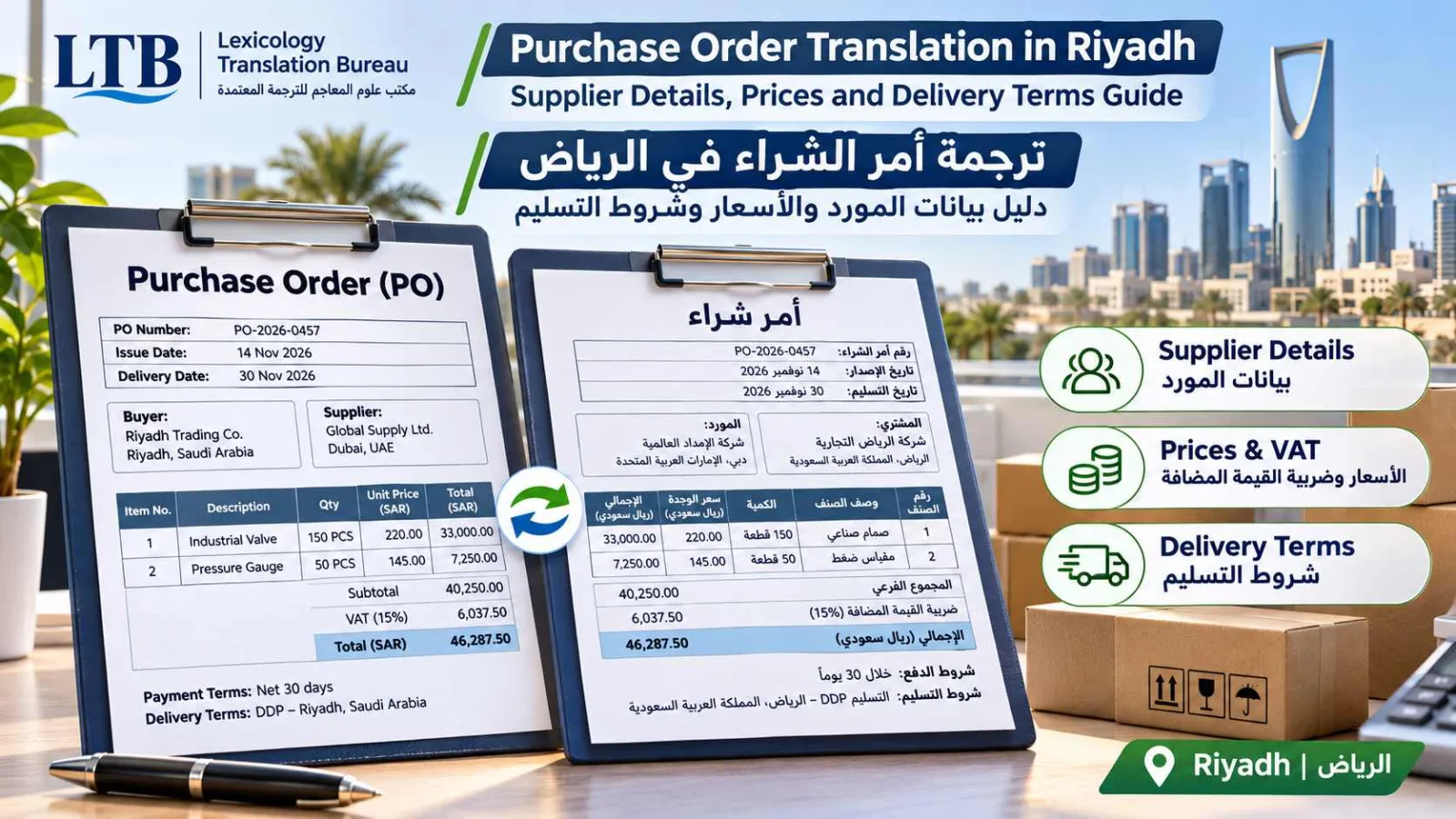
Need purchase order translation in Riyadh? Learn how supplier details, PO numbers, item codes, quantities, prices, VAT, payment terms and delivery conditions are accurately translated between Arabic and English for business and procurement use in Saudi Arabia.
Purchase Order Translation in Riyadh: A Complete Business Guide
Purchase order translation in Riyadh helps businesses, purchasing departments, suppliers and international trading partners understand purchasing instructions in Arabic and English.
A purchase order (PO) is an important commercial document that identifies the products or services requested by a buyer and records relevant transaction details.
For companies operating in Saudi Arabia, accurate translation is particularly important when procurement teams, overseas suppliers and project managers work in different languages.
An accurate translation must preserve the commercial meaning, quantities, unit prices, references and delivery conditions shown in the original purchase order.
1. What Is a Purchase Order?
A purchase order is a document issued by a buyer to request goods or services from a supplier.
Depending on the transaction, it may contain:
- Purchase order number
- Buyer and supplier details
- Issue and delivery dates
- Product or service descriptions
- Stock-keeping units (SKUs) and item codes
- Quantities and measurement units
- Unit prices and currency
- Discounts and tax information
- Total order value
- Payment and delivery conditions
- Shipping instructions
- Authorized signatures or approvals
- References to quotations, contracts or attachments
Not every purchase order includes all these fields. The translation should reflect the actual contents of the original document.
2. Why May Purchase Order Translation Be Needed in Saudi Arabia?
Purchase order translation may help companies when the buyer and supplier use different working languages or a receiving organization requests a particular language.
Common situations include:
- International purchasing and supplier communication
- Construction and engineering projects
- Retail and wholesale procurement
- Manufacturing and industrial purchasing
- Import and export coordination
- Internal company approval
- Contract and invoice reconciliation
- Warehouse and logistics coordination
- Government-related procurement documentation, where applicable
For example, a Saudi company may issue a purchase order in Arabic while its overseas supplier requires an English version to prepare the shipment.
The translation helps both parties review the same commercial information without changing the original purchase order.
3. Essential Information to Review Before Translation
Purchase Order Number and Dates
The PO number identifies the purchasing transaction and may be referenced on invoices, delivery notes and related correspondence.
Preserve the original purchase order number, version, revision code and issue date exactly as recorded.
Where Hijri or Gregorian dates appear, retain the original calendar information. Any requested date conversion should be separately verified.
Buyer and Supplier Details
Review the legal or trading names of both parties, their addresses, contact details and company registration information when provided.
An approved English or Arabic company name should be used consistently when reliable evidence is available.
Do not invent registration numbers, addresses or missing company information.
Product Descriptions and Item Codes
Purchase orders may contain technical product names, spare-part numbers, model numbers or detailed service descriptions.
A translator should distinguish between descriptions that require translation and identifying codes that must remain unchanged.
Part numbers, serial numbers, SKUs and manufacturer references should be reproduced accurately.
4. Quantities, Prices, Currencies and VAT
Financial accuracy is one of the most important aspects of purchase order translation.
Check the following against the source document:
- Ordered quantities
- Units such as PCS, KG, LTR or SET
- Unit prices
- Discount values and percentages
- Line-item totals
- Subtotal and overall total
- Currency symbols and codes
- VAT information, where displayed
- Freight or additional charges
For instance, a quantity of 150 pieces must not become 15 pieces in the translation.
Decimal separators and digit direction require particular care when translating between Arabic and English.
A translator should reproduce the source amounts rather than silently recalculate or correct them.
If the original appears inconsistent, the discrepancy should be referred to the client or document issuer.
Important: A purchase order is not automatically a tax invoice. Saudi electronic-invoicing requirements are a separate matter governed by the Zakat, Tax and Customs Authority (ZATCA). Translating a PO does not convert it into a compliant electronic tax invoice.
5. Translating Payment and Delivery Conditions
A purchase order may describe how payment will be made and when the supplier is expected to deliver.
Typical terminology includes:
- Advance payment
- Balance payment
- Payment upon delivery
- Net 30 days
- Partial delivery
- Delivery deadline
- Lead time
- Freight charges
- Warranty period
- Inspection and acceptance
- Delivery location
These terms must be translated according to their actual commercial meaning.
When an order refers to international delivery rules such as FOB, CIF or DDP, the relevant abbreviation should be preserved and any explanation carefully checked against the source context.
Translation must not introduce additional obligations, alter a deadline or change the agreed commercial conditions.
6. Checking Purchase Orders Against Related Documents
Purchase orders are often connected with other commercial and shipping documents.
The most relevant documents include:
Commercial Invoice
A commercial invoice records details of an actual sale or supply. Compare matching document references, item descriptions, quantities and amounts where appropriate.
Read our guide to Commercial Invoice Translation in Saudi Arabia.
Proforma Invoice
A proforma invoice may contain a proposed price, product description or other preliminary commercial information before a purchase order is issued.
Learn more about Proforma Invoice Translation.
Packing List
A packing list describes how goods are packed for shipment. Product references and quantities may need to be checked against the purchase order.
See our Packing List Translation Guide.
These comparisons help identify inconsistencies, but the translator should not modify the source documents without authorization.
7. Arabic-to-English and English-to-Arabic Purchase Order Translation
Arabic-to-English purchase order translation may be required when a Saudi buyer communicates purchasing instructions to an international supplier.
English-to-Arabic translation may be useful when an overseas supplier sends commercial documentation to a Saudi company.
In both directions, careful formatting helps keep the information understandable.
Special attention should be given to:
- Right-to-left and left-to-right text
- Number and currency placement
- Column headings and table alignment
- Mixed Arabic and English product names
- Long descriptions
- Attached purchasing terms
- Digital approval references
A well-prepared translation should preserve the relationship between each item description, quantity and price.
8. Is Certified Purchase Order Translation Required?
Not every purchase order requires certified translation.
The requirements depend on the receiving organization, intended use and applicable contractual or official procedures.
Some businesses may accept a professional translation for internal review. Others may request a signed, stamped or certified translation.
For government procurement, companies should check the applicable entity instructions and the relevant Etimad procedures.
Translation certification is separate from document authentication, procurement approval and legal validation.
9. Documents to Prepare Before Requesting Translation
To request purchase order translation in Riyadh, prepare:
- A complete, readable purchase order.
- All pages and relevant attachments.
- The required source and target languages.
- Any approved supplier or buyer name spellings.
- Relevant quotation or contract references, if necessary.
- The receiving organization's language and certification instructions.
- The preferred delivery format and deadline.
Editable files may help preserve complicated tables, although a clear PDF can also be submitted for review.
For confidential commercial information, use an appropriate document-sharing channel.
10. Purchase Order Translation Services at LTB Translation Riyadh
Lexicology Translation Bureau (LTB) provides professional translation services in Riyadh for commercial, legal, technical and other business documents.
Clients can submit purchase orders for a review of their language pair, terminology, document structure and formatting requirements.
The review may include:
- Buyer and supplier identification
- Purchase order references
- Item descriptions and part numbers
- Quantities and unit prices
- Currency and displayed tax information
- Payment and delivery terminology
- Tables and commercial conditions
The office can assess the translation scope and provide a quotation after reviewing the supplied document.
11. Final Purchase Order Translation Checklist
Before using the translated document, confirm that:
- The PO number matches the original.
- Buyer and supplier names are accurate.
- Dates and revision numbers are correct.
- All item codes and descriptions are included.
- Quantities and measurement units are unchanged.
- Prices, currency and totals are reproduced accurately.
- Payment and delivery terms reflect the source.
- No pages or attachments are missing.
- Required translation certification has been confirmed.
- The receiving organization accepts the proposed format.
Conclusion
Purchase order translation in Riyadh requires more than converting commercial words from one language to another.
Accurate translation should protect important purchasing information, including supplier identities, item codes, quantities, prices, payment terms and delivery obligations.
Businesses should provide complete source files and confirm the receiving organization's requirements before requesting certification or submission.
For professional Arabic–English purchase order translation in Saudi Arabia, contact Lexicology Translation Bureau (LTB) and request a quotation based on your document.
Website: https://ltbtranslation.com/
Official sources for current requirements
Receiving-organization requirements can change. Check the relevant official source before submitting a document.
Frequently Asked Questions
Can I get certified purchase order translation in Riyadh?
You can request professional Arabic–English purchase order translation in Riyadh. If certification is required, confirm the accepted format, stamp and other requirements with the receiving organization before proceeding.
Is a purchase order the same as a commercial invoice?
No. A purchase order is generally issued by a buyer to request goods or services, while a commercial invoice documents a sale or supply. Their purposes and information may differ, and translating a purchase order does not turn it into a tax invoice.
Can purchase order tables, item codes and prices be translated?
Yes. The translation can include product descriptions, table headings, supplier details, quantities, prices and payment terms. Item codes, reference numbers and financial figures must be reproduced accurately from the original document.
What happens if the purchase order contains incorrect quantities or totals?
The translator should not silently change the original figures. Any apparent discrepancy should be reported to the client or document issuer for clarification or correction through the appropriate process.