Medical Laboratory Report Translation in Riyadh: Test Results, Units and Reference Ranges Guide
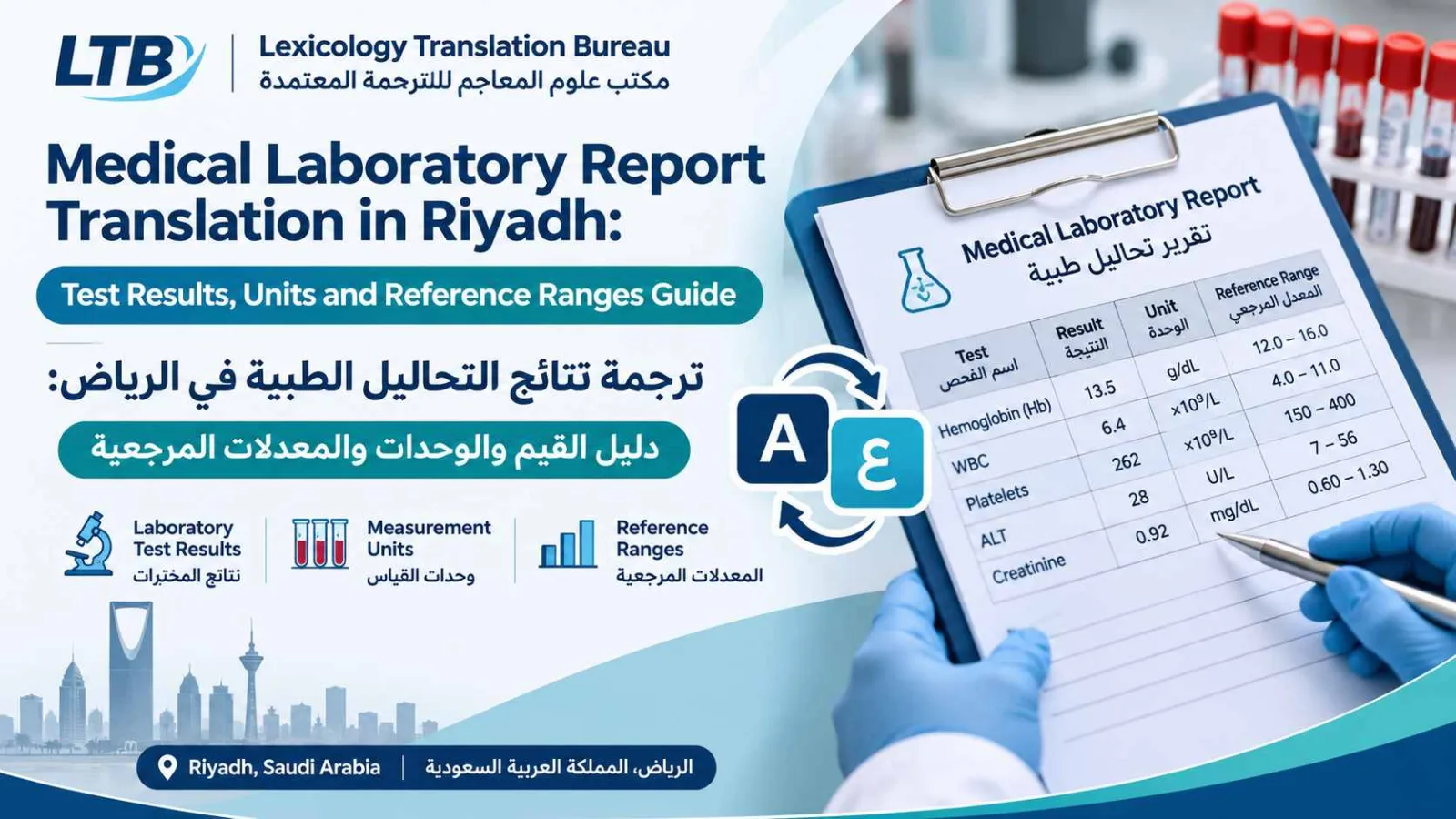
Need medical laboratory report translation in Riyadh? Learn how blood tests, urine tests, laboratory results, measurement units, reference ranges and patient information are carefully reviewed for certified Arabic–English translation in Saudi Arabia.
Medical Laboratory Report Translation in Riyadh: Test Results, Units and Reference Ranges Guide
Medical laboratory reports contain detailed information about a patient's health, including test names, numerical results, measurement units, reference ranges and laboratory observations. When these documents must be submitted to a hospital, insurance company, embassy or another organization that uses a different language, accurate medical laboratory report translation may be necessary.
In Riyadh, laboratory reports may be issued in Arabic, English or a combination of both languages. Translating these records requires attention to medical terminology and exact numerical information.
Lexicology Translation Bureau (LTB) provides Arabic–English medical document translation services in Riyadh, Saudi Arabia. This guide explains the important elements of laboratory report translation, how to prepare documents and what to review before official submission.
1. What Is Medical Laboratory Report Translation?
Medical laboratory report translation is the process of accurately transferring information from a laboratory test document into another language.
Unlike general correspondence, laboratory reports often contain technical terminology, numerical measurements, abbreviations and structured tables.
The translation should preserve the original meaning, results, units and document structure without changing the underlying medical information.
A translated laboratory report is not a new medical examination, diagnosis or independent verification of the laboratory's findings.
2. When Is Laboratory Report Translation Needed?
A laboratory report may require translation when it is intended for:
- Medical consultation or treatment abroad
- Transfer of patient records between hospitals
- International specialist referrals
- Health insurance documentation
- Embassy or immigration applications
- Employment-related medical document submissions
- University or institutional medical requirements
- Legal or administrative procedures involving medical evidence
- Personal medical records maintained in another language
The required translation language, certification format and supporting documents depend on the receiving organization.
Before ordering translation, confirm whether the recipient requires a certified translation, the original report or any additional authentication.
3. Types of Laboratory Test Reports That Can Be Translated
Medical laboratories issue many different kinds of test reports.
Complete Blood Count (CBC)
A CBC report may contain hemoglobin, white blood cell count, red blood cell count, platelet count and other measurements.
Each test name, result, unit and reference range should be reproduced accurately.
Blood Glucose and HbA1c Tests
These reports may include fasting blood glucose, random glucose or HbA1c results.
The translation must distinguish the different tests and preserve the measurement units and percentages shown in the original.
Liver and Kidney Function Tests
Reports may contain measurements such as ALT, AST, bilirubin, creatinine or urea.
Medical abbreviations should be handled consistently, without substituting one test for another.
Thyroid and Hormone Tests
These may include TSH, T3, T4 and other hormonal measurements.
The translation should preserve test identifiers, result values and laboratory-specific reference ranges.
Urine and Other Laboratory Tests
Urinalysis, microbiology reports, vitamin tests, lipid profiles and other diagnostic laboratory documents may also require translation.
The specific terminology and formatting depend on the test and the original laboratory report.
4. Important Information That Must Be Checked
Accurate medical laboratory report translation requires more than translating the names of tests.
Patient Identity Information
The patient's name, date of birth, medical record number and any relevant identity information must match the original document.
If the report will be submitted with a passport or Iqama, an official identity reference may help maintain consistent English name spelling.
Test Names and Medical Abbreviations
Laboratory terminology must be accurately represented.
Abbreviations such as CBC, HbA1c, TSH, ALT and AST should be preserved or explained only when their meaning is clear from the source and context.
An unfamiliar abbreviation must not be guessed.
Numerical Results and Decimal Points
Even a minor numerical error can change the meaning of a laboratory result.
The reviewer should carefully check:
- Every numerical test value
- Decimal points and separators
- Positive and negative signs
- Greater-than and less-than symbols
- Percentages
- Result indicators and laboratory flags
The translator must not independently correct or modify a result that appears unusual.
Measurement Units
Medical test results may use units such as mg/dL, mmol/L, g/L, IU/L or mIU/L.
These units are not automatically interchangeable. Results must remain consistent with the original report, and any requested conversion requires separate verification.
Reference Ranges
Reference ranges provide the comparison values printed by the issuing laboratory.
These ranges can differ depending on the laboratory method, patient population or other factors. The translation should reproduce the exact ranges provided in the original document.
A translator must not replace the original range with a general value found online.
Laboratory Flags and Comments
Reports may use indicators such as High (H), Low (L), Positive, Negative, Reactive or Non-reactive.
Such terms must be translated in their proper laboratory context without adding a diagnosis or changing the level of certainty.
5. Dates, Specimen Details and Laboratory Identification
A complete laboratory report may include the sample collection date, report issue date, specimen type, laboratory name, test reference number and professional authentication details.
These elements can help the receiving organization identify the report and understand its source.
Dates should be checked carefully, particularly when reports contain multiple collection, verification or printing times.
Any visible stamps, signatures, laboratory identifiers and relevant document notes should be handled according to the agreed translation scope.
6. Why Laboratory Tables and Formatting Matter
Laboratory reports are frequently arranged in several columns, such as test name, result, unit, reference range and status.
If these columns are rearranged incorrectly, a reader may associate a result with the wrong test.
A professional translation should therefore retain a clear relationship between each test and its corresponding value.
For scanned PDF reports, the translator may need to reconstruct tables carefully while preserving the original information.
7. Certified Laboratory Report Translation in Saudi Arabia
Some organizations require a certified translation for an official submission.
A certified translation office can prepare a translated version using the appropriate format and its certification procedure.
However, certified translation does not mean that the laboratory test itself has been medically validated or that every authority will automatically accept the translated document.
The receiving hospital, insurer, embassy or government-related organization determines its own submission and acceptance requirements.
8. Medical Translation Is Not Medical Interpretation
Translation and clinical interpretation are different professional activities.
A translator reproduces the medical information recorded in the source document. A qualified healthcare professional evaluates the results alongside the patient's clinical history, symptoms and other medical findings.
A high or low laboratory value should not be independently diagnosed by the translator.
Unclear results, unexpected values or potentially critical findings should be referred to the issuing laboratory or an appropriate healthcare professional.
Translation must never delay medical attention when a patient needs urgent care.
9. Confidentiality and Patient Data Protection
Laboratory reports can contain sensitive personal health information.
Documents should be transmitted through appropriate communication channels and accessed only by personnel involved in the authorized service.
In Saudi Arabia, health data is recognized as sensitive personal data under the Personal Data Protection Law.
Clients should avoid publicly sharing identifiable laboratory reports and should provide only the documents necessary for the translation request.
10. How to Prepare Your Laboratory Report for Translation
Before requesting medical laboratory report translation in Riyadh:
- Obtain the complete laboratory report, preferably as a clear PDF.
- Include every page containing relevant test results.
- Check that numerical values, decimal points and units are readable.
- Provide an official name-spelling reference when required.
- Confirm whether the translation must be Arabic or English.
- Identify the hospital, embassy, insurer or other receiving organization.
- Clarify whether certification or a printed copy is required.
- State the requested delivery date.
Avoid cropped images that remove laboratory headings, reference ranges, signatures or important notes.
11. Laboratory Report Translation Cost in Riyadh
The cost depends on several factors, including the language pair, number of pages, complexity of the medical terminology, quantity of laboratory tables and required delivery format.
LTB publishes starting prices for laboratory test results on its translation pricing page.
The displayed rates are starting prices and exclude VAT. A final quotation is provided after reviewing the actual document and confirming the requested service.
12. Request Medical Laboratory Report Translation from LTB
Lexicology Translation Bureau (LTB) is located in As Sulimaniyah, Riyadh, Saudi Arabia.
Our team reviews medical document terminology, patient information, numerical results, units, dates and formatting as part of the translation process.
For related guidance, read our Medical Report Translation in Saudi Arabia guide.
To request laboratory report translation:
- Website: https://ltbtranslation.com/
- Online quotation: https://ltbtranslation.com/quote
- WhatsApp: +966 55 954 8756
- Location: As Sulimaniyah, Riyadh, Saudi Arabia
Send a complete, readable laboratory report with the required language, intended recipient and requested deadline.
Conclusion
Medical laboratory report translation in Riyadh requires careful attention to medical terminology and numerical accuracy.
Test names, results, measurement units, laboratory reference ranges, patient details, dates and original formatting must be reviewed without altering their meaning.
A reliable translation helps the receiving organization understand the original laboratory record. Medical interpretation, laboratory validation and final document acceptance remain the responsibility of the appropriate professionals and authorities.
Official sources for current requirements
Receiving-organization requirements can change. Check the relevant official source before submitting a document.
Frequently Asked Questions
Can laboratory test reports be translated from Arabic to English in Riyadh?
Yes. Lexicology Translation Bureau (LTB) in Riyadh provides Arabic–English translation services for readable laboratory reports, including blood tests, urine tests and other medical laboratory documents. Numerical results, units and reference ranges require careful checking.
Are laboratory test values and reference ranges changed during translation?
No. The original numerical values, decimal points, measurement units and reference ranges should be preserved accurately. Any unclear information must be clarified rather than guessed. Clinical interpretation or recalculation is not part of ordinary document translation.
Do I need certified translation for a laboratory report in Saudi Arabia?
It depends on the receiving organization. A hospital, insurer, embassy or other authority may request certified translation, but requirements vary. Confirm the accepted language, certification format and any supporting documents before submission.
How much does laboratory report translation cost in Riyadh?
LTB publishes starting rates for laboratory test results on its pricing page. The final quotation depends on the language pair, number of pages, medical terminology, tables and required service. Send the complete report for an accurate quotation.