Driving License Translation in Saudi Arabia: Foreign License, Name and Category Review Guide
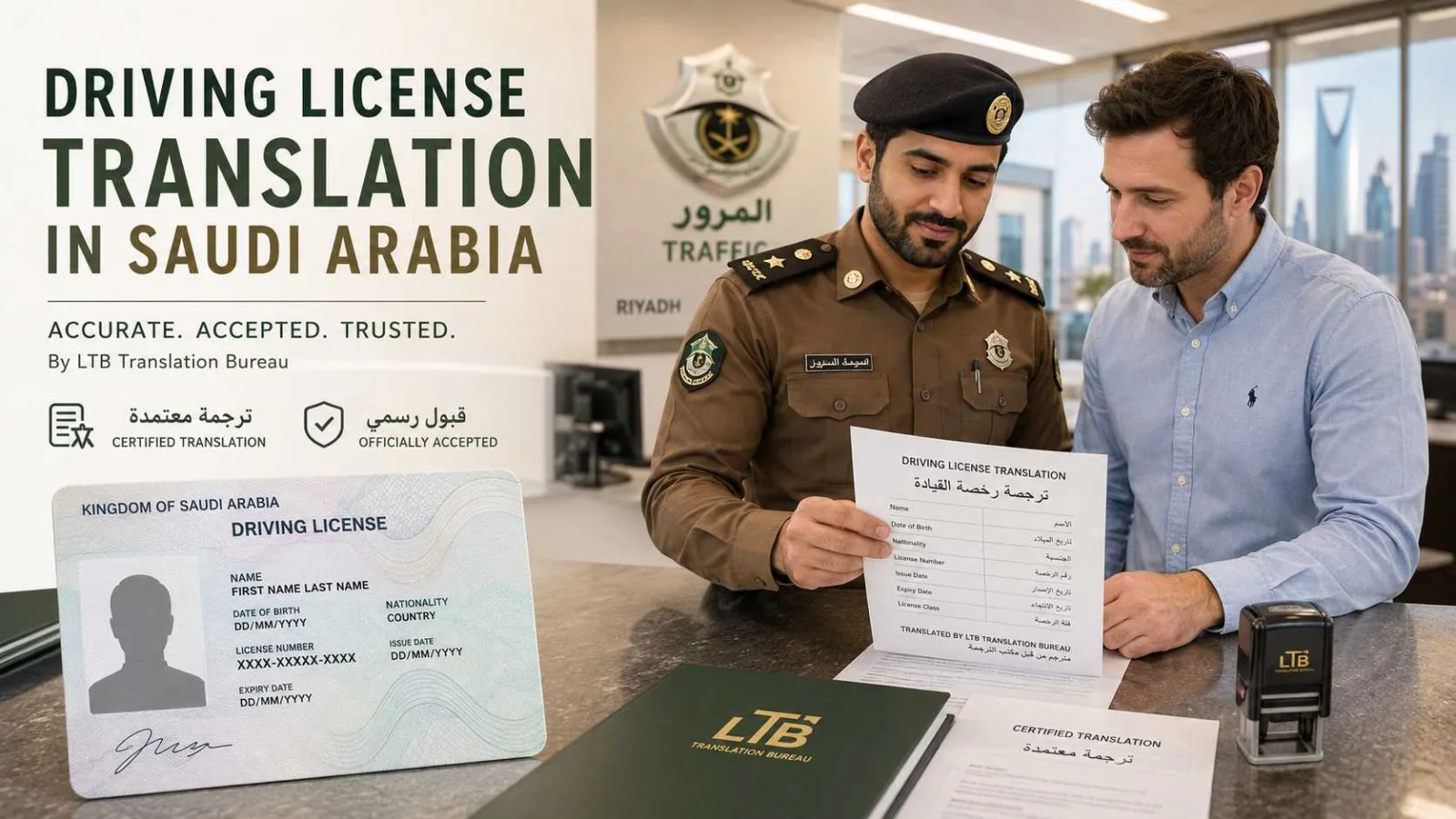
A practical guide to driving license translation in Saudi Arabia, covering foreign licenses, name matching, license numbers, dates, vehicle categories, restrictions, certified translation and official-use checks.
Driving License Translation in Saudi Arabia
A driving license may need to be translated when it is issued in a language that is not accepted by the organization reviewing it. The document may be required for a Saudi traffic procedure, an embassy application, employment, insurance, a legal case, vehicle-related administration or official use in another country.
Driving license translation is not limited to translating the holder’s name and license number. The translator must review every visible field, including the issuing country, identity details, dates, vehicle categories, restrictions, endorsements, official seals and verification information.
A translated driving license does not automatically make the original license valid in Saudi Arabia or another country. The relevant traffic authority, embassy, insurer, court, employer or receiving organization decides whether the original license, certified translation, International Driving Permit, verification, attestation or additional documents are required.
When May a Driving License Need Translation?
A certified driving license translation may be requested in situations such as:
• Presenting a foreign driving license to a Saudi authority
• Preparing documents for a driving license application or review
• Submitting a Saudi driving license to an authority outside Saudi Arabia
• Embassy, immigration or residency procedures
• Employment files where driving is part of the job
• Insurance claims or traffic-accident documentation
• Court cases or legal disputes involving a driver or vehicle
• Vehicle rental or registration procedures in another country
• Identity and address verification
• Translation of supporting traffic or vehicle documents
Requirements are not identical for every application. Before ordering the translation, the applicant should identify the receiving organization, destination country, target language and exact purpose of use.
Types of Driving Documents That May Require Translation
Foreign Driving Licenses
A foreign driving license may be issued as a plastic card, paper document, digital record or document containing information on both sides.
The client should provide a clear image of the front and back. A cropped image may omit categories, restrictions, dates, security features or issuing-authority information.
Saudi Driving Licenses
A Saudi driving license may need translation when it is submitted outside Saudi Arabia to an embassy, employer, insurer, vehicle authority, court or other organization.
The receiving authority determines whether it accepts a certified translation, requires verification of the licence information or requests an additional document from the Saudi traffic authority.
International Driving Permits
An International Driving Permit is not the same as a certified translation. It is a separate document issued according to the applicable process and does not replace the original driving license.
A translation office does not issue an International Driving Permit and cannot determine whether a driver is legally permitted to drive in a particular country.
Traffic and Vehicle Documents
Related documents may include:
• Driving record or licence-information report
• Traffic-violation record
• Vehicle registration
• Accident report
• Insurance document
• Driver authorization
• Medical fitness document
• Driving-school certificate
• Licence issuance or renewal notice
• Court or police document connected to a traffic matter
Each document should be reviewed separately because the terminology and official purpose may differ.
Information Checked During Driving License Translation
Holder’s Full Name
The name should be translated or transliterated consistently with the holder’s passport, Iqama, national identity card or previously accepted official document.
The translator should not create a new English spelling when an official spelling reference is available. Differences involving initials, middle names, family names or the order of names should be identified before delivery.
If the license contains an abbreviated name but the passport contains the full name, the translation should reproduce the information visible on the license. It should not silently add missing names from another document.
License Number and Identity Number
Driving license numbers, national identification numbers, residency numbers and other reference numbers must be copied carefully.
Digits should not be shortened, rearranged or converted unnecessarily. Spaces, hyphens and letters should be preserved when they form part of the official number.
Date of Birth
The date of birth should match the source document exactly. If another identity document shows a different date, the translator should not decide which date is correct.
The discrepancy should be reported to the client so that the receiving authority can determine whether correction or supporting evidence is required.
Issue and Expiry Dates
The issue date, expiry date and renewal date are important because they may affect how the receiving organization evaluates the document.
The translation should distinguish clearly between:
• Original issue date
• Current issue date
• Renewal date
• Expiry date
• Date of replacement
• Date of duplicate issuance
A translated expiry date does not independently confirm that the license remains valid. Official verification may still be required.
Hijri and Gregorian Dates
Some documents may contain Hijri dates, Gregorian dates or both. Dates should be transferred accurately and labelled clearly.
A translator should not perform an unofficial date conversion unless the client or receiving authority specifically requests it. When a conversion is provided, the original date should remain visible and the converted date should be identified appropriately.
Issuing Country and Authority
The translation should state the issuing country, ministry, traffic department, licensing authority, municipality or other organization exactly as shown.
Government names and official department titles should use an established translation where one is available. Logos should not be treated as proof that the document has been independently authenticated.
Vehicle Categories and Classes
Vehicle categories are one of the most sensitive parts of a driving license translation.
A license may contain categories for:
• Private vehicles
• Motorcycles
• Light vehicles
• Heavy vehicles
• Buses
• Commercial vehicles
• Trailers
• Special vehicles
• Agricultural or construction vehicles
Category letters and codes should be copied exactly. The translator should explain their visible description where appropriate but should not independently declare that one country’s category is legally equivalent to another country’s category.
The receiving traffic authority decides whether a foreign vehicle category is recognized.
Restrictions and Endorsements
A driving license may include restrictions or endorsements relating to:
• Corrective glasses or contact lenses
• Automatic-transmission vehicles
• Adapted vehicles
• Medical requirements
• Vehicle weight
• Passenger capacity
• Commercial driving
• Motorcycle engine class
• Geographic limitations
• Temporary validity
• Learner or provisional status
These restrictions must not be omitted because they may affect the legal scope of the license.
Address, Nationality and Personal Details
The license may display nationality, gender, blood group, residential address, place of birth or other personal information.
Only information visible in the supplied document should be translated. Unclear, damaged or hidden information must not be guessed.
Photograph, Signature and Physical Features
The translation may identify visible elements such as:
• Holder’s photograph
• Holder’s signature
• Official signature
• Official stamp
• Hologram
• Barcode
• QR code
• Machine-readable area
The translation should describe these elements when relevant. It should not claim that a signature, photograph, hologram or QR code is authentic unless an official verification has actually been completed.
Front and Back of the License
Both sides of the license should be submitted whenever information appears on the back.
The reverse side may contain:
• Vehicle category details
• Restrictions
• Issue information
• Security text
• Emergency information
• Authority name
• Terms of use
• Barcode or QR code
• Additional validity information
Translating only the front may produce an incomplete document.
Certified Translation and License Validity Are Different
Certified translation presents the visible content of the driving license accurately in another language.
It does not:
• Issue a new driving license
• Renew an expired license
• Convert a foreign license into a Saudi license
• Authorize the holder to drive
• Confirm that the license has not been suspended
• Confirm the holder’s driving record
• Replace an International Driving Permit
• Authenticate the issuing authority
• Guarantee acceptance by a traffic department
Licence validity and eligibility to drive must be confirmed through the appropriate official authority.
Using a Foreign Driving License in Saudi Arabia
Anyone intending to use or present a foreign driving license in Saudi Arabia should confirm the current requirements directly with the Saudi traffic authority, the relevant driving school or the organization receiving the document.
Depending on the applicant and procedure, the authority may request documents such as:
• Original foreign driving license
• Passport
• Iqama or identity document
• Certified Arabic translation
• Medical examination
• Photograph
• Driving-school or test requirements
• Appointment or electronic application
• Additional verification from the issuing country
A translation office can prepare the translation but cannot approve the application or confirm that a foreign licence will be accepted or converted.
Saudi official platforms provide services relating to driving license issuance and licence-information inquiries. Applicants should review the current service instructions because requirements and electronic procedures may change.
Using a Saudi Driving License Abroad
A Saudi driving license intended for use abroad may require translation into English or another language.
Before translation, ask the foreign authority:
• Is a certified translation required?
• Is an International Driving Permit required?
• Must the original Saudi license be presented?
• Does the translation need notarization or attestation?
• Is electronic verification required?
• Must a driving record accompany the license?
• Is the Saudi vehicle category accepted?
• How long may the foreign license be used?
A translated license does not override the traffic laws of the destination country.
Translation, Attestation and Verification
Translation
Translation transfers the visible information from the source language into the target language.
Certified Translation
Certified translation is prepared and certified by the translation service provider according to the requested document purpose.
Verification
Verification checks licence information through the issuing authority or an authorized official system where such a service is available.
Attestation
Attestation confirms a signature, seal or official origin according to the applicable government process. Attestation does not translate the document.
These procedures are separate. An applicant should not arrange attestation without first confirming that it is required for the intended use.
How to Prepare a Driving License for Translation
Before sending the document:
1. Photograph or scan the front clearly.
2. Photograph or scan the back clearly.
3. Make sure all four corners are visible.
4. Avoid glare, shadows and blurred text.
5. Do not cover the photograph, barcode or licence number.
6. Provide a passport or Iqama copy for name spelling.
7. State the source and target languages.
8. Identify the receiving authority.
9. State the destination country.
10. Confirm the required delivery date.
11. Include any attached driving record or traffic document.
12. Ask whether printed or electronic delivery is required.
Driving License Translation Process
Document Review
The translation team checks the language, document type, readability, front and back images, licence number, dates, categories and visible restrictions.
Name-Spelling Confirmation
The spelling of the holder’s name is compared with the passport, Iqama or another official identity reference.
Translation and Formatting
The visible fields are translated while preserving the document’s logical structure. Category codes, numbers and dates are reproduced carefully.
Quality Review
A second review checks names, numbers, dates, vehicle categories, restrictions, issuing-authority details and completeness.
Certification and Delivery
The completed translation is prepared in the agreed format and delivered electronically or in print according to the confirmed service.
Common Driving License Translation Mistakes
Common problems include:
• Translating only the front of the license
• Using a name spelling that differs from the passport
• Confusing issue and expiry dates
• Omitting vehicle categories
• Changing category letters or codes
• Ignoring medical or vehicle restrictions
• Claiming that translation confirms legal validity
• Treating an International Driving Permit as a translation
• Guessing unclear numbers or text
• Removing stamps, signatures or QR-code references
• Assuming the same requirements apply in every country
• Submitting a screenshot with cropped edges
These issues can cause questions, delays or a request for a corrected translation.
Professional Driving License Translation in Riyadh
Lexicology Translation Bureau (LTB) Office provides driving license translation in Riyadh for foreign and Saudi licences, driving records, vehicle registrations, accident reports, insurance documents and related official records.
The review process focuses on the holder’s name, license number, identity details, issue and expiry dates, issuing authority, vehicle categories, restrictions and visible verification elements.
Clients should send a clear copy of both sides of the license, an official name-spelling reference, the required language, the receiving organization and the intended country of use.
Final acceptance, licence conversion and permission to drive remain subject to the relevant traffic or government authority.
Official sources for current requirements
Receiving-organization requirements can change. Check the relevant official source before submitting a document.
Frequently Asked Questions
Is a translated foreign driving license automatically valid in Saudi Arabia?
No. Translation only presents the information shown on the license in another language. The Saudi traffic authority determines whether the foreign license is accepted, whether additional documents or tests are required and whether the holder is permitted to drive.
Do I need to send both sides of the driving license?
Yes, when information appears on both sides. The back may contain vehicle categories, restrictions, authority details, security text, barcodes or additional validity information that must be reviewed.
Is a certified translation the same as an International Driving Permit?
No. A certified translation reproduces the visible content of the license in another language. An International Driving Permit is a separate document and normally must be used together with the original license according to the destination country’s rules.
What documents should I send for driving license translation?
Send clear images of the front and back of the license, a passport or Iqama copy for the official spelling of the name, the required language, the destination country, the receiving authority and the required delivery date.

.png.webp)