Degree Certificate Equivalency in Saudi Arabia: Translation and Document Checklist
A practical guide to preparing foreign degree certificates, academic transcripts, identity documents and certified translations before applying for degree equivalency in Saudi Arabia.
Degree Certificate Equivalency in Saudi Arabia: Translation and Document Checklist
A university qualification obtained outside Saudi Arabia may need to be officially evaluated before it can be used for certain employment, academic or administrative purposes in the Kingdom. This process is commonly known as degree certificate equivalency.
The Saudi Ministry of Education provides an electronic service for evaluating academic qualifications issued outside the Kingdom. Preparing complete documents, readable scans and accurate translations before submitting an application can help reduce avoidable correction requests and delays.
This guide explains what degree equivalency means, which documents may be requested, when certified translation may be needed and what information applicants should check before submission.
What Is Degree Certificate Equivalency?
Degree certificate equivalency is an official academic evaluation of a university qualification obtained outside Saudi Arabia. The responsible authority reviews the qualification and determines how it corresponds to an academic level in the Saudi education system.
A translation office does not issue an equivalency decision. The final evaluation and decision remain with the Saudi Ministry of Education or the authority responsible for the particular procedure.
Certified translation helps the receiving authority understand documents issued in another language. However, translation alone does not guarantee equivalency. The authority may also review the university, academic programme, degree level, method of study, study duration, previous qualifications and supporting evidence.
Who May Need Degree Equivalency?
The requirement depends on the purpose for which the qualification will be used. Degree equivalency may be relevant for:
• Applicants seeking employment in positions that require verified academic qualifications
• Graduates applying for further education
• Holders of degrees issued by universities outside Saudi Arabia
• Applicants completing professional registration procedures
• Individuals asked by an employer or government authority to submit an equivalency decision
• Graduates who need to verify or correct qualification information
Before paying for translation or attestation, contact the receiving authority and ask exactly what it requires.
The authority may request:
• A copy of the original degree certificate
• A certified translation of the degree certificate
• An academic transcript
• A certified translation of the transcript
• Attestation of the original academic documents
• Verification directly from the awarding university
• An official degree equivalency decision
• Additional documents for a regulated profession
Translation, attestation, verification and equivalency are separate procedures.
Documents Commonly Prepared for an Equivalency Application
The exact document list may vary depending on the qualification level, country of study and applicant’s circumstances. Applicants should follow the list displayed in the official application system at the time of submission.
Documents commonly prepared may include:
• National identity document or residence identification
• Passport identification page
• Final degree certificate
• Complete academic transcript
• Previous academic qualifications
• Transfer-credit records, when applicable
• Preparatory-year transcript, when applicable
• Internship or practical-training evidence, when applicable
• Name-change evidence, when applicable
• Other supporting documents requested for the case
Do not assume that one document is enough for every application. A degree certificate may confirm that the qualification was awarded, while the academic transcript provides detailed information about courses, grades, credits and study duration.
Reviewing the Degree Certificate
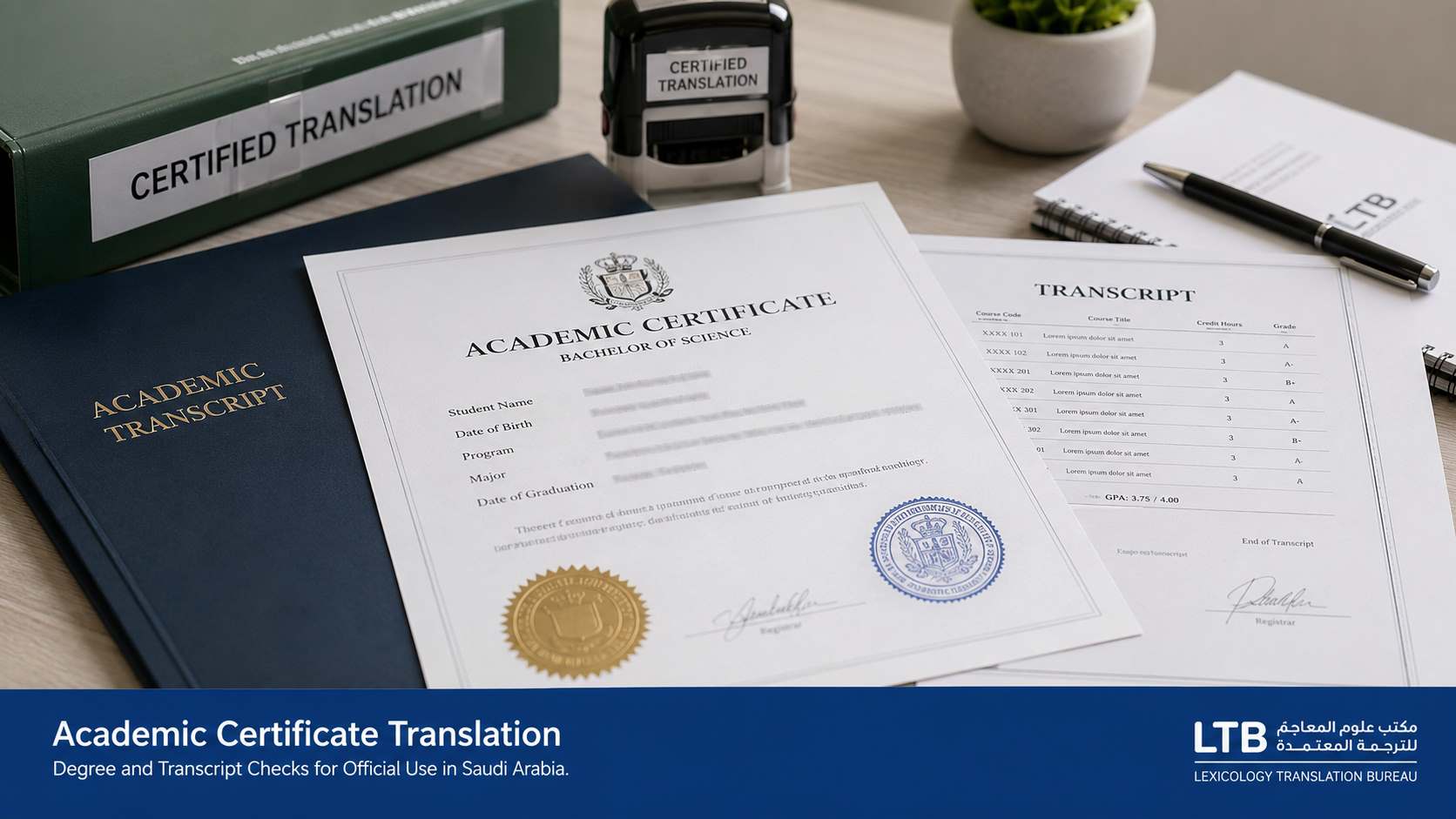
A degree certificate may contain:
• Graduate’s full name
• Name of the university or awarding institution
• Degree title
• Field of study or academic major
• Graduation or award date
• Grade, classification or honours
• Certificate or registration number
• Signatures, seals and verification information
Every visible part of the certificate should be reviewed before translation.
An embossed seal, handwritten note, electronic verification statement or stamp should not be ignored merely because it appears outside the main text.
Reviewing the Academic Transcript
The academic transcript may contain information that is not shown on the final certificate, including:
• Course titles
• Credit hours
• Individual grades
• Grade-point average
• Academic semesters or years
• Transfer credits
• Internship or practical-training details
• Thesis or research information
• Language of instruction
• Date of completing academic requirements
Course titles should be translated consistently. A technical, legal, medical or scientific course name should not be simplified in a way that changes the subject studied.
Numbers, percentages, decimal points and grading symbols must be copied carefully. The translator should not independently convert a foreign GPA into a Saudi GPA unless an approved conversion is provided by the responsible authority.
For more information, read the related guide: Academic Certificate Translation: Degree and Transcript Checks.
Previous Academic Qualifications
An applicant may be required to provide qualifications completed before the degree being evaluated.
For example:
• A master’s degree application may require the bachelor’s degree and transcript
• A doctoral degree application may require the bachelor’s and master’s qualifications
• A transferred student may need records from more than one institution
• A qualification involving a preparatory year may require the preparatory-year transcript
Names, dates, academic levels and institution names should remain consistent across all submitted documents.
When Is Certified Translation Needed?
Certified translation may be requested when an academic document is issued in a language that the receiving authority does not accept for direct review.
Applicants should confirm:
• Which documents need translation
• Whether Arabic, English or both languages are required
• Whether the original document must be attested first
• Whether the translation must be attached to the original
• Whether the receiving authority requires a particular submission format
A translation should reproduce the source document accurately. It should not add an academic conclusion that is not written in the original.
A translator should not independently:
• Convert a diploma into a bachelor’s degree
• Change the stated degree level
• Convert grades into another grading system
• Change the official field of study
• Add an academic specialisation that is not stated
• Remove a failed course from a transcript
• Change the study method or attendance status
• Alter the date of graduation
Academic evaluation belongs to the responsible authority.
Information That Must Match Across the File
Applicant’s Name
The name on the degree certificate and transcript should be compared with the applicant’s passport or official identification.
Differences may include:
• Different English spellings
• Missing middle names
• Initials instead of full names
• Previous family names
• Reversed name order
• Transliteration differences
The translation should not silently replace the name written in the original document. A genuine difference should be identified, and the applicant may need to provide an official spelling reference or supporting evidence.
University Name
Use the university’s official English or Arabic name when a reliable official version is available.
Avoid creating an unofficial translation based only on the literal meaning of the institution’s name. The institution name should also remain consistent across the degree certificate, transcript and supporting records.
Degree and Academic Major
The degree title and academic major are different pieces of information.
For example:
• Bachelor of Science is the degree
• Computer Science is the major
Similarly:
• Master of Business Administration is the degree
• Finance may be the concentration
Combining, shortening or changing these details may create confusion during academic evaluation.
Dates
Review all relevant dates, including:
• Date of admission
• Start of study
• Graduation date
• Date of completing requirements
• Certificate issue date
• Transcript issue date
• Internship period
• Transfer dates
A date should not be changed merely to make it appear consistent with another document. A real discrepancy should remain visible and may require clarification from the awarding institution.
Grades, Credits and Academic Symbols
Academic documents may use:
• Letter grades
• Percentages
• Grade points
• Credit hours
• Units
• Pass or fail symbols
• Transfer-credit symbols
• Repeated-course indicators
Every number and symbol should be checked carefully. The translation should explain an abbreviation when appropriate but should not change its academic meaning.
Stamps, Signatures and Verification Details
Academic documents may contain:
• University stamps
• Registrar signatures
• Ministry or embassy attestations
• QR codes
• Online verification links
• Document reference numbers
• Security marks
• Embossed seals
The translation may describe a visible stamp or signature. It should not reproduce a new government seal or suggest that the translation office issued the original certificate.
Translation, Attestation, Verification and Equivalency
These procedures have different functions.
Translation
Translation communicates the content of the document in another language.
Attestation
Attestation confirms a signature, seal or document through the relevant official authorities.
Verification
Verification confirms that the qualification or document was genuinely issued by the educational institution.
Equivalency
Equivalency evaluates the academic level and status of the foreign qualification.
An applicant may need more than one of these procedures. Completing a translation does not automatically complete attestation, verification or equivalency.
The Ministry of Education’s published requirements state that academic documents used for equivalency may need certification through the relevant Saudi cultural mission, Saudi embassy or other applicable official channel. Applicants should check the latest requirements for the country where the qualification was issued.
Checking Whether a University Is Recommended
The Saudi Ministry of Education provides an official service for checking recommended universities.
The service may allow users to search according to:
• Country
• University
• Academic specialization
• Degree level
A university appearing in a recommendation search should not be treated as an automatic guarantee that every programme, study method or qualification will receive equivalency.
Applicants should check the exact university, campus, degree, specialisation and study arrangement relevant to their case.
Preparing Clear Digital Copies
Unreadable files can make correct translation and official review difficult.
Before sending or uploading a document:
• Scan the complete page
• Include all corners and borders
• Use a clear colour scan when stamps or security marks are coloured
• Avoid shadows and light reflections
• Do not cover information with fingers
• Do not crop signatures or seals
• Keep table columns readable
• Include the back of the document when it contains information
• Keep pages in the correct order
• Use the file type and size accepted by the official portal
A photograph taken at an angle may distort names, numbers and transcript tables. A flat, high-resolution scan is preferable whenever possible.
Recommended Preparation Steps
Step 1: Confirm the Receiving Authority’s Requirement
Ask whether it needs translation, attestation, verification, equivalency or a combination of these services.
Step 2: Review the Official Equivalency Service
Check the current Ministry of Education service page and official application portal.
Step 3: Collect the Complete Academic File
Prepare the degree certificate, transcript, previous qualifications and applicable supporting documents.
Step 4: Compare Identity Information
Check the applicant’s name, nationality, passport details and date of birth across the file.
Step 5: Confirm Translation Requirements
Identify which documents need translation and which language is required.
Step 6: Confirm Attestation Requirements
Check whether the original academic documents need authentication before submission.
Step 7: Review Every Page
Check names, dates, degree titles, majors, grades, credits, stamps and document numbers.
Step 8: Upload Clear Files
Upload complete, readable documents in the requested format.
Step 9: Save the Application Reference
Keep the application or reference number and copies of everything submitted.
Common Problems That Can Delay an Application
Incomplete Academic Transcript
A degree certificate may not provide enough information when the authority requires course and credit details.
Different Name Spellings
Unexplained differences between the passport, certificate and transcript may require additional evidence.
Missing Previous Qualifications
A postgraduate qualification may need to be supported by earlier degrees and transcripts.
Unreadable Scans
Blurred text, cropped seals or missing pages can prevent accurate review.
Incorrect Translation of the Degree
Diploma, higher diploma, bachelor’s degree, postgraduate diploma, master’s degree and doctorate are not interchangeable terms.
Unofficial Document Editing
Changing names, dates, grades or university details inside a scanned document may damage the credibility of the entire application.
Assuming Translation Guarantees Approval
Certified translation helps the authority understand the document. It does not guarantee an equivalency decision or replace the Ministry’s academic evaluation.
How LTB Reviews Academic Document Translations
When Lexicology Translation Bureau receives an academic document translation request, the review may include:
• Comparing the applicant’s name with the passport copy provided
• Checking the university’s official name
• Separating the degree title from the academic major
• Reviewing dates, grades and credit hours
• Preserving tables and document structure where practical
• Representing visible stamps and signatures
• Checking consistency between the certificate and transcript
• Flagging unclear information instead of inventing it
• Reviewing numbers and academic terminology
• Performing a final language and data check before delivery
The applicant should still confirm the latest equivalency, attestation and submission requirements directly with the responsible authority.
Final Document Checklist
Before submitting an equivalency application, confirm that:
• The current official requirements have been checked
• The degree certificate is complete
• The full academic transcript is available
• Previous qualifications are included when required
• Passport and identification copies are clear
• Name spellings have been compared
• The university name is consistent
• The degree and major are translated accurately
• Grades and credit hours have not been altered
• All pages, stamps and signatures are visible
• Translation requirements have been confirmed
• Attestation requirements have been confirmed
• Uploaded files are clear and correctly ordered
• Copies of the submitted documents have been saved
• The application reference number has been recorded
Careful preparation cannot determine the authority’s final decision. However, it can make the application clearer, more complete and easier to review.
Official sources for current requirements
Receiving-organization requirements can change. Check the relevant official source before submitting a document.
Frequently Asked Questions
Does every foreign university degree require equivalency in Saudi Arabia?
Not necessarily. The requirement depends on the purpose of submission and the instructions of the employer, university, professional body or government authority. Applicants should confirm the requirement directly with the receiving entity.
Is certified translation alone enough for degree equivalency?
No. Translation communicates the document’s content in another language, but the applicant may also need original academic records, attestation, university verification, previous qualifications and an official equivalency application.
Which academic documents may need certified translation?
Depending on the receiving authority’s instructions, the degree certificate, academic transcript, previous qualifications, internship evidence or other supporting academic records may need certified translation.
Can a translator correct a different name written on a degree certificate?
A translator should not silently change information written in the original document. The name difference should be translated accurately and identified. The applicant may need to provide a passport, name-change document or clarification from the issuing university.